Key Takeaways
Long-tail search terms give renovation companies a practical way to match specific homeowner needs with useful pages. The goal is not to publish 47 thin pages, but to build a clear, locally relevant path from search to consultation.
- Focus each page on one service, problem, or buying question.
- Add city and neighborhood language only where it reflects your real service area.
- Explain process, pricing factors, timelines, and project fit honestly.
- Connect related pages with internal links and clear calls to action.
- Measure qualified inquiries, not rankings alone.
1. Whole house renovation contractor near me
This search usually comes from a homeowner who has moved beyond casual research. They may be comparing several companies, but the phrase “near me” signals a preference for a local team that can visit the property and understand its construction. A dedicated page should make the service area, project scope, and consultation process easy to find.
Describe what whole-house work includes without promising every possible trade. Explain how you assess existing conditions, sequence the work, coordinate specialists, and keep decisions organized. A portfolio, service-area details, and a simple inquiry form will usually do more than a paragraph stuffed with variations of the keyword.
For SEO, connect this page to kitchen, bathroom, basement, and addition services. The broader page can introduce the renovation journey, while focused pages answer the more specific searches that homeowners make once they know what they want.
2. Home renovation company for older houses
Older homes create a different search intent from a standard remodel. Homeowners are often worried about outdated wiring, uneven floors, hidden water damage, inefficient insulation, or materials that require careful removal. Your page should acknowledge those concerns and explain how an initial assessment shapes the plan.
Use photographs that show thoughtful work in an older property rather than only polished finished rooms. Explain that budgets and schedules can change when concealed conditions are discovered, and describe how allowances, approvals, and change documentation are handled. That candor builds trust before someone ever calls.
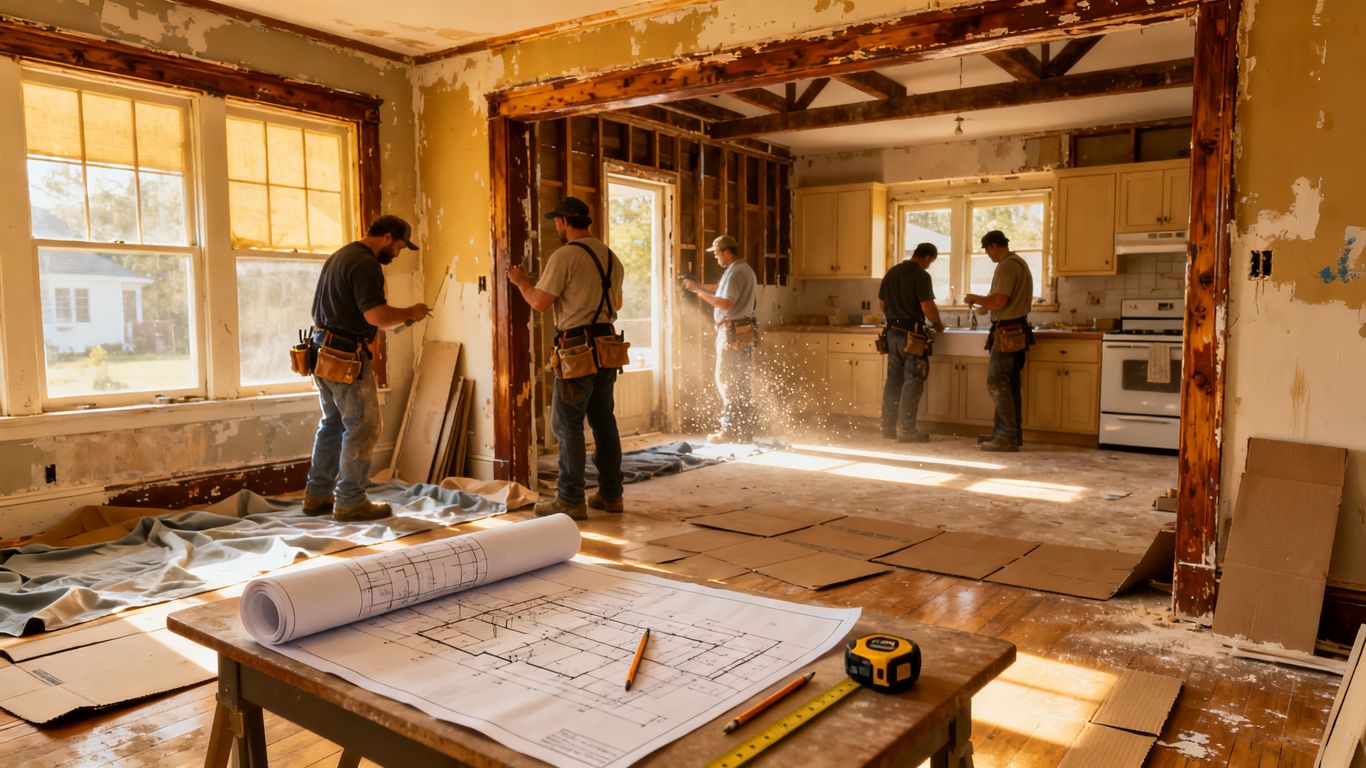
A useful page also distinguishes preservation from replacement. Mention compatible materials, careful transitions, and respect for the home’s proportions, but avoid claiming historic expertise unless the company can demonstrate it with real projects.
3. Full-service renovation contractor in [city]
A location-qualified phrase such as this one combines broad service intent with a local decision. The page needs more than a city name inserted into generic copy. Explain which phases your company manages, which services are actually available, and which nearby areas you serve.
Add locally useful information such as common housing types, permitting considerations, and how site visits are scheduled. Do not create separate city pages with identical text; each page should have a genuine local reason to exist. That might be a distinct housing stock, a service boundary, or a project example from the area.
A strong internal linking plan helps this page work as a hub. Link to the most relevant kitchen, bathroom, structural, and cost pages, then guide visitors toward one clear next step rather than scattering competing calls to action.
4. Best renovation company for historic homes
“Best” is a comparison word, so a page targeting it should provide evidence rather than self-congratulation. Discuss experience with existing materials, documentation, craftsmanship, approvals, and communication. A thoughtful explanation of fit is more persuasive than an unsupported superlative.
Historic-home prospects want to know whether a contractor understands what should remain, what can be updated, and where modern systems can be introduced discreetly. Show before-and-after images, but include context about the constraints and decisions behind the result. That detail gives search engines and readers something distinctive to evaluate.
Keep claims specific and verifiable. If your company does not handle preservation approvals or structural engineering directly, say who coordinates those parts instead of implying a broader capability.
5. Licensed home renovation contractor near me
Licensing is a high-value trust signal because homeowners are putting their property and money in another party’s hands. A page for this search should state the relevant license information, service area, and the kinds of work covered. It should also make clear when licensed subcontractors or outside professionals are involved.
Avoid vague badges with no explanation. Add insurance details, contract expectations, warranty language, and a way for visitors to ask questions. These practical details often separate a credible local page from a thin lead-generation page.
Local searchers also want a convenient first step. Make the phone number, inquiry form, and visit process visible on mobile, and use project photographs that reflect the homes and neighborhoods you actually serve.
6. Design-build renovation company in [city]
Design-build searches indicate interest in a more unified process. Explain how design decisions, estimating, selections, and construction communication fit together. Do not assume every visitor understands the term, so define it in plain language near the top of the page.
A useful page can compare the stages of a project without criticizing other models. Show when scope is developed, how revisions are documented, and when construction pricing becomes more dependable. That transparency gives a prospective client a reason to continue reading.
Use one or two real examples to demonstrate the process. The point is not to promise a particular result, but to help a homeowner understand what working with your team may look like from the first conversation through completion.
7. General contractor for home renovations near me
This phrase is broad, but the intent is still commercial. Visitors may be trying to understand whether they need a general contractor, a specialist, or a company that coordinates both. Define your role clearly and explain how scheduling, trades, materials, and site communication are managed.
A service page should answer practical questions about occupied homes, cleanup, inspections, and payment stages. These are often more useful than repeating “general contractor” throughout the copy. Include a service-area map or a concise list of locations if that information is accurate.
For keyword planning, review construction keyword strategies alongside your own search-query data. The best opportunities usually come from phrases that describe a real project, not from terms selected only because they appear to have volume.
8. Home renovation contractor with financing
Financing searches are sensitive because the visitor wants affordability but also needs clarity. If your company offers financing, explain the available process, eligibility language, and whether terms come from a third-party lender. Do not promise approval, rates, or payments that are not documented.
If financing is not offered directly, you can still create a helpful page about planning cash flow and asking the right questions. Separate construction pricing from financing terms so readers do not confuse one with the other. Clear disclaimers protect both the homeowner and the business.
The page should still sell the renovation service, but it should not make financing the only reason to contact you. Invite visitors to discuss scope first, because an honest project definition is necessary before any meaningful budget conversation.
9. Affordable home renovation companies in [city]
“Affordable” rarely means the lowest advertised price. Most homeowners mean sensible scope, durable choices, and fewer surprises. Address that intent by explaining how priorities, phasing, material selections, and contingency planning affect the final investment.
A city page can include examples of ways homeowners control costs without suggesting that every project follows the same formula. Discuss reusing sound elements, choosing standard sizes, and deciding where custom work adds real value. Keep the examples grounded in services you actually provide.
Keyword research should also filter out irrelevant traffic. A link to a coconut water guide would not belong on a renovation page, for example; that kind of mismatch illustrates why topical relevance matters more than collecting clicks from every query.
10. Home renovation contractor free consultation
A free-consultation page should explain what happens during the first conversation. Tell visitors whether the meeting is virtual, at the property, or both, what information they should prepare, and what they can reasonably expect afterward. Specific expectations make the offer feel real.
Do not use “free” to hide a hard sell. Explain whether a detailed design, site investigation, or formal estimate is a separate paid step. Homeowners appreciate knowing where the initial conversation ends and where billable planning begins.
The form should ask only for information that helps qualify the inquiry. Project type, location, timeframe, and a short description are usually enough to begin; a long form can discourage the very visitors the page is intended to serve.
11. Kitchen renovation contractor near me
Kitchen searches are often highly visual, but the decision is still practical. Homeowners want to know whether the contractor can manage layout, cabinetry, surfaces, lighting, plumbing, and the disruption of losing their main gathering space. A focused page should answer those questions in a calm, organized way.
Show several project styles and explain the constraints behind each one. A compact kitchen, a period home, and a large open kitchen require different planning decisions. Use captions or nearby copy to provide useful context rather than relying on images alone.
Connect this page to cabinet installation, small kitchens, older homes, and cost guidance. Those supporting pages capture the longer searches that often reveal a visitor’s priorities more clearly than “kitchen renovation” by itself.
12. Small kitchen renovation company in [city]
Small kitchens reward careful planning because every inch affects movement and storage. A local page should discuss circulation, appliance clearances, lighting, storage density, and how the team works within an existing footprint. Avoid suggesting that a small room must become visually crowded to become more useful.
Use a project example to show how a layout changed, not merely how the finished room looks. Measurements, door swings, work zones, and sightlines can help a reader imagine the reasoning. This kind of explanation also creates more original content than generic design language.
Location information should support the project story. Mention the city naturally, include the neighborhoods you genuinely serve, and explain how site measurements are handled before any layout is finalized.
13. Kitchen remodel contractor for older homes
Older kitchens often contain attractive proportions alongside difficult infrastructure. A page should address uneven walls, dated plumbing, unusual cabinet dimensions, and the possibility of concealed conditions. That signals experience without claiming that every older-home challenge is predictable.
Explain how you balance the homeowner’s desired function with the character of the property. Cabinet fronts, trim, hardware, flooring, and lighting can work together without turning the room into a museum. The best copy gives readers a framework for making those choices.
Be careful with guarantees about preservation or code compliance. Describe the assessment and coordination process, and identify when specialized professionals may be needed.
14. Custom kitchen renovation design-build contractor
Custom design-build pages should make the relationship between design and construction tangible. Describe how ideas become measured plans, selections, estimates, and a build sequence. Visitors are looking for confidence that the design will remain connected to what can actually be built.
Include the decisions that commonly affect scope: cabinetry, appliances, structural changes, electrical work, surfaces, and finish details. A transparent page does not need to list every possible product. It needs to show how decisions are made and recorded.
Use a visual portfolio with short project notes. A photograph is more useful when the surrounding copy explains the client’s problem, the design response, and the practical result without turning one client’s outcome into a general promise.
15. Kitchen renovation company with cabinet installation
Cabinet installation is a specific service intent, and the page should treat it as more than a line item. Explain how existing conditions are checked, how measurements are confirmed, and how cabinetry fits with appliances, counters, trim, and flooring. Small sequencing errors can affect several trades.
Clarify whether the company supplies cabinets, installs owner-purchased cabinets, or handles both. That distinction matters to homeowners and prevents inquiries that cannot be served. Include preparation expectations, delivery coordination, and what happens when materials arrive damaged or incomplete.
A useful call to action asks for room measurements, photographs, or a preliminary project description. It gives the team enough context to respond without forcing the visitor into an unnecessarily complex form.
16. Bathroom renovation contractor near me
Bathroom renovation searches are local and often urgent enough to produce calls quickly. Visitors may be dealing with a dated room, a failed fixture, or a plan to improve the space before selling. A clear page should cover design, demolition, waterproofing, installation, and final inspection at an appropriate level.
Explain how the team protects adjacent rooms from dust and moisture. Show material options, but avoid presenting a fixed package as suitable for every bathroom. A concise process section can help a homeowner understand why the project takes longer than simply replacing a vanity.
For a deeper planning resource, link to a bathroom remodeling guide where it naturally supports budgeting and material decisions. Internal links should answer the next question, not interrupt the visitor’s path with unrelated offers.
17. Small bathroom renovation company in [city]
Small bathrooms need decisions that preserve usable floor area. Discuss storage, door swings, fixture dimensions, lighting, and visual continuity. The page should help a homeowner see how thoughtful planning can improve the room without pretending that square footage can be created from nowhere.
Local relevance can come from housing stock and common layouts in the city. A narrow row-home bath, an apartment bath, and a suburban hall bath may call for different approaches. Use real examples only when they reflect completed work.
The conversion path should stay simple. A visitor who wants to know whether the project fits your service area should not have to submit a long design brief before speaking with someone.
18. Accessible bathroom renovation contractor
Accessibility searches often come from homeowners planning for a current limitation or a future change. Write with dignity and practicality, focusing on clear movement, safer transfers, reachable controls, lighting, and surfaces. Avoid assuming that every accessible bathroom needs the same features.
Ask readers to consider who uses the room, how assistance works, and what may change over time. Those questions make the page more useful than a generic list of products. They also encourage a consultation based on the household rather than a sales package.
Be precise about the difference between accessibility guidance, code requirements, and a contractor’s construction role. When regulations or specialized clinical advice apply, recommend confirming the details with the appropriate professional.
19. Walk-in shower installation and bathroom renovation
This search combines a desired feature with a broader project. Explain the choices that affect a walk-in shower, including floor slope, drainage, waterproofing, entry width, glass, niches, and controls. Homeowners need to understand that the visible tile is only one part of a successful installation.
Discuss whether the existing plumbing and framing can support the proposed layout. If demolition reveals damage, describe how the scope is reviewed before work continues. Waterproofing deserves careful attention because a beautiful surface cannot compensate for a poorly managed wet area.
A page like this can perform well when it answers both “how much” and “what is involved.” Pair practical details with photographs, a clear service area, and a consultation path that does not promise a price before the room is assessed.
20. Primary bathroom renovation contractor with design services
Primary bathroom visitors are often making a larger investment and expect design guidance. Describe how the team helps with layout, storage, lighting, fixtures, surfaces, and the relationship between appearance and maintenance. A design service should be explained as a working process, not a vague promise of inspiration.
Mention the decisions that can change the budget or schedule, such as moving plumbing, enlarging a shower, adding heated flooring, or changing windows. Present them as planning considerations rather than universal recommendations. That keeps the page useful across different homes.
A strong portfolio can show several levels of finish and different room sizes. Readers should be able to identify the kind of project they have, then understand what information is needed for a more accurate conversation.
21. Basement renovation contractor near me
Basement renovation searches cover a wide range of goals, from a family room to a home office or guest space. The page should begin with the conditions that determine feasibility: moisture, ceiling height, stairs, egress, heating, and electrical capacity. Those fundamentals are more persuasive than a long list of decorative finishes.
Explain how the existing basement is evaluated before layout decisions are finalized. If waterproofing or structural work is outside the renovation scope, say so and explain how coordination is handled. Clear boundaries prevent expensive misunderstandings later.
Use project categories to help visitors self-select. Separate general finishing from bathrooms, rental suites, and living-space conversions so each intent can lead to a more focused page.
22. Basement finishing company with bathroom installation
A basement bathroom introduces plumbing, ventilation, drainage, waterproofing, and code considerations to an already complex project. Explain how those items are reviewed before fixtures and finishes are selected. The page should make the installation feel planned rather than improvised.
Describe the relationship between the bathroom and the rest of the basement. Mechanical access, storage, sound control, and the location of walls can affect both comfort and future maintenance. A short process overview can answer many early objections.
Do not quote a universal price from a keyword page. Instead, list the variables that influence cost and invite visitors to share photographs, measurements, and their intended use for the space.
23. Basement renovation contractor for rental suites
Rental-suite searches carry additional questions about privacy, access, utilities, fire separation, parking, and local rules. A page should encourage homeowners to confirm whether the proposed use is permitted before construction planning goes too far. That advice is more responsible than implying that any basement can become a legal suite.
Explain which parts your company evaluates and which approvals or specialists may be involved. Discuss separate entrances, kitchens, bathrooms, and sound management only to the extent that they match your actual service. Avoid turning a general renovation capability into a claim of legal-suite expertise.
The content can also address long-term maintenance and durability. A rental space needs finishes and systems that are practical for repeated use, not merely attractive in listing photographs.
24. Attic renovation contractor for extra living space
Attic conversions depend heavily on structure and headroom. Begin with roof framing, insulation, ventilation, stairs, windows, and egress rather than paint colors. This helps readers understand why an attic assessment is necessary before anyone can recommend a layout.
Potential uses include an office, bedroom, studio, or quiet retreat, but each has different requirements. Explain how the intended use influences heating, lighting, storage, and safety. The page should help homeowners decide whether the space is worth investigating.
Use photographs carefully because finished attic images can hide low slopes and difficult access. Add captions that explain the planning challenge and the solution, giving the visitor a more realistic sense of the work.
25. Home addition contractor near me
Addition searches usually begin with a space problem that the existing floor plan cannot solve. A local page should explain how the team reviews site conditions, zoning, access, foundations, utilities, and the connection between old and new construction. These factors shape the project long before finishes are chosen.
Discuss common addition goals without suggesting that one design fits every property. A bedroom, family room, kitchen expansion, and second entrance each create different circulation and structural questions. Project examples should show those differences.
A nearby contractor also needs to explain how site visits and construction access work. Neighbors, landscaping, parking, and weather can affect the experience, so practical local detail helps qualify serious inquiries.
26. Second-story addition renovation company
A second-story addition is a major structural undertaking, not simply an extra floor of finishes. The page should address foundation capacity, framing, stair placement, roof removal, weather protection, and the effect on the existing home. This is where careful planning earns more trust than dramatic promises.
Explain the roles of design, engineering, permitting, and construction coordination. If some work is completed by outside professionals, present that relationship accurately. Homeowners should know who is responsible for each major decision.
The project timeline deserves realistic treatment. Weather, approvals, long-lead materials, and the condition of the existing structure can all influence sequencing, so avoid publishing a single guaranteed duration.
27. Garage conversion contractor in [city]
Garage conversion searches often come from homeowners seeking an office, bedroom, gym, or living area without expanding the building footprint. Discuss insulation, floor height, windows, heating, electrical service, and the garage door opening. These details determine whether the finished room feels like part of the home.
Local regulations may affect parking, habitable-space standards, and permitted use. Encourage readers to verify the requirements for their property, and explain what your company can handle in the planning and construction process. Do not imply approval is automatic.
A city-focused page should use local project photographs or genuinely local service information. Repeating the city name in every paragraph will not replace evidence that the company understands the area.
28. Sunroom addition and renovation contractor
Sunrooms sit between indoor and outdoor living, so comfort is the central issue. Talk about glazing, shading, insulation, heating, ventilation, flooring, and how the room connects to the rest of the house. A bright photograph is helpful, but the technical explanation makes the page credible.
Some homeowners want a seasonal room while others expect year-round use. Make that distinction early because it affects design, materials, and budget. Avoid calling a space four-season unless the actual construction supports that description.
A useful page can compare renovation and new-addition paths. If an existing porch or enclosed room has sound structure, improvement may be possible; if not, replacement could be the safer route.
29. Open-concept renovation contractor near me
Open-concept searches are often about connection, but removing walls can introduce structural and mechanical complications. Explain how the team reviews load paths, plumbing, wiring, heating, and sightlines before recommending demolition. That balances the appeal of a larger-feeling room with the realities of construction.
Talk about zoning the open space with lighting, flooring, ceiling treatments, furniture, and partial separations. A successful plan does not necessarily mean every room becomes one uninterrupted box. It means movement and daily use make sense.
Include a consultation prompt that asks what the homeowner dislikes about the current layout. The answer may reveal that better storage or circulation is the real goal, which can lead to a more suitable renovation.
30. Load-bearing wall removal contractor for home renovation
A load-bearing wall removal page must be direct about safety and professional assessment. Explain that the wall’s role, temporary support, beam design, posts, utilities, and permits all need review before removal. Never frame this work as a simple demolition task.
Homeowners also need to understand the impact on floors, ceilings, trim, and adjacent rooms. A new opening can change finishes and alignment even when the structural plan is sound. Explain how those secondary effects are included in the scope.
Use the page to qualify projects, not to provide a do-it-yourself sequence. A request for photographs, floor plans, and the property’s age can help the contractor decide what information is needed for the next step.
31. Structural home renovation contractor near me
Structural renovation searches tend to carry a high level of concern. Visitors may be dealing with settlement, a damaged beam, a foundation issue, or a layout change that requires reinforcement. The page should explain how observations are documented and when an engineer or other specialist is required.
Avoid diagnosing a problem from a photograph or promising a repair before investigation. Describe the process: site review, documentation, professional design where needed, permits, construction, and final checks. A measured tone is reassuring.
Local service details matter because structural work often requires site access and coordination. State the areas served and the kinds of structural renovation your company actually undertakes.
32. Energy-efficient home renovation company
Energy-efficiency pages perform best when they connect upgrades to comfort and operating conditions. Discuss insulation, air sealing, windows, doors, heating, cooling, ventilation, and controls only where those services are truly available. Avoid claiming a specific savings percentage without project data.
Explain that the right improvement depends on the home’s envelope, equipment, climate, and existing problems. A homeowner may need an assessment before choosing products. This approach keeps the page educational and avoids a one-size-fits-all sales pitch.
Use before-and-after details such as drafts, uneven temperatures, or condensation when documented. Those human observations often make the topic more relatable than a list of technical terms.
33. Aging-in-place home renovation contractor
Aging-in-place searches are about preserving choice and independence over time. Address entrances, bathrooms, bedrooms, lighting, flooring, storage, and circulation in a way that serves current needs without making the home feel institutional. The best page respects both function and personal taste.
Encourage homeowners to plan before a crisis forces rushed decisions. Small changes may be useful now, while wider doorways or a first-floor bathroom can provide future flexibility. Explain that the right scope depends on the household and the property.
Be cautious with medical or accessibility guarantees. A contractor can discuss construction options, but individual recommendations may require an occupational therapist or another qualified professional.
34. Home renovation contractor for mobility needs
This phrase is closely related to accessibility but can reflect a more immediate household need. The page should invite readers to describe how they move through the home, where transfers occur, and which spaces cause difficulty. That information leads to better planning than a generic checklist.
Possible considerations include thresholds, door widths, shower access, handrails, kitchen reach ranges, and clear turning areas. Present them as options to evaluate, not automatic requirements. Real photographs and measured examples can make the discussion concrete.
A calm consultation process is especially valuable here. Make it easy to request a visit, share relevant details privately, and understand what the contractor can assess during the first meeting.
35. Water damage renovation contractor near me
Water damage renovation begins with stopping the source and understanding what has been affected. A page should distinguish emergency mitigation from reconstruction, because drying, removal, testing, and rebuilding may involve different stages and professionals. That distinction helps homeowners choose the right next step.
Discuss documentation, moisture assessment, damaged materials, odors, and the possibility of hidden problems. Do not promise that every room can be restored or that the timeline is predictable before the property is inspected. Honest uncertainty is better than false reassurance.
Local availability and response expectations should be stated accurately. If the company does not provide emergency service, say so and explain whether it handles reconstruction after mitigation is complete.
36. Fire damage home renovation company
Fire damage affects more than visibly burned surfaces. Smoke odor, soot, water used during suppression, damaged systems, and compromised materials may all influence reconstruction. A focused page should explain why the first assessment must be thorough.
Describe the relationship between cleanup, removal, repair, and finish work. Insurance documentation may also shape decisions, but do not imply that coverage or approval is guaranteed. The homeowner needs a clear view of what is known, what remains to be investigated, and what comes next.
Use sensitive project photography and avoid sensational language. The tone should be steady and practical, especially for visitors who may be navigating a stressful loss.
37. Insurance restoration and renovation contractor
Insurance-related renovation searches require careful wording. Explain how the contractor documents conditions, prepares scope information, communicates with the property owner, and coordinates with other parties. Make clear that the insurer determines coverage and that the contractor does not control the claim decision.
A helpful page can outline the records homeowners should keep, including photographs, correspondence, estimates, and receipts. It should also explain when a change in scope may require additional review. This makes the page useful without offering legal or insurance advice.
Avoid presenting one claim outcome as typical. Every property, policy, and event is different, so the page should focus on process, communication, and accurate reconstruction planning.
38. Home renovation contractor after a flood
After a flood, homeowners often want to know when rebuilding can begin. Explain that drying, safety checks, removal of unsalvageable materials, and moisture verification come before cosmetic renovation. The exact sequence depends on the cause, extent, and condition of the property.
Discuss flooring, drywall, cabinetry, insulation, electrical systems, and odors as possible scope areas without assuming they are all affected. A site assessment should determine what can remain. This protects the homeowner from paying to replace sound materials or overlooking damaged ones.
The page should offer a clear communication path. Tell visitors what photographs and documents are useful, who attends the first visit, and how the reconstruction scope is reviewed before work is scheduled.
39. Home renovation cost per square foot in [city]
Cost-per-square-foot searches are useful for early planning but can mislead when treated as a quote. Explain that structure, access, finishes, mechanical systems, permits, and the existing condition of the home can move the number substantially. The city affects labor and material conditions, but it does not erase project-specific variables.
A comparison table can help readers understand why broad averages are limited. Keep the categories descriptive rather than presenting unsupported local prices.
| Cost driver | Why it changes the budget | What to clarify |
|---|---|---|
| Existing condition | Repairs may be needed before finishes | What the assessment includes |
| Project scope | Kitchens, baths, and structure vary widely | Which rooms and systems are included |
| Material selections | Products differ in price and availability | Allowances and substitutions |
| Site access | Tight or occupied sites can slow work | Delivery, protection, and cleanup |
The table is a planning tool, not a substitute for a measured scope. A good page should invite the homeowner to discuss the property and desired outcome before treating any number as meaningful.
40. How much does a whole house renovation cost
There is no responsible single answer without knowing the home’s size, condition, location, and intended scope. A cosmetic refresh differs greatly from a project that changes layouts, replaces systems, or adds structure. Explain those distinctions before discussing budgets.
Homeowners should ask whether estimates include design, permits, demolition, disposal, materials, labor, protection, cleanup, and contingency. Missing categories can make an attractive early number difficult to compare. Transparent inclusions are more useful than a low headline figure.
Publish ranges only when they are based on the company’s documented experience and clearly labeled as planning guidance. Otherwise, build trust by explaining the estimating process and what information makes a conversation productive.
41. Kitchen renovation cost for a mid-range remodel
“Mid-range” can mean very different things to different homeowners. Define the assumed scope, such as cabinet replacement, counters, flooring, lighting, appliances, or a modest layout change. Without that definition, the phrase has little practical value.
Explain the choices that commonly move the budget: cabinet construction, appliance specifications, surface materials, plumbing relocation, electrical upgrades, and custom details. A homeowner can then decide where to spend and where to simplify. That is more helpful than naming a single package price.
The page should also discuss schedule and temporary kitchen arrangements. A renovation budget is easier to evaluate when the household understands the disruption, decisions, and lead times involved.
42. Bathroom renovation cost with a walk-in shower
Walk-in shower budgets depend on more than the shower enclosure. Waterproofing, drainage, framing, plumbing, tile layout, glass, controls, storage, and accessibility details can all affect the scope. Explain these components so visitors know what a comparison should include.
Existing conditions matter as well. A room with accessible plumbing and sound framing may follow a different path from one with water damage or a layout that needs to change. Encourage an assessment before treating an online estimate as realistic.
A cost page should answer the question without turning into a false quote. Give readers a framework for comparing proposals, then provide a straightforward way to request project-specific guidance.
43. How long does a full home renovation take
A full renovation timeline usually includes planning, design, approvals, ordering, preparation, construction, inspections, and closeout. The construction portion is only one part of the experience. Explain the phases so homeowners do not mistake a build estimate for the entire calendar.
Factors such as hidden conditions, long-lead products, weather, site access, and decision speed can affect the schedule. A responsible contractor describes how these risks are managed rather than promising an exact completion date before the scope is known.
Use a sample sequence if it reflects the company’s real process. Label it as an example and explain where the actual project may differ. That gives readers useful context without turning a marketing timeline into a guarantee.
44. Home renovation contractor for projects while living at home
Many homeowners cannot move out during renovation, so this search deserves practical detail. Explain how rooms are phased, dust is contained, utilities are coordinated, and daily access is maintained. The right plan depends on the project and the household’s tolerance for disruption.
Discuss temporary kitchens, bathroom access, pets, children, deliveries, and working hours where relevant. These details show that the contractor understands the lived experience, not just the finished photograph. They also help visitors decide whether phasing is realistic.
Be honest about limits. Some structural, electrical, water, or whole-house projects may make temporary relocation safer or more efficient, and the page should say that when appropriate.
45. Renovation company that handles permits and inspections
Permit questions often signal that a homeowner is ready to compare contractors seriously. Explain which permits the company coordinates, which professionals prepare technical documents, and how inspections fit into the schedule. Do not claim to handle every permit category unless that is documented.
A useful page can describe the homeowner’s role as well. Property information, approvals, access, and timely decisions may still be needed. Clear responsibility reduces delays and makes proposals easier to compare.
The page should connect permits to the work itself rather than treating them as a trust badge. Explain how approvals affect demolition, rough-ins, insulation, closing walls, and final completion so the process feels understandable.
For project planning, a short sequence is easier to scan than a dense paragraph. These are common checkpoints to discuss with the contractor:
- Confirm the project scope and applicable permit types.
- Prepare drawings or technical information where required.
- Schedule inspections around construction milestones.
- Document approved changes before work proceeds.
That sequence is a conversation guide, not a promise that every renovation follows identical steps. Local requirements and project conditions should always be confirmed before construction begins.
46. Home renovation contractor with 3D design plans
Three-dimensional plans can help homeowners understand scale, circulation, finishes, and sightlines before construction starts. Explain what the plans show, how revisions are handled, and whether they are conceptual or suitable for construction documentation. The distinction matters when visitors are comparing design services.
Use a side-by-side example that pairs a plan with the completed room when possible. This demonstrates how the visual tool supports decisions without claiming that a rendering guarantees the final result. Materials, lighting, and site conditions can still create differences.
The design page should lead naturally to a scope conversation. Ask what the homeowner is struggling to visualize, then explain what information the team needs to create a useful plan.
A video can support this section if it shows how renovation layouts are reviewed. Keep it secondary to the written explanation, since search visitors may arrive with different questions and may not watch the entire clip.
47. Renovation company for projects with a fixed-price contract
Fixed-price searches usually reflect a desire for budget certainty. Explain what the price includes, what assumptions support it, how allowances work, and which conditions could create a documented change. A fixed price is only useful when the scope behind it is clear.
Homeowners should compare proposals by inclusions, exclusions, schedule, payment stages, materials, protection, cleanup, and warranty terms. Encourage them to ask how unforeseen conditions are handled. That process helps distinguish a genuinely clear contract from a low number with missing work.
Do not imply that fixed-price contracting eliminates every risk. A well-defined agreement manages uncertainty through documentation and communication; it does not make concealed conditions, owner changes, or product delays disappear.
Get More Qualified Renovation Leads
If your renovation website is attracting broad research traffic but few serious inquiries, start by mapping these searches to specific pages, service areas, and conversion paths. When the structure is ready, take the next step by making it easy for qualified homeowners to begin a conversation.
Conclusion
The opportunity in renovation company SEO long tail keywords is not the number 47 itself. It is the specificity behind each search: a house condition, a room, a budget question, a timeline concern, or a local need. Build pages that answer those questions honestly, connect them into a useful site structure, and measure whether they produce conversations with homeowners your company can genuinely help.
Frequently Asked Questions
What are long-tail keywords for renovation companies?
They are specific search phrases that usually contain several words and describe a service, location, problem, feature, or buying question. They tend to attract narrower audiences than broad terms and can reveal clearer intent.
Should every long-tail keyword have its own page?
No. Closely related phrases can often share one strong page. Create a separate page when the search represents a genuinely different service, audience, location, or decision stage.
How should a renovation company choose local keywords?
Start with the places the company actually serves, then combine those locations with real services and customer needs. Avoid creating pages for cities where the business cannot reasonably visit or complete work.
Where should keywords appear on a renovation page?
Use the main phrase naturally in the title, heading, introduction, page address, and relevant metadata. Supporting language should explain the service rather than repeat the same wording unnaturally.
What information helps a renovation SEO page convert?
Clear scope, service area, project photographs, process details, realistic cost factors, trust information, frequently asked questions, and an easy contact option all help visitors decide what to do next.
How can contractors measure whether long-tail SEO works?
Track qualified calls, form submissions, consultation requests, booked estimates, and revenue alongside impressions and rankings. Search traffic matters only when it reaches the right audience and supports business goals.
How often should renovation keyword pages be updated?
Review them when services, locations, pricing assumptions, regulations, portfolios, or conversion paths change. A periodic review can also reveal new search language in call records, forms, and search-console data.