Key Takeaways
Whole home renovation company branding works best when it gives homeowners a clear reason to remember and trust the business. The strongest brands connect positioning, proof, creative, and measurement rather than treating them as separate marketing tasks.
- Define the type of homeowner, project, and experience your company serves best.
- Turn your process and point of view into a recognizable brand position.
- Use project proof, reviews, and transparent service information to reduce uncertainty.
- Match website content and advertising to the homeowner’s stage of decision-making.
- Measure qualified consultations and revenue, not just clicks or form submissions.
Define a brand position beyond “quality craftsmanship”
“Quality craftsmanship” is reassuring, but it is also one of the most common claims in renovation marketing. A homeowner can agree with it without remembering who said it. Strong whole home renovation company branding gives that familiar promise a sharper context: the kind of project, client, design sensibility, or working experience the company is especially suited to provide.
Positioning should also help a paid media team make decisions. If every audience, service, and message is equally important, campaigns become expensive collections of vague promises. A narrower position can make the right prospects feel recognized before they ever submit a consultation request.
Identify the homeowners and projects you serve best
Start with the projects that produce the best fit, not simply the largest possible audience. Consider home age, neighborhood, budget range, project complexity, design expectations, and the homeowner’s tolerance for living through construction. A company that excels at coordinated renovations across several rooms should not present itself like a general repair provider.
Look for patterns in profitable past work and in the conversations that salespeople enjoy having. The goal is not to reject every project outside the ideal profile. It is to make the preferred project obvious enough that qualified homeowners self-select.
Choose a distinctive renovation specialty or point of view
A specialty can be practical, aesthetic, or experiential. You might focus on older homes, accessible layouts, historically sensitive updates, design-build collaboration, or renovations where the company manages many connected decisions under one plan. The point of view should be visible in the work and defensible in the process.
Review how other renovation businesses frame themselves without copying their language. For instance, whole-home remodeling examples can provide useful inspiration for how a company might communicate design, construction, and communication as one experience. Your own position still needs to come from your actual work, not from a borrowed slogan.
Turn your process into a competitive advantage
Homeowners often fear confusion more than construction itself. They want to know who makes decisions, when selections happen, how changes are handled, and how communication works once the project begins. Those details can become meaningful brand assets when they are explained clearly and supported by real examples.
Describe the process in plain language, from early consultation through design, budgeting, construction, and final walkthrough. A design-build planning guide is a useful reference for organizing the relationship between design, budget, and construction, but your website should explain how your own team handles those stages.
Build a positioning statement that guides marketing decisions
A useful positioning statement is an internal filter, not necessarily the line displayed on your homepage. It should identify who you serve, what kind of renovation you handle, what experience you provide, and why that combination matters. Keep it specific enough to rule out weak ideas.
For example, a statement might describe a renovation company for homeowners planning complex, design-led updates in older properties, with a structured process that keeps decisions and communication organized. That sentence can guide service-page copy, photo selection, ad headlines, qualification questions, and even which leads the sales team prioritizes.
Create a brand identity homeowners can recognize and trust
A brand identity is more than a logo placed over project photography. It is the repeated visual and verbal pattern that helps someone recognize the company across a search result, social post, website page, estimate, and follow-up email. Consistency matters because renovation decisions usually involve several visits before a homeowner is ready to speak with a company.
The identity should feel credible for the projects you want. An overly polished luxury look may discourage practical buyers, while a generic construction aesthetic may undersell design-led work. Choose a system that makes the company’s intended experience easy to understand.
Select a visual direction that matches your ideal projects
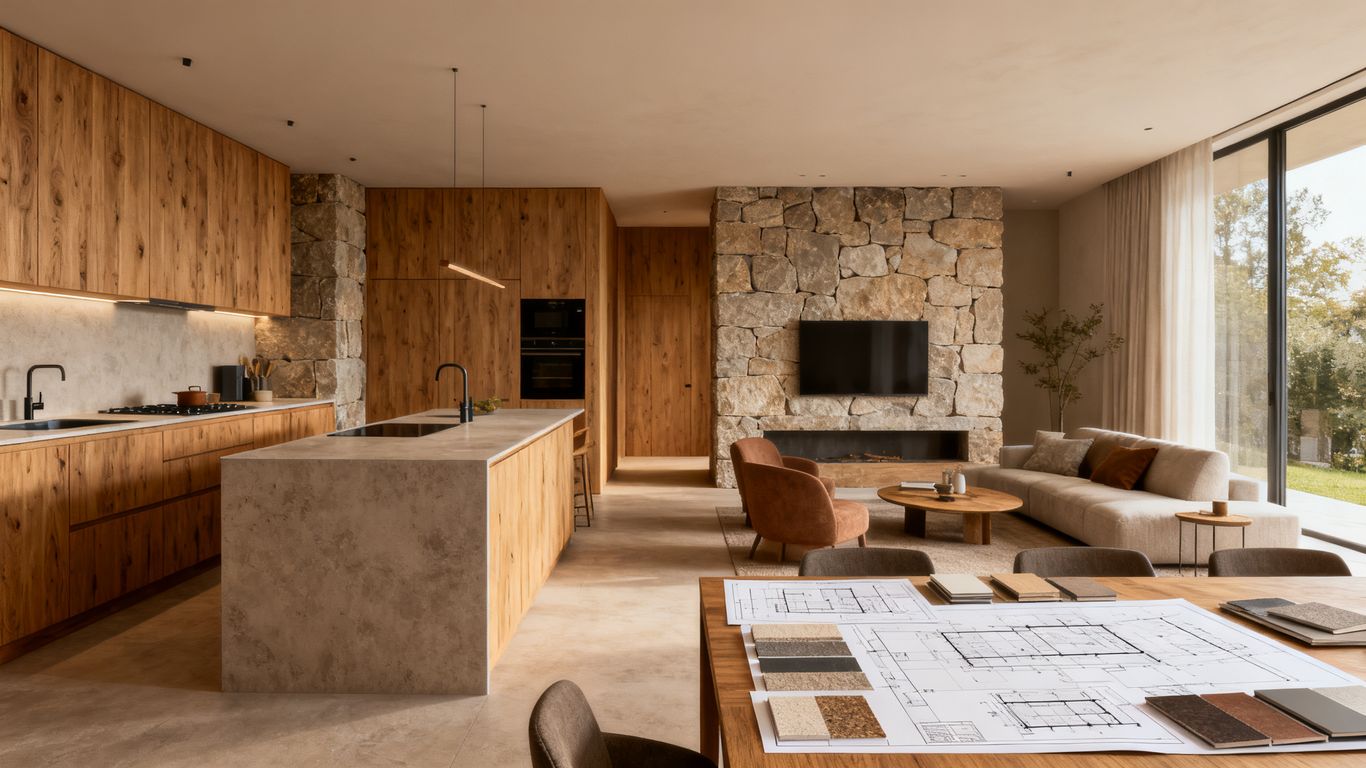
Study the visual qualities that already appear in your best work: natural materials, clean lines, traditional details, bold color, warm lighting, or highly functional layouts. Then build a restrained palette, type system, image treatment, and layout style around those qualities. The identity should support the photography rather than compete with it.
Use real project images whenever possible. Stock imagery can fill a temporary gap, but it rarely communicates the scale, finish, and lived-in detail that homeowners need to assess a renovation company. A consistent visual direction also makes a small library of projects feel more coherent.
Develop a memorable name, tagline, and messaging hierarchy
The name earns recognition, the tagline creates a quick association, and the message hierarchy explains the offer. Do not ask a tagline to carry every proof point. Let the homepage lead with the position, follow with the project type and process, and then give visitors evidence through work, reviews, and credentials.
A useful hierarchy might move from “what we do” to “who it is for,” then “how the experience works,” and finally “why homeowners should believe us.” This structure is especially helpful in ads, where the first line has to earn attention before the landing page can provide detail.
Use a consistent voice across your website and ad campaigns
The voice should sound like the company people will meet during a stressful, expensive project. Decide whether it is calm and consultative, design-minded and precise, warm and neighborly, or direct and practical. Then use the same vocabulary in Google Ads, Meta creative, service pages, consultation forms, and sales follow-up.
Consistency does not mean repeating one sentence everywhere. It means preserving the same attitude and promises while adapting the message to the channel. Inspiration creative can be more visual; search copy should be more direct; the landing page can take time to explain the process.
Avoid generic contractor branding that blends into the market
Generic branding usually relies on the same combination of tools, trucks, hard hats, neutral colors, and broad claims. None of those elements is automatically wrong, but they rarely answer the homeowner’s central question: why should this company be considered for this particular renovation?
Replace broad claims with observable details. Explain what happens during planning, show the types of homes and spaces you work on, and let clients describe the experience in their own words. The service business website guide is a useful reminder that conversion-focused structure, credentials, testimonials, mobile performance, and tracking matter alongside visual polish.
Build proof around the whole-home renovation experience
A renovation portfolio proves that a company can make attractive spaces. It does not automatically prove that the team can coordinate a complicated project, communicate through uncertainty, or respect the homeowner’s daily life. Brand proof should therefore cover both the finished result and the way the result was achieved.
Think of every case study as an answer to a concern. Can this team solve a difficult layout? Can it manage many selections? Can it keep a project organized? Can it deliver a result that feels personal rather than templated? Strong proof makes those answers easier to find.
Organize case studies around homeowner problems and outcomes
Start each case study with the situation before the renovation. Describe the constraints, the reason the homeowners decided to act, and the decisions that shaped the scope. Then connect the design and construction choices to practical or emotional outcomes, such as better circulation, more useful storage, or a home that works for changing family needs.
Avoid turning every project into a list of rooms completed. A whole-home renovation story is more persuasive when it has a clear tension and resolution. The page should leave the reader understanding not only what changed, but how the company thought through the change.
Show the transformation with project photography and video
Photography should give visitors enough context to understand scale, transitions, materials, and craftsmanship. Use wide views for flow, closer images for detail, and before-and-after pairs when the original condition helps explain the work. Video can add movement, homeowner perspective, and a sense of how the spaces connect.
If the team records long interviews or walkthroughs, ShortMind can transform long-form content into social media clips, adding titles and captions and automatically reframing content for TikTok, YouTube Shorts, and Instagram Reels. That documented capability can help a renovation company repurpose footage without pretending that every short clip replaces a complete project story.
The most useful videos still need a clear subject and a strong opening. Show the problem, the decision, or the transformation quickly, then point viewers toward a relevant project page or consultation step.
Use reviews that highlight communication, planning, and reliability
Reviews are more useful when they describe the parts of renovation that are difficult to judge from photos. Ask clients to speak about communication, planning, coordination, cleanliness, responsiveness, and how the team handled changes. These details help a prospective client picture the working relationship.
Place reviews near the claims they support. A comment about clear selections belongs near the process explanation; a comment about thoughtful design belongs near the gallery. Do not bury every review on one isolated testimonials page where it has less context.
Present credentials, warranties, and guarantees without overloading the page
Credentials reduce perceived risk, but a crowded badge wall can make a page feel defensive. Present the most relevant licenses, insurance information, memberships, warranties, and guarantees near the questions they answer. Explain what each item means for the homeowner rather than assuming a logo is self-explanatory.
Use a simple order: project proof first, process clarity next, formal reassurance after that. This keeps the brand human while still giving serious prospects the information they need before scheduling a conversation.
Turn your website into the brand’s primary sales tool
A renovation website should do more than look finished. It should help a homeowner decide whether the company fits, understand what happens next, and take a low-friction action when the timing is right. That requires clear information architecture and disciplined conversion paths.
The homepage can introduce the position, but service pages and project pages do much of the selling. They answer specific questions for visitors arriving from organic search, Google Ads, referrals, and social media. Good remodeling website examples often make project galleries, testimonials, visual storytelling, and consultation booking easy to find; those principles are more useful than copying a particular design.
Structure service pages around whole-home renovation decisions
Organize pages around the decisions homeowners are making, not only the internal departments of the business. A whole-home renovation page might explain scope, planning, design coordination, construction management, and the kinds of homes or projects that are a good fit. Supporting pages can address kitchens, additions, bathrooms, exteriors, or other meaningful project categories.
Each page should state the service area, show relevant work, answer common objections, and offer a next step. Avoid sending every ad to the homepage when the search clearly indicates a particular project need.
Create project galleries that demonstrate scope and design quality
A gallery should let visitors move from a compelling image into a complete project story. Include enough photos to show relationships between rooms, not just isolated hero shots. Add a short summary of the challenge, scope, design approach, and result so the images have a commercial purpose.
Filter galleries by project type, style, or scope only when those filters make browsing easier. Too many categories create empty pages and dilute attention. A smaller, well-described portfolio is usually stronger than a large grid with no context.
Explain timelines, budgets, selections, and the construction process
Uncertainty grows when the website avoids practical details. Explain what affects a timeline, when budget conversations occur, how selections are managed, and what communication looks like during construction. You do not need to publish a universal price or promise a fixed duration; you do need to show that these subjects have a defined place in the process.
Use short sections, diagrams, or carefully labeled examples where they help. The goal is to make a complex service feel navigable without turning the page into a legal document.
Strengthen calls to action for high-intent renovation leads
A high-intent visitor usually needs a clear action, not a clever button. “Discuss your renovation” or “Schedule a project consultation” sets a more accurate expectation than a generic “Learn more.” Include phone and form options, explain what happens after submission, and ask only the questions needed to qualify the inquiry.
The call to action should appear after the position, proof, and process have earned it. Repeat it at useful stopping points, but keep the wording and destination consistent so measurement remains clean.
Make the brand visible across local search and paid media
Brand visibility is built through repeated encounters. A homeowner may first see a local search result, later encounter a project video, then click a Google ad after recognizing the company name. When those touchpoints use different promises and visuals, trust has to restart each time.
Local SEO and paid media should therefore share the same position while serving different jobs. Search captures active demand; social and video can create familiarity earlier. Both need accurate business information, credible proof, and a landing page that continues the conversation.
Align Google Business Profile, local SEO, and directory information
Keep the business name, address, phone number, hours, service areas, categories, and website destination consistent wherever the company appears. The Google Business Profile should reflect the actual business and give visitors useful paths to photos, reviews, services, and contact options.
A broader Home Services SEO strategy can support this work through Google Business Profile optimization, review development, targeted website content, and technical SEO. Treat local search as an owned asset that compounds with useful pages and genuine customer evidence, not as a substitute for a distinct brand.
Build location pages without creating thin, repetitive content
A location page should explain why the company is relevant to that place and project type. Include local service context, representative work, realistic service boundaries, and questions that homeowners in the area actually ask. Changing only the city name across dozens of pages creates little value for visitors and weakens the brand.
Publish fewer pages if necessary, then make each one useful. Link them to relevant projects and services, and make sure advertising traffic lands on the page that best matches the search intent.
Match Google Ads messaging to the company’s brand position
Search ads have limited space, so the position must survive compression. Pair the service and location with a meaningful differentiator, such as a defined renovation specialty, a structured planning experience, or a particular design point of view. Avoid stuffing every headline with “quality,” “reliable,” and “professional.”
Build separate ad groups and landing pages when the project intent differs materially. Review search terms regularly, add negatives for poor-fit demand, and judge the campaign by qualified consultations rather than cheap clicks.
Use Meta, Instagram, and video ads to showcase the renovation experience
Meta and Instagram are well suited to visual proof, but a beautiful room alone may not explain why someone should inquire. Pair transformations with process footage, designer or builder commentary, selection moments, and client-centered explanations. Short creative should make the company feel recognizable before the viewer needs a contractor.
Rotate formats so the account does not depend on one polished montage. Carousels can explain a sequence, vertical video can show a walkthrough, and still images can make a specific material or detail memorable.
Differentiate creative by renovation stage and customer intent
Not every homeowner is ready for the same message. Someone saving kitchen ideas needs a different introduction from someone comparing estimates or trying to understand why a project has become complicated. Stage-based creative keeps the account from asking for a consultation before the audience has enough context.
This is also where branding becomes practical media strategy. A consistent position can appear as inspiration, proof, explanation, or invitation without becoming repetitive.
Address inspiration-stage homeowners with visual storytelling
Early-stage audiences respond to a strong visual idea and a reason to keep watching. Show a meaningful before-and-after, an unusual constraint, a material decision, or the relationship between several rooms. Keep the copy curious and specific rather than pushing a hard sales pitch immediately.
Use a soft next step such as viewing a related project or saving renovation ideas. The audience may not be ready to book, but it can begin associating the company with a particular kind of work.
Convert comparison-stage prospects with process and proof
Comparison-stage prospects need evidence that the company can manage the project, not just produce attractive images. Ads and landing pages should answer questions about planning, communication, scope, selections, and what makes the team a fit for the project.
Put the strongest proof close to the form or call button. A review about communication, a case study with a clear challenge, and a concise process explanation can do more than another generic claim about workmanship.
Use retargeting to reinforce trust after a website visit
Retargeting should continue the story a visitor began, not follow them around with the same homepage banner. Someone who viewed whole-home projects might see a process video; someone who read about additions might see a relevant case study. Frequency controls matter because repetition without new information can make a premium service feel pushy.
Exclude people who have already booked where the platform and tracking setup allow it. Keep audience windows and creative sequencing simple enough that the team can understand what is actually running.
Test headlines, offers, formats, and landing pages against qualified leads
Testing should be tied to a business question. Is a process-led headline attracting better-fit homeowners than a design-led one? Does a project-specific landing page produce more useful consultations than a general service page? Do video viewers become identifiable leads later?
A sensible test sequence prevents random changes from obscuring the result:
- Start with one clear positioning hypothesis.
- Keep the audience and conversion definition stable.
- Compare creative formats only after the message is understandable.
- Review lead quality with the sales team, not just the ad platform.
After the test, document what changed and where the result applies. A winning headline for bathroom searches may not be the right message for a full-home renovation campaign.
Measure whether branding is improving marketing performance
Branding should influence performance even when it is not the final click. Recognition can raise click-through rates, improve the quality of inquiries, shorten the explanation required on a sales call, and make direct traffic more valuable. Measurement needs to account for those effects without assigning every later conversion to brand activity.
Set up tracking before scaling creative. Use consistent campaign naming, call tracking, form event quality checks, and a CRM process that records consultation outcomes. The cleaner the data, the easier it is to distinguish a memorable brand from attractive marketing that produces poor-fit leads.
Track lead quality instead of relying on form volume
Define a qualified lead in operational terms. It might involve location, project scope, budget fit, timeline, property type, or willingness to enter the design process. Then make sure those fields are captured consistently enough for weekly analysis.
A campaign that generates fewer inquiries but more suitable consultations may be doing better than one that fills the sales queue with small or unrelated requests. Qualified demand matters more than a high count of incomplete forms.
Connect calls and consultations to campaigns and project revenue
Lead sources should travel with the prospect from first contact through consultation and, where possible, project outcome. Call tracking, CRM source fields, offline conversion imports, and consistent booking records can connect advertising decisions to actual revenue.
Do not treat platform-reported conversions as the whole truth. They are useful for optimization, but the renovation company’s own sales records reveal whether the leads become conversations, estimates, signed work, and profitable projects.
Monitor branded search, direct traffic, and assisted conversions
Watch for changes in branded search volume, direct sessions, returning visitors, engagement with project pages, and assisted conversion paths. These signals can indicate that people remember the company even when the final inquiry arrives through another channel.
Interpret them alongside seasonality, market demand, spend, and sales capacity. A rise in branded searches is encouraging, but it becomes more meaningful when qualified consultations and revenue improve as well.
Refresh positioning and creative based on performance data
Review performance by message, project type, audience, geography, and stage. If process-led creative produces stronger consultations, make process proof more prominent across the website and ads. If a visual style earns attention but attracts poor-fit inquiries, keep the visual lesson and revise the qualification message.
Branding is not a one-time design handoff. It is a working system that gets clearer as the company learns which promises attract the right homeowners and which ones merely produce traffic.
Conclusion
Whole home renovation company branding becomes distinctive when it connects a clear position with a recognizable identity, credible project proof, useful website content, stage-specific advertising, and disciplined measurement. The goal is not to sound louder than every contractor using the same claims; it is to make the right homeowner understand why your company fits. When you are ready to turn that interest into a scheduled conversation, book a consultation with a simple next step.
Frequently Asked Questions
What makes whole home renovation company branding different from general contractor branding?
It presents the company around the complexity, coordination, design decisions, and homeowner experience involved in connected renovation work rather than relying only on broad construction claims.
How can a renovation company stand out without narrowing its services too much?
Choose a clear primary position based on the projects and homeowners you serve best, then explain related services as supporting capabilities within that larger point of view.
What should appear on a whole-home renovation website?
The site should include a clear position, relevant service pages, detailed project stories, process information, reviews, credentials, service areas, and an easy way to request a qualified conversation.
Are before-and-after photos enough to build trust?
They help visitors understand the transformation, but trust also requires evidence about communication, planning, project coordination, selections, timelines, and how the team handles uncertainty.
Which advertising channels work well for renovation branding?
Google Ads can capture active project searches, while Meta, Instagram, and video formats can build familiarity through visual storytelling. The best mix depends on audience, market, creative quality, and tracking.
How often should a renovation company update its brand creative?
Review performance regularly and refresh creative when it becomes repetitive, the business changes its ideal project mix, or data shows that a different message attracts better-qualified inquiries.
What is the most useful branding metric for a renovation company?
Qualified consultations and resulting project revenue are more useful than reach or raw form volume. Branded search, direct traffic, and assisted conversions can add context to those outcome measures.