Building Trust for Your HVAC Brand: The Signals That Make Homeowners Pick Up the Phone
Key Takeaways
Homeowners often decide whether to call an HVAC company before they read more than a few lines. The strongest brands make their reliability easy to verify across search results, websites, reviews, ads, and the first phone conversation.
- Make your service area, specialties, and next step obvious.
- Use consistent visual and verbal cues across every customer touchpoint.
- Treat reviews, credentials, real project details, and response quality as proof.
- Match advertising promises to the experience customers receive after calling.
- Measure booked jobs and revenue, not just clicks or raw lead volume.
Understand the trust signals homeowners use before calling
HVAC decisions carry more perceived risk than many routine home-service purchases. A homeowner may be inviting a technician inside, committing to an expensive repair, or choosing equipment that affects comfort for years. That makes HVAC company branding trust signals less about looking polished and more about reducing uncertainty at every step.
Why HVAC purchases require more reassurance than many home services
A loose door handle can wait, but a failed furnace or leaking air conditioner can disrupt sleep, work, and family routines. Even planned replacement projects involve technical explanations, substantial costs, and concerns about whether the installation will be done correctly. Homeowners therefore look for evidence that a company is legitimate, capable, and accountable before they ask for an estimate.
That evidence does not need to be complicated. A clearly named service area, current reviews, visible credentials, and a straightforward explanation of what happens next can do more than a grand slogan. The goal is to answer the quiet question behind the search: “Can I safely trust this company with my home?”
How urgency changes the way homeowners evaluate your brand
Urgency compresses the decision. Someone with no heat may scan the first few search results, check whether a business appears nearby, glance at ratings, and tap the easiest phone button. They are not necessarily looking for the most distinctive brand; they are looking for the least risky option they can find quickly.
That means emergency messaging should be calm and specific. State the service availability you can actually provide, show the areas you serve, and avoid promises that your dispatch team cannot consistently keep. A fast response is valuable, but only when the business can deliver the experience implied by the ad.
The difference between familiarity, credibility, and conversion intent
Familiarity means a homeowner recognizes your name or has seen your truck before. Credibility means the available evidence supports your ability to do the work. Conversion intent appears when those impressions combine with a clear, low-friction next step.
These are related but not interchangeable. A memorable logo may improve recognition, while a detailed service page and recent review may build credibility. A prominent call button, useful scheduling information, and a confident answer from the office can turn both into action. Verifiable trust for HVAC businesses is a useful way to think about the difference between appearing established and giving people evidence they can check.
Which trust signals matter most on mobile search results
Mobile search gives a company very little room to make its case. The business name, rating, review count, location, service language, photos, and call action may determine whether a homeowner visits the site or moves on. A cluttered page or unclear service area creates doubt before your best proof is ever seen.
Prioritize the information that helps someone decide quickly: what you do, where you do it, whether you handle the problem, and how to reach you. The broader lesson is simple: online trust signals for HVAC companies should be visible before a visitor has to hunt for them.
Build an HVAC brand that looks established and dependable
A dependable HVAC brand is built through repetition. The same service promise, visual system, and standard of communication should appear on the website, in paid ads, on trucks, and when a technician arrives. Design matters, but it works best when it makes real business standards easier to recognize.
Clarify your service area, specialties, and ideal customer
A homeowner should not have to guess whether you serve their neighborhood or handle their particular issue. Organize the brand around the jobs you want more of, the locations you can serve profitably, and the customers whose needs match your capabilities.
Say whether you focus on repairs, maintenance, replacement, commercial work, indoor air quality, or another documented specialty. Then use those terms consistently in page titles, ad groups, service descriptions, and call-handling scripts. Precision feels more credible than a long list of every possible service.
Create visual consistency across your website, ads, trucks, and uniforms
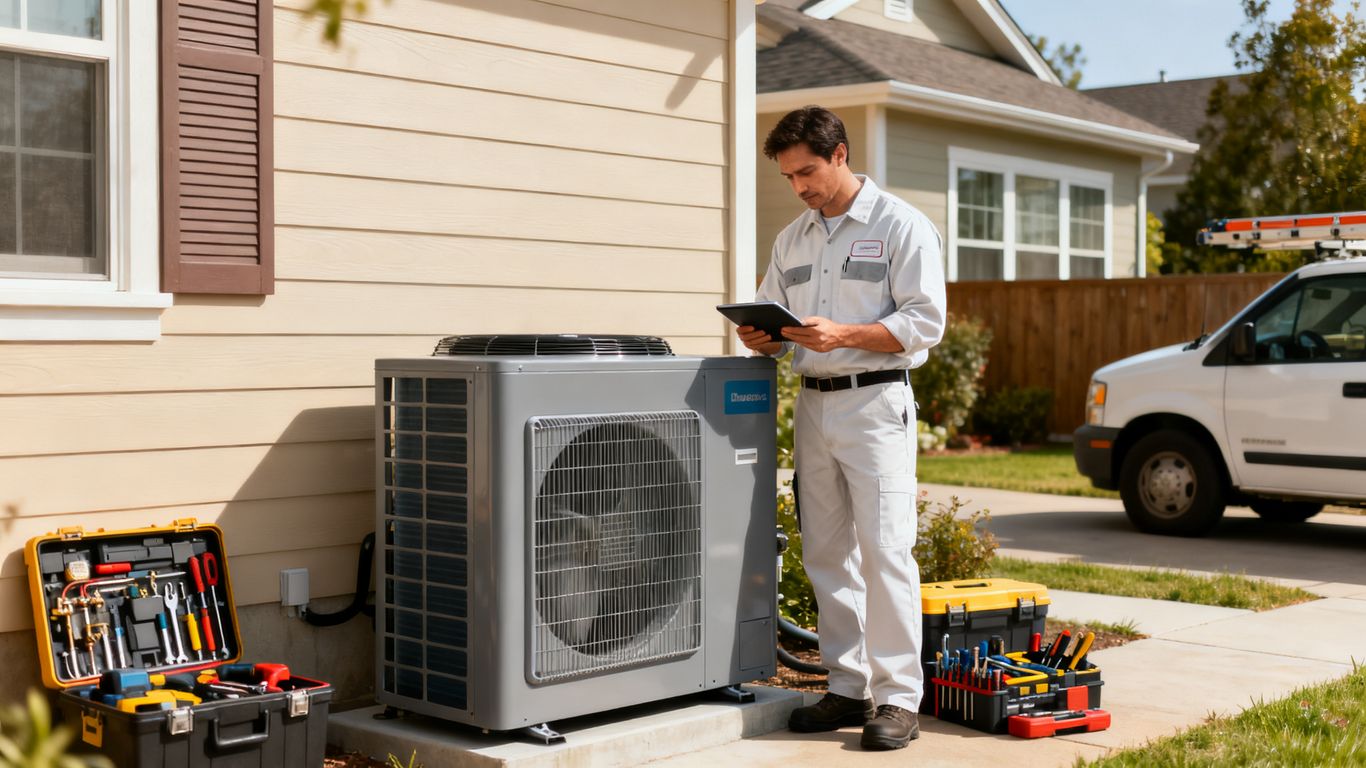
Visual consistency helps a homeowner connect separate encounters with the same business. A familiar color palette, logo treatment, photography style, and technician presentation can make an ad feel connected to the truck that arrives later. It also reduces the impression that a company is improvising its identity from channel to channel.
The system does not need to be elaborate. It needs clear rules for logo spacing, colors, typography, vehicle graphics, uniforms, and imagery. Branding across HVAC touchpoints is most useful when the visual work is applied consistently rather than left as a logo file that never reaches the field.
Use messaging that communicates expertise without sounding generic
“Quality service” and “customer satisfaction” appear on nearly every contractor website, so they rarely distinguish a company on their own. Stronger messaging names the situation the homeowner faces, explains how the team approaches it, and makes the next step feel manageable.
Write like a knowledgeable technician who can explain a problem without talking down to the customer. Specific language about diagnostics, maintenance plans, installation standards, or communication practices is more persuasive than inflated claims. A useful brand promise should be easy for the office and field team to repeat accurately.
Make your guarantees, financing options, and service standards easy to understand
Guarantees and financing can reduce hesitation, but only when the conditions are clear. Explain what is covered, for how long, and what the customer should expect during the process. If financing is available, give enough context for the visitor to understand that approval, terms, and eligibility may vary.
The same standard applies to service promises. “Same-day” should mean something operationally specific, while “free estimate” should not conceal a different obligation later. Clarity protects trust because it prevents a reassuring claim from becoming a source of disappointment.
Turn your website into proof that your company can deliver
Your website is not merely a brochure for the brand. It is where a cautious searcher checks whether the claims in an ad, map listing, or recommendation hold up. Every important promise should lead to supporting evidence, an understandable explanation, or a simple way to ask a question.
Put licensing, certifications, warranties, and insurance information in context
Credentials matter more when visitors understand what they mean. Rather than placing a row of badges in the footer, explain which qualifications apply to the work, which team members hold them, and whether a warranty covers equipment, labor, or both. Only publish current information that the business can substantiate.
This context also helps paid traffic convert. A visitor arriving from a replacement ad may care about installation standards and warranty coverage, while someone seeking a repair may care more about diagnostic experience and response time. The page should answer the concern that brought the visitor there.
Show real technicians, projects, equipment, and local service experience
Stock photography can make a site feel interchangeable. Real images of technicians, completed work, equipment, service vehicles, and recognizable local settings give homeowners something concrete to evaluate. Captions can explain the job without turning the page into a case-study archive.
Use photos honestly and keep them current. A polished image is not proof by itself, but a body of consistent, specific evidence helps the company feel present and accountable. It also gives the sales team useful material to reference when a caller asks what the process looks like.
Design service pages around homeowner questions and decision points
A service page should follow the homeowner’s thought process. What is happening? Is it urgent? What might the visit involve? How should the customer prepare? What information is needed to schedule? Answering these questions in plain language makes the page useful before it becomes persuasive.
A practical page usually combines a brief diagnosis guide, service scope, proof of experience, expectations about timing, and a clear contact option. HVAC website trust and credibility guidance fits this stage because credibility is created through useful information, not only through claims about expertise.
Remove friction from mobile navigation, contact forms, and click-to-call buttons
Every extra tap creates another chance to abandon the visit. Keep the phone number easy to find, make tap targets comfortable, limit form fields to what the office actually needs, and avoid hiding the contact path behind a vague “learn more” button. The page should still work when someone is distracted, worried, or standing beside a broken system.
Test the experience on real phones, not only on a desktop preview. Call the number, submit the form, check confirmation messages, and confirm that leads reach the right person. A trustworthy page can still lose the job if the contact process feels uncertain.
Match landing page claims to the promise made in Google Ads and LSAs
Message continuity is one of the easiest trust wins to miss. If an ad says emergency furnace repair in a particular city, the landing page should confirm that service and location immediately. If a Local Services Ad suggests a specific availability or screening status, the subsequent page and phone conversation should not introduce a conflicting story.
Audit the full path from query to booked appointment. Look for differences in service names, geographic coverage, pricing language, scheduling expectations, and offers. Consistency does not make every page identical; it makes the customer feel that the same company is speaking throughout.
Use reviews and reputation as conversion assets
Reviews are often treated as a score to improve, but their real value is more detailed. Homeowners read them for clues about communication, punctuality, cleanup, diagnosis, pricing conversations, and how a company handles mistakes. Your reputation becomes more persuasive when it reflects the actual concerns a new customer has.
Build a review-generation process around completed service calls
Ask for feedback at a natural point, such as after the customer confirms that the system is working or the installation walkthrough is complete. Make the request easy, use an approved process, and avoid coaching customers toward a particular rating or wording. Consistency matters more than a short burst of requests once a quarter.
Review volume also depends on internal follow-through. Give the office a clear trigger, make sure the right customer receives the request, and monitor whether messages are being delivered. A steady process creates a more representative reputation over time.
Respond to negative reviews without creating more doubt
A defensive reply can turn one unhappy experience into a public demonstration of poor judgment. Keep the response calm, acknowledge the concern without disclosing private details, and invite the customer to continue the conversation through a direct channel. Do not argue about every detail in public.
The response is also for future readers. They are watching whether the company takes responsibility, communicates respectfully, and offers a reasonable path forward. A measured reply cannot erase a poor experience, but it can prevent the response itself from becoming another trust problem.
Display review volume, recency, and service-specific feedback strategically
A five-star average tells only part of the story. Visitors also want to know whether the reviews are recent and whether they describe the service they need. Place relevant feedback near the related service, and avoid presenting a single glowing quote as if it explains the entire customer experience.
A useful review display gives context without overwhelming the page. The following signals are especially practical to organize:
- Recent feedback that reflects current staff and processes.
- Comments tied to the service or equipment category being considered.
- Enough review volume to show the rating is not based on a tiny sample.
- Specific details about communication, workmanship, and follow-through.
After the list, connect those signals to the page’s next step. A visitor who sees relevant proof should not have to return to the navigation to find the phone number or booking form.
Connect Google Business Profile reviews with website and ad campaigns
Your Google Business Profile is often the first reputation surface a searcher sees, while your website provides room for deeper proof. Keep the business name, phone number, service area, and categories consistent, then use website sections and campaign landing pages to expand on the themes customers mention most often.
Do not copy reviews into every ad or imply that one comment guarantees a particular outcome. Instead, let the wider reputation support the ad’s promise. Searchers should encounter the same basic story whether they begin with a map listing, a search ad, or an organic result.
Recognize when testimonials need more detail than a star rating
A detailed testimonial can answer questions that a rating cannot. It may explain what failed, how quickly the company responded, whether the technician communicated clearly, or what the finished installation was like. Ask permission before using a customer’s words and preserve the meaning of the original feedback.
Specificity makes testimonials useful, but accuracy matters more than drama. A modest, verifiable account of a service call is stronger than a vague superlative that sounds written for marketing.
Make paid advertising reinforce your HVAC company branding trust signals
Paid media is often the first controlled introduction a homeowner has to the company. That makes every campaign an extension of the brand, not just a source of clicks. Search, Local Services Ads, Meta, TikTok, and Spotify each offer different creative environments, but the underlying promise should remain recognizable.
Use Google Search ad copy to prove local relevance and service expertise
Search ads should reflect the query and the service area without trying to cram every selling point into a few lines. Name the relevant service, location, availability, or customer concern when those claims are accurate. A repair search needs a different reassurance than a replacement or maintenance search.
Use assets and landing pages to carry the details that do not fit in the ad. Then review search terms and call outcomes to see whether the language attracts the jobs the business actually wants. High click-through rate is not a substitute for qualified conversations.
Strengthen Local Services Ads with accurate screening and business information
Local Services Ads depend heavily on business information that helps a homeowner choose among nearby providers. Keep service categories, hours, locations, photos, screening details, and booking information current. Inaccurate details may produce a short-term lead but create distrust when the customer calls.
Treat the profile as a living part of the brand. Review the questions homeowners ask, verify that the phone team can support the stated availability, and remove claims that no longer match operations. Accuracy is a conversion asset in a channel built around immediate local intent.
Apply trust-building creative principles to Meta, TikTok, and Spotify campaigns
Interruptive channels need a different opening. Meta and TikTok creative can use short technician explanations, before-and-after context, common homeowner questions, or a behind-the-scenes look at the service process. Spotify requires a concise audio message that identifies the problem, audience, and next step without relying on visual proof.
The creative should feel like the same company a homeowner would encounter after clicking. Keep the voice, service boundaries, and offer conditions consistent. A clever video that promises a service the call center cannot explain will create attention but not durable demand.
Match ad promises to the experience homeowners get after they call
The handoff from ad to phone is where many trust systems break. If the ad suggests fast scheduling, the receptionist should know how to discuss available windows. If the ad highlights a particular service, the caller should not need to repeat the basic context three times before reaching the right person.
Use recordings, call notes, and appointment outcomes to compare the promise with the experience. The best campaign is not the one that sounds most confident; it is the one whose confidence survives contact with the customer.
Avoid urgency, discounts, and “best in town” claims that undermine credibility
Urgency can be appropriate when a real safety or comfort issue exists, but manufactured pressure makes a cautious homeowner suspicious. The same is true of endless discounts and unsupported superlatives. Claims should be specific enough to verify and modest enough for the business to honor.
A clear offer can still be compelling. Explain what is included, who qualifies, when it ends if there is a real deadline, and what happens after the customer responds. Trust grows when the promotion feels like a business decision rather than a tactic to force a call.
Create landing pages that convert cautious HVAC shoppers
A landing page has one job: help the right visitor take the next appropriate step with confidence. That step may be an emergency call, a maintenance booking, a replacement consultation, or a request for more information. The page should not make every visitor decode the same generic sales pitch.
Structure above-the-fold content around the homeowner’s immediate concern
The first screen should confirm relevance quickly. State the service, location, primary benefit, and preferred action in language that matches the ad or search intent. Include enough proof to reduce doubt, but do not push the essential contact path below a wall of decorative content.
For an emergency visitor, availability and phone access may lead. For a planned replacement visitor, expertise, options, financing context, and an evaluation process may deserve more room. The layout should follow the decision, not a fixed template.
Use service-specific proof instead of relying on broad brand claims
A page for air conditioner repair should not rely only on “trusted HVAC company” language. Show proof related to diagnosis, communication, repair expectations, or the types of systems the team actually handles. A replacement page can focus on installation planning, equipment education, warranty context, and project coordination.
This approach also improves campaign relevance. When the ad, page, and proof all address the same service problem, visitors spend less time wondering whether they landed in the right place.
Present pricing guidance, financing, and next steps without overpromising
Most homeowners want some sense of cost, but a responsible page should explain why pricing varies rather than inventing false precision. Mention the factors that affect an estimate, describe what the initial visit includes, and make any financing language conditional where terms depend on approval.
Then explain what happens after the form or call. A short sequence, contact, assessment, options, decision, can be more reassuring than a vague promise to “get started.” The page earns trust by making the process visible.
Make booking and phone conversion paths clear for emergency and planned jobs
Use distinct paths when the customer’s urgency changes the appropriate action. A prominent phone button can serve emergency visitors, while a scheduling form or consultation option may work better for planned work. Both paths should communicate what information the customer needs to provide and what response to expect.
Keep forms short and confirmation messages useful. If the office cannot answer immediately, say when someone will respond and provide an alternative way to reach the team. Good conversion design respects the homeowner’s time after the click.
Test trust elements as conversion variables rather than adding them blindly
Trust elements should earn their place through evidence. Test a technician photo against a project photo, a detailed warranty explanation against a badge row, or a service-specific testimonial against a generic review carousel. Keep the primary offer and audience stable enough that the result can be interpreted.
Judge the test by qualified calls, booked appointments, and downstream outcomes where possible. A small lift in form submissions may not matter if the added leads are outside the service area or cannot be reached.
Measure which trust signals actually generate qualified calls
Brand work becomes more useful when it is connected to business outcomes. The measurement challenge is that trust is rarely one isolated click; it is a sequence of impressions, page visits, calls, conversations, appointments, and revenue. Build reporting that respects that sequence instead of declaring success at the first conversion.
Separate phone leads, form leads, booked appointments, and revenue
A phone call is not automatically a qualified lead, and a form submission is not a booked job. Track these stages separately so the team can see where volume is being created and where value is being lost. Include missed calls, duplicate leads, unserviceable locations, cancellations, and closed revenue when the systems allow it.
This distinction changes optimization decisions. A campaign with fewer leads but a stronger booking rate may deserve more budget than one that generates inexpensive inquiries with little commercial value.
Track source-level performance across Search, PMax, LSAs, Meta, and organic traffic
Each channel can contribute at a different point in the decision. Search may capture immediate demand, while Meta or TikTok may introduce the company earlier. Organic traffic and map visibility can reinforce familiarity before a later direct call. Reporting should preserve those distinctions without pretending that every touchpoint is independently responsible for the sale.
Use consistent naming, call tracking, form attribution, and CRM source fields. Then compare sources using the same meaningful endpoints: qualified call rate, booked-job rate, cost per booked job, and revenue where available.
Use call recordings and CRM outcomes to evaluate lead quality
A conversion report cannot tell you whether the caller was asking about a service you offer, a location you serve, or a job your team can schedule. Call recordings and CRM outcomes add that context. Review a sample regularly for message match, staff response, appointment handling, and common objections.
Protect customer privacy and follow applicable recording requirements. The goal is not to score individual employees unfairly; it is to identify patterns the marketing and operations teams can fix together.
Identify where trust breaks down between the ad, website, and sales call
A drop in performance may have nothing to do with the ad itself. The landing page might bury the phone number, the form might fail on mobile, or the receptionist might contradict the offer. Trace the customer path in order and compare what each stage promises.
A simple audit can ask whether the service, location, price framing, availability, and next step remain consistent. When they do not, improving the handoff may create more value than producing another round of creative.
Prioritize brand improvements based on cost per booked job and close rate
Use the numbers closest to revenue to decide which trust problem deserves attention first. If calls are plentiful but bookings are weak, investigate qualification, phone handling, and offer clarity. If traffic is strong but calls are scarce, inspect the landing page, mobile experience, and proof near the conversion path.
Brand improvement is not a one-time redesign. It is a series of practical corrections informed by customer behavior. That is how HVAC branding design guidance can support a larger system in which identity, proof, and performance work together.
Schedule More Qualified Conversations
If your next priority is making it easier for interested homeowners to take the next step, explore a simple scheduling option that can support a more organized booking experience.
Conclusion
The most persuasive HVAC brand is not necessarily the loudest or most polished; it is the one that makes its reliability easy to verify. Clear service information, consistent presentation, relevant reviews, honest advertising, useful landing pages, and disciplined measurement work together to turn uncertainty into a call.
Frequently Asked Questions
What are HVAC company branding trust signals?
They are visible clues that help a homeowner judge whether an HVAC company is legitimate, capable, local, and dependable. Examples include clear service information, current reviews, real project details, credentials, consistent branding, and a straightforward contact process.
Why do homeowners need more reassurance when choosing an HVAC company?
HVAC work can affect safety, comfort, energy use, and household budgets. Customers may also need to invite a technician into their home, so they look for evidence of competence, accountability, and respectful service before making contact.
Which trust signals should appear first on an HVAC website?
Start with the service offered, service area, immediate next step, and a concise reason to believe the company can help. A visible phone button, relevant reviews, real photos, and clear expectations can then support the initial decision.
How can an HVAC company use reviews more effectively?
Request feedback consistently after completed service, display recent and service-relevant comments, and respond to criticism calmly. Detailed feedback about communication, workmanship, and follow-through is often more useful than a star rating alone.
Should HVAC landing pages include pricing?
They should provide honest pricing guidance when possible, while explaining why an exact quote may depend on the equipment, diagnosis, property, or scope of work. Financing and promotional terms should be described clearly and without implying guaranteed approval or savings.
What makes HVAC advertising feel trustworthy?
Trustworthy advertising is specific, locally relevant, and consistent with the landing page and phone experience. It avoids unsupported superlatives and manufactured urgency, and it makes promises the business can reliably keep.
How should HVAC companies measure branding performance?
Track the full path from source to qualified call, booked appointment, completed job, and revenue where possible. Comparing these outcomes by channel and reviewing call quality helps separate attractive traffic from marketing that produces profitable work.