Facebook Ads for Drain Cleaning Specials: The $99 Offer Campaign That Fills the Schedule
Key Takeaways
A $99 drain cleaning promotion can fill open capacity, but only when the offer, economics, targeting, and follow-up work together.
- Define the $99 service clearly, including access limits and exclusions.
- Calculate allowable lead and booked-job costs before launching.
- Target a practical service area and keep the campaign simple.
- Use direct creative that qualifies prospects instead of chasing clicks.
- Optimize around completed jobs and revenue, not lead volume alone.
1. Build the $99 drain cleaning offer around profitable jobs
A low advertised price gets attention quickly, but it also creates expectations that dispatch and technicians must be able to meet. The offer should be easy to explain in one sentence and easy to apply consistently in the field. Treat the special as a controlled entry point into the business, not as a promise to solve every drainage problem for $99.
Define what the $99 service includes, and what it excludes
Write the service description before producing the ad. State whether the price covers one accessible drain, a standard machine, a specific amount of labor, or another clearly defined scope. Then spell out exclusions such as multiple drains, difficult access, camera inspection, hydro jetting, major stoppages, or repairs that require separate approval.
A customer should know what happens after the technician arrives. If the work needs more time or different equipment, the technician can explain the next step and quote it before proceeding. That clarity protects trust and keeps a compelling offer from becoming a vague discount.
Set service-area, access, and equipment limitations upfront
A $99 promotion only works when the truck can reach the job efficiently and the technician has the right conditions to complete it. Define the zip codes, normal hours, property types, parking expectations, and access requirements that qualify. Put the most important limitations in the ad and repeat them on the form or booking page.
Avoid burying the service area in fine print. A homeowner outside the route is not a cheap lead; they are an avoidable scheduling problem. Clear boundaries also help the campaign learn which neighborhoods produce practical appointments.
Protect margins with add-ons and follow-up opportunities
The initial drain cleaning can create legitimate opportunities for additional work, but those opportunities should come from inspection and customer need rather than pressure. A technician may identify a recurring blockage, damaged line, or maintenance issue that deserves a separate recommendation. Build a simple process for documenting that recommendation and following up on estimates.
The offer should also account for travel, labor, payment fees, and the time a truck is unavailable for another job. Margin discipline matters more than a large lead count. A promotion that attracts profitable follow-up work can be useful even when the first visit is priced aggressively.
Test whether the offer attracts booked jobs or only price shoppers
Run the special long enough to see more than form submissions. Compare inquiries with answered calls, qualified appointments, completed visits, and revenue after the initial service. Ask dispatch to record why prospects did not book, including price confusion, location mismatch, unavailable times, and requests outside the stated scope.
The useful question is not whether people like $99. It is whether the offer brings in homeowners who accept the terms, show up for appointments, and fit the company’s operating model.
2. Calculate the campaign economics before spending on ads
Paid social can create demand before a homeowner is actively searching, which makes the economics different from a high-intent search campaign. Start with the capacity of the trucks and the value of a completed customer, then decide how much uncertainty the promotion can absorb. A campaign should have a financial ceiling before the first ad is published.
Work backward from average ticket, close rate, and allowable cost per lead
Begin with the average revenue from the first visit and any realistic follow-up work. Estimate the percentage of leads that become appointments, the percentage of appointments that become completed jobs, and the gross contribution available after direct costs. Those assumptions produce an allowable cost per booked job and, from there, an allowable cost per lead.
Use conservative assumptions at launch. If a lead costs more than planned but produces unusually strong booked revenue, the campaign may still work; if cheap leads rarely answer the phone, the apparent efficiency is misleading.
Compare lead cost with booked-job cost and revenue per truck
Lead cost is an early signal, not the final score. A useful reporting view follows the path from inquiry to answered conversation, scheduled visit, completed job, and additional approved work. This is also where Meta Ads should be judged against the plumbing company’s actual operating data rather than broad platform averages.
A simple working model can keep the team aligned:
| Measure | What to calculate | Why it matters |
|---|---|---|
| Cost per lead | Ad spend divided by inquiries | Shows initial acquisition efficiency |
| Cost per booked job | Ad spend divided by scheduled jobs | Connects media to dispatch demand |
| Revenue per truck | Completed-job revenue by route or day | Tests capacity and profitability |
| Follow-up revenue | Approved additional work after the visit | Captures value beyond the special |
After a few weeks, these numbers reveal whether the promotion is filling useful capacity or merely increasing call volume. Keep the definitions consistent so one week’s “booking” does not become the next week’s “lead.”
Set a realistic daily budget for the available schedule
Budget should follow appointment capacity, not ambition. If the company can handle only four additional drain visits this week, spending enough to generate twenty inquiries creates avoidable pressure on call handling and dispatch. Start with a budget that can produce learning while leaving room to answer every qualified prospect.
Plan for uneven demand. One day may generate several leads and another none, so judge the campaign over a meaningful window rather than making decisions from a single afternoon. The budget can increase once the team proves it can respond and convert consistently.
Decide when to pause, adjust, or scale the promotion
Set decision rules before emotions enter the process. Pause an ad when it produces poor-fit inquiries, repeated location problems, or a rising booked-job cost despite adequate follow-up. Adjust the offer when people misunderstand the scope, and scale only when completed work remains profitable and dispatch has room.
Document each change. Changing the audience, creative, price, and landing page at once makes it difficult to know what actually improved performance.
3. Set up the Facebook and Instagram campaign for local demand
The campaign structure should match how quickly the company can respond. A lead form can reduce friction, a landing page can provide more explanation, and a call-focused setup can work well when someone is available to answer. The best choice is the one that produces a qualified conversation or appointment, not simply the lowest cost per click.
Choose a lead form, landing page, or call campaign based on response speed
Use an instant form when the team can contact new inquiries quickly and the offer is easy to understand. Use a landing page when service limits, qualifications, and scheduling details need more room. A call campaign makes sense when calls are answered reliably during the hours the ad runs.
The campaign can use different paths by time of day. During staffed hours, calls may be the fastest route; after hours, a form with an immediate confirmation and next-step message may preserve demand until the office reopens.
Configure location targeting around serviceable neighborhoods
Start with the actual service footprint, then inspect results by neighborhood. Radius targeting can be useful around a central shop, while selected zip codes may be better when routes follow municipal or county boundaries. Do not include an area merely because it looks attractive on a map if travel time makes the $99 visit unworkable.
The local plumbing audience is not one uniform group. Older housing, property density, route time, and existing customer concentration can all affect response and profitability.
Use campaign settings that prioritize completed bookings over cheap leads
Choose an objective and conversion event that reflects the next valuable action. If the system is optimized only for form completion, it may find people who submit quickly but never answer. Feed back appointment and job outcomes when the account has enough volume to support that signal.
Keep the structure uncomplicated at first. One clear offer, a small set of creative variations, and a defined service area usually produce cleaner learning than a dozen narrow ad sets with too little data in each.
Connect Meta Pixel, Conversions API, CRM, and call tracking
Install the Meta Pixel and Conversions API where appropriate, then connect submitted leads to the CRM and call tracking system. The purpose is to join marketing activity with operational outcomes: who called, who was reached, who booked, and what happened at the visit. Confirm events with test submissions and test calls before spending heavily.
Do not assume a successful tracking connection means the data is useful. Audit duplicate leads, missed calls, canceled appointments, and offline job outcomes so the optimization signal reflects reality.
4. Target homeowners most likely to need drain cleaning
Drain cleaning is often planned or semi-planned work rather than a response to an emergency search. That makes social advertising useful for reminding local homeowners about a known problem, a recurring backup, or a limited service offer. The audience strategy should stay broad enough for the platform to find likely responders while remaining strict about geography and exclusions.
Start with broad local targeting instead of overbuilding interest audiences
A defined service area and a clear offer may be enough to begin. Overloaded interest stacks can shrink reach and make performance difficult to interpret, especially for a common household problem. Let the creative explain the situation and allow the platform to find patterns among local responders.
Test broad local delivery against a modestly constrained audience rather than building many tiny groups. The winning approach is the one that produces qualified appointments at a sustainable cost.
Use customer lists and website visitors for retargeting
Retarget people who visited the service page, opened a form, engaged with a video, or previously contacted the company but did not schedule. Their message can be more direct because they already have some familiarity with the business. Keep prospecting and retargeting budgets separate so one does not hide the other’s performance.
Past customers may also respond to maintenance reminders, but they should not be counted as new-customer acquisition. Use clear audience labels in the CRM and ad account.
Separate new prospects from past customers and inactive estimates
New homeowners need proof, scope, and a reason to act. Past customers may need a reminder that the company serves the same neighborhood, while inactive estimates may need a specific follow-up rather than another introductory ad. Separate these groups to avoid showing an entry-level promotion to someone already in an active service conversation.
This separation also makes reporting more honest. A campaign can look excellent when returning customers are mixed into new lead results, yet fail to acquire enough new demand.
Exclude existing leads, booked customers, and out-of-area users
Exclude active leads, booked appointments, recent completed customers, and anyone outside the service boundary where possible. Check exclusions regularly because CRM statuses change and uploaded lists can become stale. Suppression is especially valuable when the offer has limited capacity.
A clean audience is not about making targeting complicated. It is about paying to reach people who can actually become the next appropriate customer.
5. Create Facebook ads that make the $99 special credible
A drain cleaning ad has to interrupt a scroll without sounding like a bait-and-switch. Put the household problem, the price, the service area, and the next action close together. The best plumber ad structure is usually plainspoken: identify the issue, explain the offer, show who will perform the work, and state the qualification.
Lead with the drain problem, price, and service area
A useful opening might mention a slow kitchen drain, recurring backup, or unpleasant standing water, followed by the $99 service and a defined local area. Avoid vague claims such as “best service” when a homeowner needs to know what is actually available. The offer should be understandable with the sound off and without a second click.
Include exclusions where they protect the conversation. A short qualification line can reduce curiosity clicks while improving the quality of people who submit a form.
Show the technician, equipment, and real customer experience
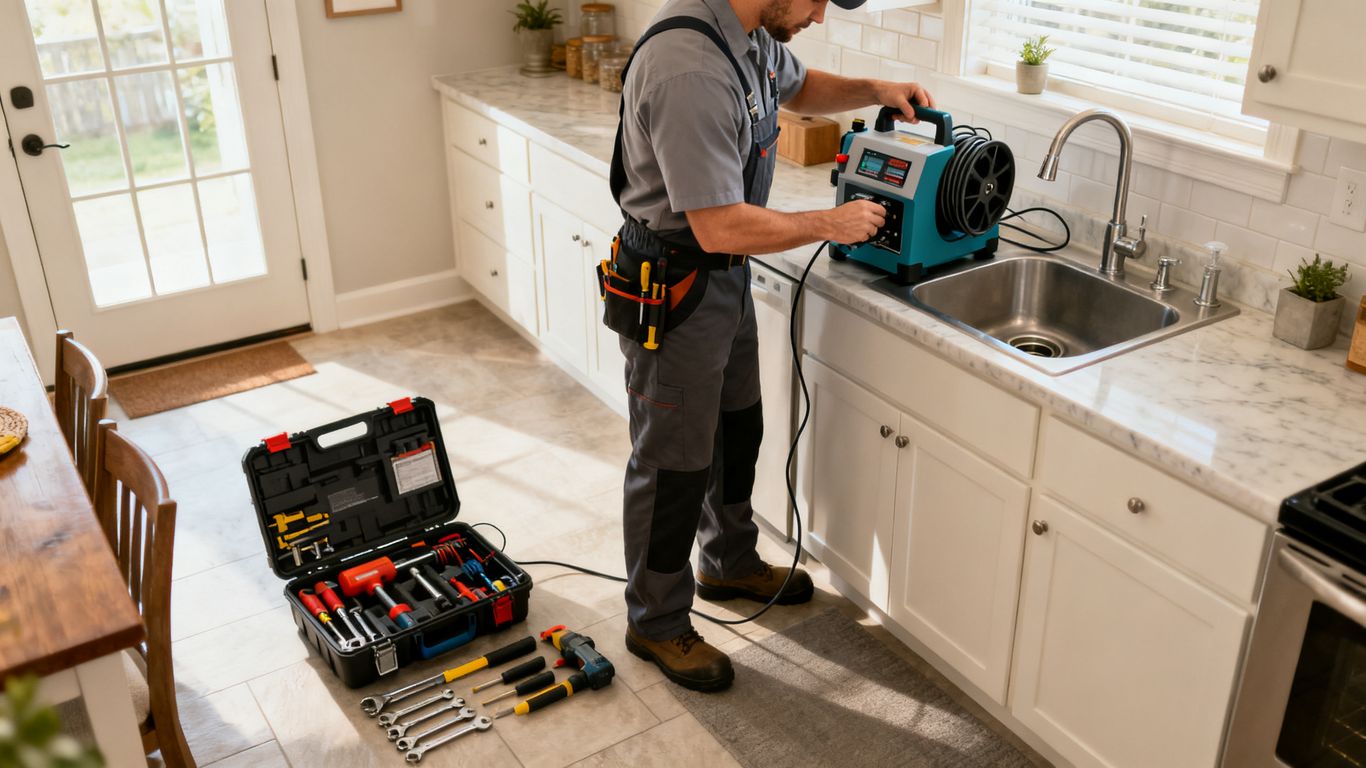
Use photographs or short video of a technician preparing equipment, working carefully, and leaving the space clean. Real working conditions generally build more confidence than overly polished stock scenes. Keep the visual centered on a recognizable household problem and a professional response.
If customer images or reviews are used, obtain permission and keep the wording accurate. The goal is to reduce uncertainty about who will arrive and what the visit will feel like.
Write primary text that filters out poor-fit inquiries
Say who qualifies, where the promotion applies, what the basic service covers, and what may cost extra. This may reduce total form volume, but it gives the office fewer conversations that begin with a dispute over the offer. A direct line such as “for accessible residential drains in selected service areas” can do useful work.
The copy should also make the next action obvious. Ask the homeowner to request an appointment, call during staffed hours, or submit the short form rather than offering several competing instructions.
Test short videos, before-and-after visuals, and static offer ads
Test one variable at a time when possible. A short technician video may build trust, while a before-and-after image may communicate the problem faster and a static price card may win on clarity. Keep the offer and qualification consistent while comparing creative formats.
Watch for comments that reveal confusion. Questions about service area, access, or what the price includes are useful creative feedback, not just community management tasks.
6. Turn clicks and leads into scheduled drain cleaning appointments
The ad earns attention, but the booking process earns revenue. A homeowner who has to hunt for the price, repeat details several times, or wait hours for a response will often move on. Treat the landing page, phone handling, texts, and scheduling calendar as one conversion path.
Match the landing page headline to the Facebook ad
Repeat the same offer language, price, service area, and basic qualification above the fold. If the ad promises a $99 drain cleaning special and the page opens with a general plumbing headline, the visitor has to work to confirm they are in the right place. Keep the first screen focused on the problem and the next action.
Support the headline with a short scope explanation, trust elements, service-area detail, and a visible booking option. Remove unrelated services that distract from the promotion.
Use a short booking form with service-specific qualification questions
Ask only for information that helps determine fit or schedule the visit. Name, phone, address, drain problem, preferred time, and whether the drain is accessible may be enough for an initial request. Long forms create friction before the company has earned the customer’s confidence.
Use the answers operationally. A qualification field that nobody reads or routes to dispatch is decoration, not useful conversion data.
Give prospects immediate options to call, text, or select a time
Different homeowners prefer different contact methods. Offer a call button when staff are available, a text option when that workflow is monitored, and a scheduling choice when appointment inventory is current. Every option needs an owner; an unattended channel only creates another version of a missed lead.
A scheduling link can reduce back-and-forth for straightforward requests. Keep available times synchronized with real capacity and reserve buffers for jobs that may run long.
Build a fast follow-up process for missed calls and new leads
Set a response standard that the office can meet, then track it. A new form should trigger an immediate acknowledgment, while a missed call should receive a prompt callback or text during operating hours. Continue with a small number of useful follow-ups rather than sending repetitive messages with no new information.
Review recordings and contact notes weekly. They reveal whether the problem is ad quality, slow response, unclear pricing, or a schedule that cannot accommodate the demand.
7. Optimize the plumbing company Facebook ads campaign for booked revenue
Optimization begins after the lead arrives. The account should connect ad data with the office’s records so the team can see which creative and neighborhoods produce completed work. This is where a campaign stops being judged by attractive dashboard numbers and starts being managed like a small operating system.
Review lead quality by ad, audience, placement, and neighborhood
Break performance down by the dimensions that affect dispatch: creative, audience type, placement, neighborhood, time of day, and response path. Look for repeated patterns in qualified rate, answer rate, booking rate, and cancellation rate. A placement with a low lead cost may still be weak if its contacts rarely become appointments.
Make changes deliberately. If one neighborhood converts well, expand carefully around it; if another produces out-of-area or low-fit requests, tighten the boundary or adjust the message.
Track calls answered, appointments set, jobs completed, and upsells
Create a simple funnel that the marketing and office teams both understand. Record answered calls, qualified conversations, scheduled appointments, completed jobs, initial revenue, and approved additional work. The source of truth should be the operational record, not a platform estimate alone.
The booked-job tracking guide is a useful reminder that social campaigns should be compared with the job types and intent they can realistically influence. Emergency demand may behave differently from a planned drain special.
Refresh creative when frequency rises or cost per booking increases
Creative fatigue often appears first as weaker click-through, repetitive comments, or rising cost per qualified conversation. Refresh the opening visual, first sentence, technician footage, or explanation of the offer while preserving the parts that still work. Do not change every campaign component at once.
Frequency is a clue, not an automatic reason to shut down. If repeat exposure continues to produce profitable bookings, it may be acceptable; if it produces irritation and lower-quality inquiries, change the message or audience.
Scale the offer without overwhelming dispatch capacity
Increase spend in measured steps and watch response time, booked-job cost, and technician utilization after each change. If the schedule is full, shift delivery windows, narrow the service area, or pause prospecting rather than allowing leads to wait. A campaign that creates more demand than the company can serve is not performing well.
The strongest plumbing company facebook ads drain cleaning campaign is one the business can answer, schedule, complete, and learn from. When marketing and operations share the same definitions, scaling becomes a controlled business decision instead of a guess.
Book More Drain Jobs
Make the next step easy for qualified homeowners by offering a clear way to request a time, then book a call to review how the campaign can fit your service capacity.
Conclusion
A $99 drain cleaning special works best as a tightly scoped offer supported by honest economics, local targeting, credible creative, fast follow-up, and reporting tied to completed jobs. Build the campaign around the schedule you can serve, then improve it using real booking and revenue data.
Frequently Asked Questions
Is a $99 drain cleaning offer profitable?
It can be, provided the service scope, travel area, labor time, and equipment requirements are controlled. Profit may also come from appropriate follow-up work, but the initial visit should have a defined cost ceiling.
What should the $99 drain cleaning special include?
It should identify the basic service, the number or type of drains covered, access requirements, service area, scheduling limits, and exclusions. Customers should know what may require a separate quote before they book.
Should plumbing companies use Facebook ads for emergency drain calls?
Social ads are generally better suited to planned or non-emergency demand than urgent searches. Emergency callers often need an immediate answer, so the campaign should not assume every social lead has the same intent.
How much should a plumbing company spend on the campaign?
Start with the number of additional appointments the team can actually serve and the allowable cost per booked job. Increase the budget only after response time, booking rate, and completed-job economics are stable.
Are lead forms or phone calls better for drain cleaning ads?
The better option depends on staffing and response speed. Calls can work well when someone answers promptly, while forms can capture interest when the office needs structured information or operates on a limited schedule.
What information should a drain cleaning ad disclose?
Include the price, basic scope, service area, access or equipment limitations, scheduling conditions, and a clear next step. Disclosure helps filter out inquiries that cannot become appropriate appointments.
How should campaign success be measured?
Track the path from lead to answered contact, scheduled appointment, completed visit, revenue, and any approved follow-up work. Cost per lead is useful for diagnosis, but completed-job profitability is the stronger business measure.