How to Analyze Your HVAC Competitors' Google Ads Strategy (Free Tools Included)

Key Takeaways
A useful competitor review shows you where demand, messaging, and conversion opportunities sit, not merely which companies appear above you.
- Search competitors across the services, locations, devices, and urgency levels that matter to your business.
- Separate what you can observe from what you are only inferring.
- Compare keyword themes, ad promises, offers, trust signals, and landing page experiences.
- Use competitor findings to create clearer campaigns rather than copying another advertiser.
- Judge the plan by qualified calls, booked appointments, and lead quality, not clicks alone.
1. Define what you want to learn from a competitor analysis
A good HVAC company competitor PPC analysis starts with a question, not a browser tab full of screenshots. You may want to learn which services competitors prioritize, how they position emergency work, or where their landing pages create unnecessary friction. Define the decision you hope to make before collecting evidence. Otherwise, the exercise turns into an interesting but unusable scrapbook.
Separate observable data from informed assumptions
Search results can show you an ad headline, a visible offer, a landing page, and sometimes a phone number. They cannot reliably show the competitor’s budget, conversion rate, keyword match types, or profit margin. Record visible facts separately from your interpretation so an assumption does not quietly become a campaign rule.
For example, “same-day service appears in the description” is observable. “This company must be winning because of its same-day offer” is an assumption. That distinction protects your budget when you turn research into tests.
Choose competitors that compete for the same HVAC jobs
The most visible advertiser is not always your closest commercial competitor. A large regional company may target replacement projects while your business wins repair calls, or a nearby provider may serve a different set of suburbs. Choose businesses that overlap with your services, service area, job value, and availability.
Include a small mix: companies you regularly lose calls to, businesses appearing repeatedly in paid results, and one or two specialists focused on a valuable service. This gives you a more useful comparison than simply copying the first listing you notice.
Set a geographic and device-specific scope
Search behavior changes by city, neighborhood, time of day, and device. A competitor that appears for “furnace repair” in one suburb may not show for the same search ten miles away. Decide which locations, search windows, and devices belong in the review, then keep them consistent.
If you operate in several markets, treat each market as its own observation set. Also record whether results came from a phone or desktop. Mobile users may see call-focused layouts, while desktop users have more room to compare several ads and landing pages.
Create a tracking sheet for consistent comparisons
A simple spreadsheet is enough. Give each observation a date, location, device, search term, advertiser, ad position or placement, visible message, landing page, and notes about the next action. Add a column for confidence so you know whether a conclusion comes from one search or a recurring pattern.
A compact comparison structure keeps the work practical:
| Area | What to record | Why it matters |
|---|---|---|
| Search context | Query, city, date, device | Makes results repeatable |
| Ad message | Headlines, offer, call to action | Reveals positioning choices |
| Destination | URL, service focus, conversion path | Shows message-to-page alignment |
| Competitive signal | Frequency, visibility, local proof | Helps prioritize further testing |
After several searches, look for repeated behavior rather than isolated wording. A message that appears across many relevant queries deserves attention; a single unusual headline may simply reflect an experiment or a temporary promotion.
2. Find HVAC competitors' Google Ads in the wild
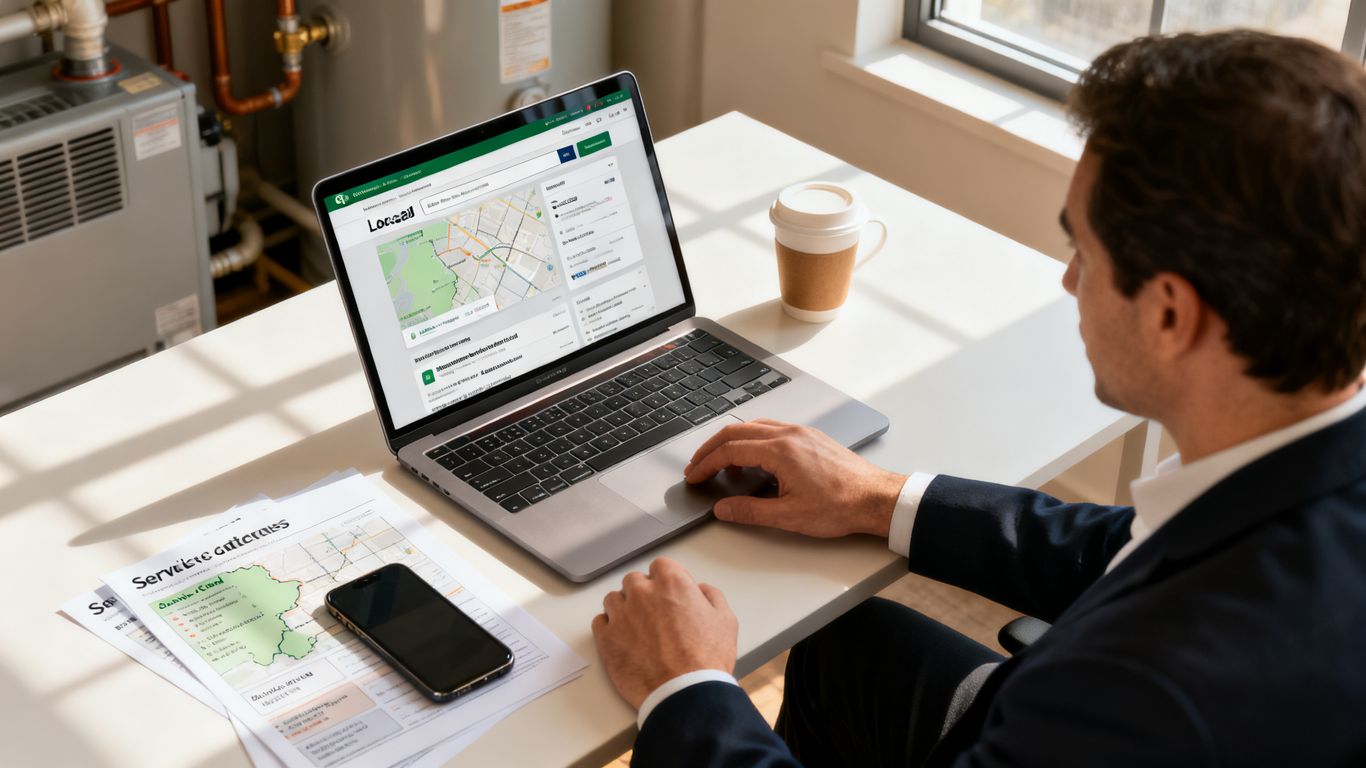
Competitor research is most useful when it resembles the searches your prospects actually make. Search from the target service area, use realistic wording, and record what appears without assuming every result is permanent. Paid visibility can vary with location, timing, audience signals, budget, and auction conditions.
Search high-intent HVAC terms in target service areas
Start with terms that indicate a homeowner may be ready to contact a company: repair, replacement, installation, emergency service, and “near me” variations. Add the city or suburb where appropriate, then repeat the process for heating and cooling services. The HVAC PPC guide is a useful reference for thinking about urgent searches and the setup choices that can affect wasted spend.
Do not limit the review to one generic term. “AC repair,” “air conditioner not cooling,” and “replace central air” can attract different advertisers because they represent different levels of urgency and purchase intent.
Use Google search features to identify paid placements
Paid placements are labeled, but the page can also contain local listings, map results, organic pages, and other search features. Record the complete page context rather than treating the first company you see as the only competitor. A business may appear organically, in a local result, and in a paid placement with different messages.
When using Google Ads, focus on what the searcher can actually see: the ad’s wording, assets, offer, and destination. Do not infer a competitor’s exact bid or account structure from placement alone.
Record ad visibility across emergency and planned-service searches
Emergency searches often produce a different competitive set from planned replacement or maintenance searches. Run both groups during the same research period and note whether the same advertisers appear. Also record whether an ad emphasizes immediate response, a scheduled estimate, financing, maintenance, or equipment expertise.
A useful observation is not simply “Company A showed.” It is “Company A showed repeatedly for emergency repair, but not for replacement searches.” That difference can point to campaign specialization, budget allocation, or a service focus worth investigating.
Check competitors on desktop and mobile results
Use both devices when possible, ideally with a clean search session and a consistent location. On mobile, note click-to-call options, phone prominence, and how quickly the page communicates the next step. On desktop, examine the full headline and description structure, additional assets, and how much competing information appears above the fold.
Do not treat one device as the master version. Your own campaigns should reflect how prospects actually contact you, especially when a broken system creates a need for immediate action.
3. Use free tools to uncover competitor PPC insights
Free tools will not reveal a competitor’s entire account, and they should not be treated as a substitute for first-party conversion data. They can still help you build a reasonable picture of demand, wording, seasonality, and visible market activity. Use them to form hypotheses, then validate those hypotheses with your own campaign results.
Analyze ad copy with Google search and Google Ads Transparency Center
Search manually to capture the language that appears in your market, then compare it with historical or publicly available advertiser information in the Google Ads Transparency Center. Look for recurring themes rather than assuming every archived or visible variation is active in your location today.
Collect the exact headline ideas, service terms, calls to action, and offers you see. Then ask whether the language matches the query and whether the destination page keeps the promise. That relationship is usually more actionable than a list of competitor slogans.
Review keyword themes with Google Keyword Planner
Google Keyword Planner can help organize the language people use around repairs, installation, maintenance, equipment, and locations. Use broad themes to discover possible demand, but do not copy every suggested term into a campaign. A keyword idea still needs to fit your service area, economics, and ability to answer the call.
Group related phrases by intent and compare them with the searches where competitors appeared. This creates a working map of coverage without pretending that a planning estimate equals actual booked-job volume.
Compare search demand and seasonality in Google Trends
Google Trends can help you compare relative interest in topics over time and across locations. Review heating and cooling terms separately, and watch for seasonal movement that may affect when competitors become more visible. The result is directional, not a forecast of your exact lead count.
Use those patterns to plan observation windows and creative tests. If demand shifts between cooling and heating, your campaign structure and landing page priorities should be ready to shift too.
Estimate traffic and rankings with free versions of third-party tools
Free versions of SEO and competitive research tools can provide rough estimates of visible keywords, organic rankings, or traffic sources. Treat those figures as directional because the tools model data and may miss local variation, paid activity, or low-volume searches. Their best use is finding questions for deeper research.
For example, an estimated ranking may prompt you to inspect a service page, but it should not convince you that the page generates profitable calls. Paid search decisions still need evidence from your own account.
Capture landing page details with browser tools and spreadsheets
Open each relevant destination in a private window and record the page title, primary service, headline, phone number, form fields, booking options, trust signals, and location references. Browser tools can help you inspect mobile rendering and load behavior, while a spreadsheet keeps comparisons consistent.
A short screen recording can also preserve the experience as you saw it. This is especially useful when a page changes before the team discusses the finding. The campaign audit perspective can help you think about conversion tracking, wasted spend, and message gaps without treating a competitor’s visible page as proof of performance.
4. Analyze competitors' keyword and service targeting
The goal is not to reconstruct another advertiser’s account line by line. It is to understand which customer problems receive attention and where your own coverage may be thin. Organize observations by service and intent first; only then decide whether a separate campaign, ad group, landing page, or negative keyword is justified.
Group keywords by HVAC service and customer intent
Separate emergency repair, standard repair, replacement, installation, maintenance, indoor air quality, and equipment-specific searches. Within each service, distinguish people asking for help now from people researching options. The same word can carry different intent depending on modifiers such as “cost,” “near me,” “installer,” or “open now.”
This grouping makes performance easier to read later. If repair and replacement terms share one budget and landing page, a strong result in one category can conceal weak relevance in the other.
Identify emergency, repair, replacement, and maintenance campaigns
Look for clues that competitors treat these services differently. Emergency messaging may emphasize availability and phone contact, while replacement messaging may focus on estimates, equipment, efficiency, or financing. Maintenance searches may call for plans, tune-ups, or seasonal reminders.
Do not assume a visible difference proves separate campaigns. It does, however, give you a useful testing hypothesis. Build around the customer’s problem and expected next step instead of forcing every HVAC search into one general campaign.
Look for local modifiers, brand terms, and problem-based searches
Record city names, neighborhoods, “near me” language, manufacturer terms, and problem descriptions. Problem-based searches often reveal how homeowners describe symptoms rather than services. Those phrases can inform ad language and landing page copy when they accurately match what your technicians handle.
Brand terms require special care. A competitor’s name may attract navigational searches that do not belong in your acquisition campaign, while your own brand terms may deserve separate reporting. Keep these categories distinct so the account does not blur new demand with existing awareness.
Infer negative keyword opportunities from irrelevant results
Competitor research can expose searches that look related but are poor fits, such as employment queries, training, parts, manuals, do-it-yourself instructions, or equipment-only shopping. Add candidates to a review list rather than blocking them immediately. Confirm that they are genuinely irrelevant to your services and customers first.
A practical review sequence is:
- Save the exact query or phrase.
- Identify whether it produced a click, call, or form.
- Check whether the business can profitably serve that intent.
- Add a negative keyword only when the pattern is clear.
This keeps negative keyword work tied to evidence instead of personal preference. It also reduces the chance of excluding a valuable homeowner search merely because the wording looks unusual.
Compare coverage for high-value equipment and job types
Map which competitors address high-value work such as full replacements, commercial service, heat pumps, or specialized systems: only where those jobs fit your business. Compare the page and offer, not just the keyword. A competitor may mention a system type in an ad but send every visitor to a generic homepage.
The gap may be a missing service, a weak page, or simply a different business model. Your response should be based on margin, technician capacity, and close rate, not on the appeal of owning every possible query.
5. Deconstruct HVAC competitors' ad messaging
Ad copy is a compact record of what an advertiser believes will earn attention from a particular search. It is also easy to overvalue because polished language can look persuasive before it produces a qualified lead. Compare messages against intent, proof, and the next step a homeowner is expected to take.
Compare headlines, descriptions, and calls to action
Record the main service term, location reference, benefit, differentiator, and call to action separately. Then check whether the parts work together. “AC repair” paired with “request an estimate” may be reasonable for one audience but confusing for someone whose system stopped working that afternoon.
Look for repeated structures across competitors. You may find that many advertisers use the same service-first headline, leaving room for a clearer explanation of availability, process, or qualification without copying their wording.
Identify offers such as discounts, financing, and same-day service
Offers deserve a closer review because they can change both click behavior and lead quality. Note whether a discount has conditions, whether financing is explained on the landing page, and whether same-day language is limited by staffing or geography. An offer that cannot be fulfilled consistently can create poor calls even when it improves click-through rate.
Test only promises your operation can support. If competitors advertise a price or promotion, treat it as a market signal, not an instruction to match it.
Evaluate trust signals including certifications, guarantees, and reviews
Record the trust elements that appear in ads and on the destination page: ratings, review counts, certifications, warranties, guarantees, years in business, and technician credentials. Then check how specific and verifiable each signal is. Generic claims are less useful than proof connected to the service and market.
Your goal is not to pile on badges. It is to answer the prospect’s concern at the right moment, especially when the job is expensive or the customer is inviting a technician into the home.
Check how competitors use location and availability messaging
Location language can be as important as the service itself. Note whether ads name a city, a broader region, a service radius, or a response window. Compare that claim with the landing page and the actual areas the business serves.
Availability messaging should be equally concrete. “Open now,” “24/7,” and “same-day” carry different operational expectations. If your business has a more precise and credible scheduling promise, that may be more persuasive than a louder claim.
Spot gaps your ads can own without copying competitors
A gap might be an unclear next step, a missing service-area reference, a weak explanation of the process, or no answer to a common objection. It does not need to be a clever slogan. Often, the strongest opportunity is simply making the ad and page feel more relevant to the exact search.
Write down the gap, the evidence supporting it, and the test you would run. That discipline turns competitor review into original positioning rather than imitation.
6. Audit the landing pages behind competitor ads
The ad earns the visit, but the landing page influences whether the visitor calls, submits a form, or leaves. Review the experience as a homeowner would, starting from the exact search and ad promise. A page can look professional and still make the next action surprisingly difficult.
Match each ad promise to the landing page experience
Compare the service named in the ad with the headline, opening content, imagery, and call to action on the page. If an ad promises emergency furnace repair but lands on a general services page, the visitor has to do extra work before deciding what to do. That mismatch is worth documenting even if the page contains the right information somewhere below.
Review the page at the same device size used for the search. The first screen should make the service, location, and next step understandable without requiring a long investigation.
Evaluate phone calls, forms, booking flows, and conversion friction
Count how many steps a visitor needs to contact the company. Check whether the phone number is easy to tap, whether forms ask for only useful information, and whether a booking flow explains what happens next. Friction is not always a long form; vague confirmation messages and hidden availability can be just as discouraging.
Your own audit should distinguish between a click and a meaningful conversion. A phone click may not become a conversation, and a form submission may not become a serviceable job. Those differences matter when comparing landing page tactics.
Review local proof, service-area coverage, and technician credibility
Look for city-specific information, recognizable neighborhoods, service-area details, reviews from the market, and evidence that technicians handle the requested work. Local proof should support the decision rather than make the page feel stuffed with place names.
Also check whether the page explains qualifications in a believable way. A customer deciding between several providers wants to know who will arrive, what they can solve, and what the next step will cost or involve.
Check page speed, mobile usability, and tracking signals
Test the page on a phone and a normal connection. Note delayed content, intrusive pop-ups, small buttons, broken forms, and phone numbers that are difficult to tap. You can also inspect whether conversion actions appear to be tracked, while remembering that third-party observation cannot confirm the accuracy of another company’s setup.
Apply the same standard to your pages. A fast, usable page is helpful, but it does not rescue an unclear offer or a poorly matched search term.
Distinguish effective conversion tactics from compliance risks
Some tactics may increase attention while creating legal, platform, or customer-trust concerns. Be cautious with unsupported guarantees, misleading urgency, unclear financing terms, fake scarcity, or review language that cannot be substantiated. Competitor usage is not evidence that a tactic is safe.
Keep a separate note for ideas that are effective-looking but risky. The best competitor analysis improves your judgment as much as it improves your copy.
7. Turn competitor findings into a stronger Google Ads plan
Research only earns its keep when it changes what you do next. Convert observations into a short list of campaign decisions, tests, and measurement requirements. Resist the urge to rebuild everything at once; a focused plan makes it easier to see which insight actually mattered.
Prioritize opportunities by intent, economics, and competitive pressure
Rank opportunities by the urgency of the search, expected job value, service capacity, and evidence of competitive activity. A crowded emergency term may still be worthwhile if the calls are valuable, while a less competitive term may be a poor choice if it rarely produces jobs. Use your own close-rate and revenue data whenever available.
A useful PPC planning guide can provide background on campaign structure and auction factors, but your decisions should reflect your market and economics rather than a generic benchmark.
Build an HVAC campaign structure around services and locations
Separate services when intent, offer, landing page, or economics differ materially. Use locations where the message, budget, or service availability genuinely changes. Keep the structure understandable enough that you can identify which service and market are producing qualified opportunities.
Avoid creating dozens of thin segments simply because a competitor appears to do so. Start with a structure your team can monitor, answer, and improve.
Create testing angles for offers, messaging, and landing pages
Turn each competitor observation into a controlled test. You might compare a direct repair message with a process-oriented message, or test a clear scheduling promise against a general consultation call to action. Keep the service and audience stable when possible so the result teaches you something.
Change one meaningful variable at a time, give the test enough qualified traffic, and judge it by downstream outcomes. A higher click-through rate is useful only if the additional visitors are worth handling.
Set conversion values for calls, forms, and booked appointments
Assign different values to actions based on their likelihood of becoming revenue. A booked appointment generally tells you more than a page view, while a short call may need qualification before it receives full value. Use historical close rates and average job economics rather than arbitrary numbers.
The goal is not perfect attribution. It is a measurement system that helps bidding and budget decisions favor useful opportunities instead of cheap but unqualified activity.
Monitor impression share, cost per lead, and lead quality over time
Track visibility alongside economics. Impression share can show whether you are missing eligible searches, while cost per lead shows acquisition efficiency and lead quality reveals whether the campaign is attracting work you can actually sell and fulfill. Review these measures by service and location, not only at account level.
Use a regular cadence for search-term reviews, call-quality checks, landing page audits, and competitor observations. Market conditions change, but a consistent process helps you distinguish a real shift from a noisy week.
Plan Your Next Step
Once your findings are organized, a scheduled conversation can help turn the highest-priority opportunities into an actionable marketing plan. Book a consultation when you are ready to discuss the next move.
Conclusion
A strong HVAC competitor review is less about discovering a secret tactic and more about building a clearer view of intent, message, experience, and economics. Search the market consistently, separate evidence from assumptions, and use the findings to test a campaign your team can measure and fulfill.
Frequently Asked Questions
What is an HVAC company competitor PPC analysis?
It is a structured review of competing paid search visibility, keyword themes, ad messaging, offers, landing pages, and apparent service targeting within a defined market.
Can I see a competitor’s exact Google Ads budget?
Usually not. Public observations can show visible ads and destinations, but they do not reliably reveal another advertiser’s budget, bids, conversion rate, or profitability.
How many competitors should an HVAC company review?
Start with roughly five to ten relevant businesses, including direct local competitors and specialists that compete for valuable services. Expand the list only when it adds a distinct market or service perspective.
Should emergency HVAC searches be analyzed separately?
Yes. Emergency searches often carry different urgency, messaging, calls to action, and staffing expectations than planned maintenance or replacement searches.
Which free tools are useful for competitor research?
Manual search, public ad transparency resources, keyword planning tools, trend tools, browser testing, and spreadsheets can all help form useful hypotheses when their limitations are understood.
How often should HVAC competitors be checked?
A monthly review is a reasonable starting point, with additional checks during heating and cooling demand shifts or before launching a major offer. Keep the location, device, and query set consistent.
What should I measure after applying competitor insights?
Measure qualified calls, forms, booked appointments, cost per qualified lead, close rate, revenue, and lead quality by service and location. Clicks and impressions are useful context but should not be the final scorecard.