Marketing Marble Countertops: Attracting the High-End Buyer Without Sounding Pretentious
Key Takeaways
Luxury countertop marketing works best when it gives buyers a clear reason to care, then makes the next step feel easy. The strongest campaigns connect design appeal with practical guidance and measurable sales outcomes.
- Position marble around craftsmanship, choice, and fit rather than status alone.
- Separate early design research from searches that signal immediate buying intent.
- Use visual content to answer questions about veining, fabrication, and maintenance.
- Build campaigns and landing pages around consultations, not just traffic.
- Judge performance by qualified projects, revenue, and profit instead of lead volume alone.
Define a luxury position buyers can believe
A luxury position is not created by adding words such as “exclusive” or “bespoke” to every headline. It comes from explaining what the buyer receives, why the work requires care, and how the finished countertop will function in the home. For a marble countertop luxury marketing strategy, the promise should feel specific enough to believe and attractive enough to remember.
Translate craftsmanship into customer outcomes
Most homeowners do not buy fabrication skill as an abstract concept. They buy a slab that suits the room, edges that feel intentional, seams that are thoughtfully placed, and an installation that fits the renovation schedule. Describe the decisions behind the work in terms of those outcomes: clearer selection, a more cohesive design, fewer surprises, and a surface that feels made for the space.
A useful project gallery can explain how a team reviewed movement in the stone, planned the layout, and selected the finish. A guide to marble fabrication can also help prospective buyers understand why cutting, finishing, and installation deserve attention before they request an estimate. Specific proof builds confidence more effectively than grand claims about artistry.
Differentiate natural marble from quartz and porcelain
Buyers comparing materials need a fair explanation of tradeoffs. Natural marble offers variation, depth, and a pattern that cannot be selected from a repeating print, while engineered surfaces may appeal to people prioritizing a more uniform appearance or a different maintenance routine. The point is not to dismiss other choices; it is to show which priorities marble serves well.
Use side-by-side content carefully. Discuss appearance, feel, care, finish options, and how each material works with the intended room. A thoughtful material comparison guide can give sales teams a useful framework for conversations without forcing every visitor into the same decision.
Use exclusivity without relying on vague prestige language
Exclusivity becomes credible when it refers to something concrete: a limited slab selection, a particular edge detail, a carefully coordinated bookmatch, or a consultation focused on the homeowner’s plans. Avoid suggesting that a buyer must want marble to have good taste. That tone creates distance and can make a premium service feel insecure.
Instead, let the customer see what is distinct about the project. Show how a particular pattern works with cabinetry, lighting, hardware, and room proportions. The result feels special because the reasoning is visible, not because the copy tells the reader to feel special.
Support premium pricing with proof, not hype
Premium pricing needs a trail of evidence. Include clear photographs, process details, service-area information, realistic expectations, and answers to common care questions. Testimonials can help when they describe the experience honestly, but they should not substitute for project evidence or imply a guaranteed result.
A page about marble and home value can attract buyers thinking about resale, provided the language stays measured. Avoid promising a specific return. A stronger claim is that the material may influence perception and design appeal, while the final value depends on the property, renovation, and local market.
Build audiences around renovation intent and buying power
Audience strategy should begin with the renovation decision, not a broad label such as “wealthy homeowner.” People with very different budgets can search for the same stone, while a high-income user may only be gathering ideas. Treat intent as a sequence that changes from inspiration to evaluation to consultation.
The goal is to spend more attention on signals that predict a real project: service-area relevance, an active kitchen or bath renovation, a request for slab guidance, or a willingness to discuss timing. Demographic targeting can support that work, but it should not replace evidence from behavior.

Identify high-value customer segments
Start with project types that fit the company’s capabilities and economics. Full kitchen renovations, primary bathroom upgrades, custom islands, and design-led remodels may require different creative, landing pages, and sales questions. Build segments around the job rather than assuming that every marble inquiry has the same value.
Review historical estimates and closed projects to find patterns in geography, property type, scope, and timeline. If the data is thin, begin with practical hypotheses and revise them as qualified conversations accumulate. A small, accurate audience is more useful than a large audience defined by vague affluence.
Separate inspiration searches from ready-to-buy searches
Search language often reveals where someone is in the process. Queries about colors, kitchens, and inspiration suggest exploration; queries involving fabrication, installation, estimates, or a nearby service area usually deserve a faster response. Both groups matter, but they should not receive identical budgets or landing-page experiences.
Create different content paths for each stage. Inspiration visitors can see completed rooms and material education, while ready-to-buy visitors should find availability, consultation details, project requirements, and a direct contact option. This distinction keeps early research useful without allowing it to consume the entire acquisition budget.
Use first-party data to create remarketing audiences
A visitor who views several project pages, returns to a material guide, or starts a consultation form has given the business more useful information than a generic interest category. With appropriate consent and privacy practices, organize audiences around meaningful actions and reasonable time windows.
Exclude people who have already booked when the campaign is designed to generate first consultations, and create a separate audience for prospects who submitted incomplete information. The message can then reflect the next decision: choosing a slab, confirming scope, or arranging a design conversation. Remarketing should feel like helpful continuity, not repeated pressure.
Reach affluent homeowners without making assumptions about wealth
Affluence is not a creative style. Some buyers want a dramatic focal point; others want quiet veining and a restrained finish. Some are renovating a long-held family home, while others are coordinating a larger design project. Let the imagery and questions reveal preferences instead of using elitist language or narrow stereotypes.
Use location, renovation behavior, project scope, and response quality as stronger signals than luxury-coded interests alone. The best audience model is one that learns from actual consultations and revenue, then becomes more precise over time.
Create marble marketing that feels aspirational and useful
Marble is naturally visual, but beautiful photography does not answer every objection. The creative should make the room desirable while also helping someone decide whether the material, finish, and care routine fit their life. That combination gives the sales team a warmer prospect and gives the buyer a more honest starting point.
Show the stone in real homes and design contexts
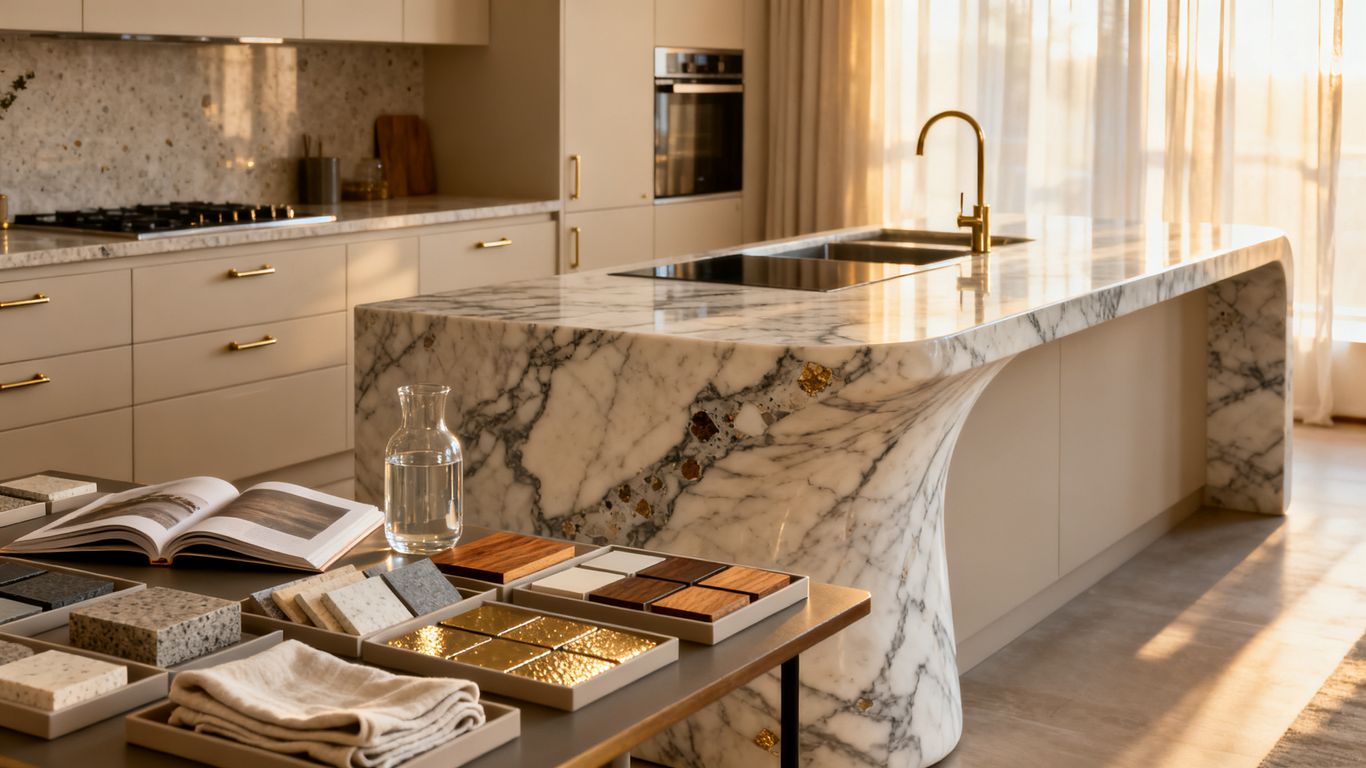
A slab photographed in isolation can look impressive and still leave the buyer unsure how it will work at home. Show islands, backsplashes, bathrooms, lighting conditions, cabinetry, and nearby materials. Include enough of the room to communicate scale and enough detail to preserve the stone’s character.
Organize galleries by room, style, or project challenge. A client considering a waterfall island may respond to different evidence than someone planning a compact bathroom vanity. Context makes inspiration more actionable.
Use close-up creative to highlight veining, finish, and fabrication
Close-ups should show movement, edge profiles, junctions, and surface finish without excessive retouching. A slow pan across a slab can help viewers notice variation, while detail shots can explain how the pattern was carried across an island or aligned at a seam.
Pair each image with a short caption that answers a question. Explain whether the finish is polished or honed, why the layout was selected, or how the detail relates to the surrounding design. The creative then serves both the emotional and practical parts of the decision.
Address maintenance concerns honestly
Maintenance anxiety is one of the most common barriers to a marble inquiry. Explain that natural stone requires informed care and that finishes may affect how marks appear. Do not hide the possibility of etching or imply that sealing eliminates every risk.
A useful page can outline daily habits, suitable cleaning questions, and the difference between expected character and damage. Honest education may reduce some clicks, but it improves the quality of the people who remain interested. Buyers who understand the tradeoff are more likely to appreciate the material after installation.
Develop video concepts for Meta, TikTok, and YouTube placements
Short video should have a clear job rather than simply adding motion to a gallery. A fabricator can show slab selection, a designer can explain how veining affects layout, and an installer can walk through the final inspection. Keep the opening visual strong, then move quickly to one useful idea.
For Meta Ads, TikTok Ads, and YouTube placements, adapt the edit to the audience’s attention pattern and the platform’s format. Test room tours, close-up detail, process clips, and maintenance answers separately so the reporting reveals which idea generated interest. End with a consultation invitation that matches the video’s topic.
Avoid clichés that make luxury messaging feel pretentious
Words such as “opulent,” “elite,” and “unparalleled” often say less than a plain description of the stone and service. They can also make a homeowner feel that the company is speaking at them. Calm, precise language usually feels more expensive because it suggests control.
Describe the visual effect, the design decision, and the next step. “Review veining with a designer before fabrication” is clearer than “enter a world of timeless luxury.” The former gives the reader something useful to do.
Structure paid campaigns for high-intent countertop leads
Paid campaigns work harder when the account reflects the buyer’s decision path. Separate searches for a material from searches for fabrication or installation, then connect each group to a page that answers the corresponding question. Tracking must reach beyond the form submission so the account learns which inquiries become worthwhile projects.
Organize Google Ads around product, service, and location intent
Use distinct campaign or ad-group structures for marble countertops, fabrication and installation, and location-modified searches. Keep keyword themes tight enough that the ad and landing page can speak directly to the query. Add negative keywords based on actual search-term data, especially when low-intent research begins consuming spend.
Match the call to action to intent. Someone searching for local installation may be ready to call, while someone researching finishes may need a guide before requesting a consultation. Both can be valuable, but they should be measured against different expectations.
Combine Search with Performance Max and Local Services Ads
Search is useful for capturing explicit demand, while Performance Max can extend reach across eligible Google inventory when the account has suitable conversion signals and creative assets. Local Services Ads can provide another route for local service inquiries where the business and category qualify. Treat these as distinct sources of leads, not one blended bucket.
Set clear rules for lead handling and attribution before expanding coverage. If a channel produces volume but few qualified conversations, the answer may be better exclusions, stronger qualification, or a different budget, not automatic scale.
Use Meta campaigns to turn design inspiration into consultations
Meta Ads can introduce a project to people who are not yet searching for a countertop provider. Use room photography, short videos, and educational carousels to create interest, then retarget engaged visitors with a more specific consultation offer. The transition should feel natural: inspiration first, guidance second, contact third.
Keep prospecting and remarketing creative separate. A cold audience may need a strong visual and a simple promise of design help, while a returning visitor may respond to slab-selection details, project examples, or an invitation to discuss scope.
Apply geographic and budget controls in high-value service areas
Service-area campaigns should reflect actual installation capacity, travel time, and project economics. Break out priority areas when differences in demand or close rate justify separate budgets. Do not assume that a larger radius is better; distant leads can be expensive to qualify and difficult to serve.
Review location reports alongside booked consultations and revenue. A neighborhood that produces fewer leads may still deserve more budget if those inquiries consistently become larger, healthier projects.
Write ad copy that qualifies buyers before the click
Ad copy can set expectations about custom work, consultation, service area, and project scope without sounding defensive. Mention the type of guidance available and make the next step clear. A useful qualifier might invite people planning a kitchen or bath renovation to discuss material and timing.
Before expanding headlines, check whether the message filters the right audience. Strong copy does not merely raise click-through rate; it helps reduce mismatched inquiries and gives the sales team a more informed opening conversation.
- Name the project type the service is built for.
- Describe the consultation or selection help available.
- State the service area plainly.
- Avoid unsupported price promises or guaranteed outcomes.
These constraints keep the ad persuasive without turning it into a discount message. They also make landing-page alignment easier, because the visitor arrives with a more accurate expectation.
Turn the website into a premium consultation experience
A premium website should feel like the first stage of the design process, not a digital brochure with a contact box at the bottom. It needs to answer visual, practical, and logistical questions in a sensible order. Every page should help the visitor decide whether to continue and what information to bring to the conversation.
Build landing pages around stone selection and design guidance
Create pages for the decisions buyers actually face: choosing marble, comparing finishes, planning an island, or arranging fabrication and installation. Keep the page focused on one intent, with photographs, useful explanations, service-area context, and a clear consultation path.
Avoid sending every ad to the homepage. A visitor who searched for fabrication should not have to hunt through a general navigation menu to understand what happens next. Relevance improves both user experience and paid-media efficiency.
Use project galleries as conversion assets
A gallery should do more than display attractive rooms. Add brief project context, such as the room type, design challenge, finish, or fabrication detail. When possible, show several views so the visitor can judge scale and consistency.
Place contact options near relevant projects rather than reserving them for one final button. Someone inspired by a particular island may be ready to ask a question at that moment. The invitation can be low pressure: discuss a similar layout, review available options, or plan an initial consultation.
Make forms capture budget, timeline, location, and project scope
A short form is not automatically a better form. For high-consideration work, a few well-chosen questions can help the team respond intelligently and identify whether the project fits the service area and schedule. Ask only for information that will change the next step.
Budget should be framed respectfully, perhaps through ranges or a request for an expected investment level. Include project type, location, timing, and whether the visitor has plans, measurements, or a selected slab. The form should feel like preparation for a useful conversation rather than an interrogation.
Add trust signals that reduce perceived purchase risk
Trust is built from details: an understandable process, accurate service information, real project images, clear expectations, and accessible contact options. Explain what happens after submission and how soon someone will respond. If credentials, warranties, or policies apply, present them precisely rather than burying them in broad claims.
A marble kitchen design guide can provide helpful context while reinforcing the visual and material expertise behind the service. Educational content works best when it answers a real concern and leads naturally to the next consultation step.
Optimize mobile pages for calls and consultation requests
Many local service visitors will first see the site on a phone, often after a quick search or social click. Make the phone number easy to use, keep forms comfortable to complete, and place key project information above unnecessary decorative elements. Compress images without making the stone look flat or inaccurate.
Test the experience on several devices and review recordings or analytics for friction. If visitors repeatedly open the gallery but never reach the contact area, the page may need a more visible bridge between inspiration and action.
Qualify and follow up with high-end countertop prospects
The first response can shape the buyer’s impression as much as the advertisement. A premium prospect may not be ready to choose a slab, but they should quickly understand that the business can guide the process. Sales and marketing need a shared definition of quality so the campaign is optimized for useful opportunities rather than easy-to-count submissions.
Define a qualified marble lead for the sales team
Agree on basic criteria before judging channels: service-area fit, relevant project type, reasonable timing, decision-maker involvement, and enough scope to assess the opportunity. Budget can be part of the conversation without becoming the only filter. A lead who needs education may still be valuable if the timeline and project fit are strong.
Write the definition into the CRM and review it with the people answering calls. Consistent labeling makes later reporting far more reliable and reveals where the form or ad copy is creating confusion.
Use call tracking and CRM stages to measure lead quality
Track calls, forms, booked consultations, estimates, closed projects, and revenue as separate stages. Recording the source and campaign at the first interaction helps connect marketing spend with downstream outcomes. The exact stage names matter less than consistent use.
A simple reporting view can make the difference between lead volume and commercial value clear:
| Stage | What to record | Why it matters |
|---|---|---|
| Inquiry | Source, service area, project type | Shows initial demand and fit |
| Consultation | Date, attendance, scope | Measures meaningful sales engagement |
| Estimate | Value, material, timeline | Indicates commercial potential |
| Closed project | Revenue, margin, source | Connects marketing to business results |
Review the table with the sales team, not just the marketing team. If many inquiries stall before consultation, improve qualification or follow-up; if consultations become estimates but not sales, examine pricing, process, and offer clarity.
Create follow-up sequences for undecided design buyers
A homeowner may need time to compare finishes, coordinate a contractor, or bring a partner into the decision. Follow-up should give them a reason to re-engage rather than repeat the same “just checking in” message. Send relevant project examples, answers to care questions, or a simple invitation to revisit the design.
Keep the sequence human and time-aware. A quick response after an inquiry, a helpful note after the initial conversation, and a later check-in around the stated timeline are usually more appropriate than daily pressure. Record preferences so the next message feels connected to the previous discussion.
Handle price shoppers without discounting the brand
Price questions are not always a rejection. They may indicate that the buyer is trying to understand scope, material differences, or what the estimate includes. Respond with clarity about the process and the factors that influence cost, such as slab selection, fabrication details, edge work, installation conditions, and project size.
If the project is not a fit, be courteous and direct. Protecting the brand does not require dismissing the person. It requires explaining value honestly and avoiding a race to the lowest number.
Measure the marble countertop luxury marketing strategy
Measurement should follow the economics of the project. Clicks and form fills are useful diagnostic signals, but they do not tell an owner whether paid marketing is producing profitable work. The reporting model should connect channel, inquiry quality, consultation activity, estimates, closed revenue, and margin where possible.
Track consultations, estimates, close rates, and revenue by channel
Set primary conversion actions around meaningful milestones, then keep softer actions, gallery views, guide downloads, and partial form starts, as secondary signals. Import offline outcomes when the sales cycle allows it. This gives campaign decisions a better view of what happens after the lead leaves the website.
Look for lag between inquiry and close. A marble renovation may take weeks or months to decide, so judging a channel only on the first few days can favor low-quality volume over durable demand.
Compare lead quality across Google Ads, Meta Ads, and organic search
Each channel may play a different role. Search often captures active demand, social can create or develop interest, and organic content may support research over a longer period. Compare them using qualified consultations, estimate rates, close rates, revenue, and cost, not one headline metric.
Be careful with last-click conclusions. A social interaction or educational page may assist a later branded or direct inquiry. Use consistent source data and, when volume permits, compare assisted behavior alongside the final recorded source.
Use conversion data to refine bidding and audience targeting
Once enough reliable outcomes exist, feed qualified stages back into campaign decisions. Separate a completed form from a booked consultation, and avoid teaching an automated system that every low-intent submission is equally valuable. Data quality comes before aggressive optimization.
Refine location, queries, creative, and audience exclusions based on observed project fit. Small changes are easier to evaluate when the account has stable definitions and clean tracking.
Test creative angles without weakening premium positioning
Test one meaningful idea at a time: close-up stone detail, room transformation, fabrication expertise, maintenance education, or consultation guidance. Keep the visual standard consistent while changing the message or opening frame. A winning ad should produce better business outcomes, not merely cheaper attention.
Use comments and sales feedback as qualitative evidence. If a creative generates questions about care or timing, turn those questions into the next useful asset rather than hiding the concern.
Scale the campaigns that produce profitable projects
Scale gradually when qualified volume, sales capacity, and close rates support it. Increase budgets where the business can handle additional consultations and where revenue remains healthy after fulfillment costs. A campaign that produces fewer but better projects may be the right growth engine.
For home service owners, the final decision is operational as well as promotional. Marketing can create demand, but profitability depends on answering promptly, estimating accurately, and delivering the level of craftsmanship the promise sets.
Book a Better Consultation
If your countertop business needs a clearer path from qualified searchers to design conversations, schedule a marketing consultation to review campaigns, landing pages, tracking, and follow-up together. The right plan should fit your service area, sales process, and capacity.
Conclusion
A credible luxury countertop strategy makes marble desirable without pretending it is effortless or suitable for everyone. When material education, precise audience signals, useful creative, focused landing pages, and revenue-based measurement work together, premium positioning feels less like posturing and more like good guidance.
Frequently Asked Questions
What makes marble countertop marketing feel luxurious?
It combines strong visual presentation with specific information about material choice, fabrication, installation, and care. Buyers should feel guided rather than pressured.
Should a countertop company target only affluent homeowners?
No. Use project scope, location, renovation intent, and engagement behavior alongside any demographic signals. Income assumptions alone are too blunt to predict fit.
What content helps sell marble countertops?
Project galleries, slab close-ups, finish explanations, room tours, fabrication details, and honest maintenance guidance can all support the decision. The best mix answers both emotional and practical questions.
How can a business separate serious leads from casual inquiries?
Capture project type, location, timeline, scope, and an appropriate budget indication. Then track whether the inquiry becomes a consultation, estimate, and closed project.
Is paid search or social media better for marble leads?
Neither is universally better. Search can capture active demand, while social media can create interest and support remarketing. Compare channels by qualified opportunities and revenue.
How much should a luxury countertop ad say about price?
It should set realistic expectations without reducing the service to a low-price comparison. Explain the factors that shape an estimate and invite a conversation about project scope.
How long should a countertop prospect be followed up with?
Follow up according to the buyer’s stated timeline and decision stage. A helpful initial response, relevant education, and a considerate later check-in are usually more effective than persistent generic reminders.