Marketing to Interior Designers as a Stone Fabricator: The Partnership Funnel

Key Takeaways
A productive designer partnership gives interior designers practical help, not just a trade discount. The strongest funnel connects useful material guidance with visible project proof, disciplined follow-up, and clear measurement.
- Define the designer offer around expertise, access, and dependable communication.
- Build visibility across search, social, showrooms, and professional relationships.
- Convert inspiration into qualified opportunities with focused landing pages and useful assets.
- Match follow-up to the designer’s project stage and buying process.
- Measure qualified opportunities, estimates, booked work, and revenue, not raw lead volume.
Define the partnership offer interior designers actually value
Interior designers are not simply another source of countertop inquiries. They bring a project brief, a client relationship, and a need for a fabricator who can help protect the design intent. A worthwhile offer makes that collaboration easier from the first material conversation through installation. This is the foundation of effective stone fabricator trade partnership marketing.
Position fabrication expertise as a design resource
A designer may need help understanding slab limitations, seam placement, edge details, sink cutouts, or how a finish will behave in a particular application. Present the shop as a technical resource that can answer those questions early, before a specification becomes difficult or expensive to change. The stone fabrication business guide is also a useful reminder that equipment, pricing, and operating habits shape what a shop can confidently promise.
The message should be practical rather than boastful. Explain how your team reviews drawings, flags risks, suggests workable details, and communicates changes. That gives a designer something valuable to share with a client: confidence that the beautiful concept can become a well-executed surface.
Choose profitable project types and designer segments
Not every designer relationship deserves the same sales process. Start by identifying the work your shop handles well and profitably, such as detailed residential kitchens, hospitality interiors, bathroom renovations, or larger commercial specifications. Then consider which designer segments regularly encounter those projects and have enough influence over material and fabricator selection.
Build a short profile for each priority segment. Note typical project value, decision timeline, preferred communication style, material interests, and the level of technical support required. A narrower audience usually produces better messaging than a vague promise to serve every design professional.
Package samples, finish guidance, and technical support
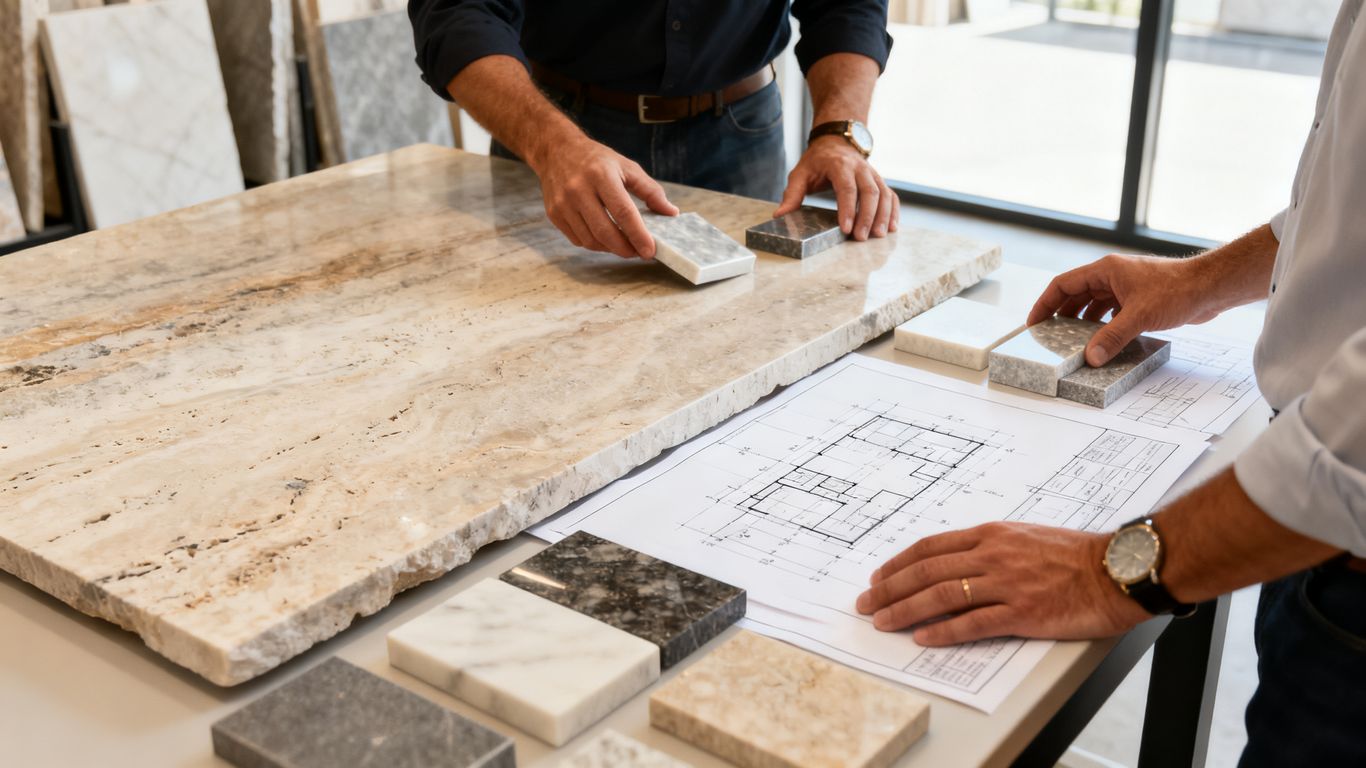
A partnership becomes tangible when the designer can use it during a real project. Assemble a sample experience that includes representative materials, finish notes, care considerations, lead-time guidance, and a clear way to ask technical questions. The package does not need to be elaborate; it needs to help a designer make and defend a specification.
Keep the information easy to scan and easy to update. If certain materials require special detailing or have installation constraints, explain those alongside the sample rather than burying them in a later email. Useful guidance early can prevent rework and makes the fabricator more welcome in the design process.
Set trade pricing, referral policies, and project expectations
Trade pricing should be clear enough that a designer understands how it works before presenting a project. Put the rules in writing, including whether pricing applies to fabrication only, how revisions are handled, and when an estimate becomes a confirmed job. Avoid policies that create awkward surprises between the designer and the end client.
Also define who owns communication at each stage. A designer may want to remain the primary client contact, while the fabricator may need direct access to the contractor or installer. Agreeing on those boundaries early keeps the relationship professional and reduces friction when a project gets busy.
Build visibility where interior designers discover stone partners
A trade offer cannot generate partnerships if designers never encounter it. Visibility should follow the way design professionals research: broad inspiration first, then material and technical questions, then a search for a local partner who can execute. The goal is not to be everywhere, but to appear with a useful answer at each meaningful stage.
Create SEO content around materials, applications, and specifications
Create pages and articles that answer the questions designers actually type or ask suppliers. Topics might include selecting stone for a wet room, planning seams in a waterfall island, comparing finish options, or preparing drawings for fabrication. Each page should connect the design question to a practical next step, such as a consultation, sample request, or project review.
Local relevance matters too. Include the service area, project types, and the kinds of specifications the shop accepts. Industry resources such as stone trade news and technical tips can help a marketing team identify timely subjects, but the finished content should reflect the shop’s own process and knowledge.
Use Google Search campaigns for high-intent trade queries
Paid search is most useful when it captures a specific need rather than simply buying broad exposure. Test terms related to designer trade programs, stone fabrication for interior designers, custom slab fabrication, and local commercial or residential specifications. Send each theme to a page that answers that exact intent instead of routing every click to the homepage.
Separate trade campaigns from homeowner campaigns so budgets, messages, and conversion data remain readable. Search terms, call recordings, and form quality will tell you whether the campaign is attracting actual design opportunities or people seeking general price information. Adjust negative keywords as the account gathers evidence.
Showcase completed work through Instagram, Pinterest, and Meta Ads
Designers often discover possible partners through visual work before they search for a service. Publish finished projects with close views of edges, seams, junctions, backsplashes, and unusual details. Pair each image with a short explanation of the design problem and the fabrication decision, rather than relying on a generic caption.
Organic posts build a library of proof, while Meta Ads can put selected projects in front of relevant local audiences. Use separate creative for awareness and retargeting: a finished installation may introduce the shop, while a technical detail or sample offer may give a returning visitor a reason to inquire.
Build referral relationships with showrooms, contractors, and design associations
Some of the best trade introductions happen through adjacent professionals. Make it easy for showrooms, contractors, and design groups to understand which projects fit the shop, what information is needed for a quote, and how quickly the team typically responds. A referral partner should never have to guess whether an introduction is appropriate.
Relationships also improve when the shop contributes something useful, such as a material session, a fabrication walkthrough, or a concise specification checklist. Resources about marketing for stone industry associations illustrate why specialized knowledge matters when generic marketing language misses the realities of the trade.
Turn project inspiration into qualified trade leads
A portfolio can create interest, but interest alone does not create a workable pipeline. The conversion path should help a designer identify the next action and provide enough context for the shop to judge the opportunity. Keep the experience polished, but do not hide the practical questions that sales and production will need.
Design a landing page for interior designer partnerships
Create a dedicated page with a clear trade-focused headline, a brief explanation of the collaboration process, project examples, and one primary call to action. Explain what the designer receives: material guidance, drawing review, samples, estimating support, or another documented part of the process. Keep homeowner-oriented language from taking over the page.
The form should ask only for information that improves the first response. Project type, location, material, estimated timeline, and the best contact method are usually more useful than a long biography. Add a phone number and a visible response expectation for designers who prefer to talk through a project.
Use portfolio proof to demonstrate fabrication quality
Portfolio images should show more than a wide room photograph. Include details that reveal accuracy, finish consistency, transitions, and how the stone meets adjacent materials. A short project note can explain the scope, the design challenge, and the completed result without making unsupported claims about performance.
Organize proof by application or project type so a visitor can quickly find relevant work. A designer specifying a hospitality bar needs different evidence from one planning a residential kitchen. Relevance often builds trust faster than a larger, unfocused gallery.
Offer a useful conversion asset such as a sample kit or material consultation
The conversion offer should be valuable enough to justify a new conversation. A curated sample kit, a material consultation, or a drawing-readiness checklist can all work when they address a real point of uncertainty. Make the offer specific about what happens next and who it is for.
Use a short form and a confirmation page that sets expectations. After the request, send a helpful confirmation rather than an immediate sales pitch. The first interaction should feel like the beginning of a professional working relationship.
Track calls, form submissions, sample requests, and specification downloads
Set up each meaningful action as a separate conversion event. A phone call from a designer, a sample request, and a specification download may indicate different levels of intent, so combining them into one number makes optimization difficult.
Review the quality of those actions with the sales team. A spreadsheet or CRM note should record whether the inquiry became a conversation, estimate, or active project. That feedback gives paid media and SEO decisions a connection to commercial reality.
Create a funnel that moves designers from interest to collaboration
The funnel should not treat every visitor as ready for an estimate. Someone discovering a finished kitchen on Instagram needs a different invitation from a designer who has drawings and a material deadline. Segmenting that difference makes follow-up more helpful and keeps sales time focused.
Separate awareness, consideration, and project-ready audiences
Awareness audiences may have seen a project or read an educational page but have not identified a specific need. Consideration audiences have visited service pages, reviewed a portfolio, or requested material information. Project-ready audiences show stronger signals, such as submitting scope details or asking for a fabrication review.
Create distinct messages and audiences for each group. This also makes reporting more honest: a low-cost awareness click should not be compared directly with a qualified project inquiry. The funnel is doing several jobs, and each job needs its own success measure.
Retarget portfolio visitors with relevant materials and applications
Retargeting works best when it remembers the visitor’s likely interest. Someone who viewed hospitality work can see related project proof or a trade consultation, while a visitor reading about a particular material can receive content focused on its application and detailing. Keep the creative close to the original subject.
Frequency matters. A small professional audience can quickly become tired of repeated ads, so rotate images and exclude people who have already submitted a form. Retargeting should support the relationship, not make the brand feel intrusive.
Use lead forms without sacrificing qualification details
Short forms can improve completion rates, but an ultra-short form often creates more work later. Include a few fields that distinguish a genuine design opportunity from a general inquiry: project location, anticipated timing, material interest, and whether the designer is working with an end client or contractor.
Use conditional questions when the platform allows them, and keep sensitive pricing discussions for the follow-up. The right balance is enough context for routing and prioritization without turning the first step into a bid application.
Match follow-up messaging to the designer’s project stage
A new contact may need a simple welcome and a useful material resource. A sample requester may need handling guidance and an invitation to discuss the application. Someone with drawings and a deadline needs a prompt, direct response that confirms what the shop can review and when.
Automation can handle acknowledgments, but it should not replace judgment. The message should reflect the information already provided and give the designer one clear next step. A single relevant question is often more effective than a long generic nurture email.
Qualify and respond to designer partnership opportunities
Marketing creates the opportunity; operations determine whether the relationship becomes profitable. A fast, thoughtful response signals that the shop can manage detail, while a vague reply creates doubt before the first estimate. Qualification should feel like collaboration, not an interrogation.
Ask about scope, timeline, material, and decision-makers
The first conversation should establish what is being designed, where the stone will be used, what material is under consideration, and when a decision is expected. Ask who is involved in approving the material and fabrication details as well. These answers help the team decide what information to send and who needs to be included.
Keep the tone curious and useful. If the designer is still exploring, offer guidance that helps narrow the options. If the project is ready for pricing, move efficiently toward drawings, dimensions, and the information required for an estimate.
Identify projects that fit equipment and installation capabilities
A trade lead is not automatically a good lead. Compare the project’s geometry, material, finish, size, access conditions, and installation requirements with the shop’s actual capabilities. If outside partners or special handling will be needed, identify that before promising a schedule or price.
This protects both sides. The designer gets a realistic answer, and the fabricator avoids accepting work that strains production or creates avoidable risk. A clear no, paired with a practical explanation, can preserve a relationship for a better-fit project later.
Set response-time standards for samples, estimates, and technical questions
Choose service standards the team can maintain, then make them visible internally. For example, the shop might set separate targets for acknowledging a new inquiry, confirming a sample request, answering a technical question, and delivering an estimate. The exact timing matters less than consistency and ownership.
When a complete answer will take longer, send a brief progress update. Designers can work around a delay more easily when they know what is happening. Silence, on the other hand, makes even a capable shop appear unreliable.
Use a CRM pipeline to prevent trade leads from going cold
Create stages that reflect the real process: new inquiry, qualified conversation, sample or drawing review, estimate, decision pending, booked project, and nurture. Assign an owner and a next action to every active record. A CRM is useful here because it makes forgotten follow-up visible before the opportunity disappears.
Keep notes specific enough for another team member to understand the project. Record the material, scope, deadline, participants, and promised follow-up. That small discipline helps the shop deliver a consistent experience even when several people handle the relationship.
Nurture relationships before the next project arrives
Interior design projects do not arrive on a predictable weekly schedule. A designer may like the shop but have no suitable project for several months. Nurture keeps the relationship familiar without filling the inbox with empty promotions.
Build email sequences for samples, education, and project inspiration
Create separate sequences for different reasons a designer joined the list. A sample recipient might receive care guidance and application ideas, while a technical subscriber might receive drawing-preparation tips and examples of resolved fabrication details. Project inspiration can sit alongside education, not replace it.
Use a restrained cadence and let contacts choose what they want to receive. Each email should have one useful point and one sensible next action. That could be a reply, a consultation request, or simply saving a reference for a future project.
Share fabrication constraints designers need to know early
Designers benefit from knowing constraints while concepts are still flexible. Explain how seams, overhangs, support, access, slab dimensions, and cutouts can affect a design. Frame these topics as planning information rather than restrictions.
A short visual guide or project example can make the lesson easier to remember. The goal is to help designers bring the fabricator in at the right moment, when changes are still inexpensive and creative alternatives remain available.
Use showroom visits, continuing education, and specification support
Digital marketing should open doors to useful offline contact. Invite designers to a showroom visit, offer a small educational session, or provide support while a material is being specified. These interactions create more context than an isolated ad click and often reveal future project needs.
Professional events can also strengthen the shop’s network. For example, a stone fabrication workshop can be a natural source of ideas for educational programming and industry conversations, provided the shop chooses events that fit its audience and goals.
A video can extend that education to designers who prefer to learn asynchronously. Keep it focused on a real decision, such as planning a detail or preparing for fabrication, and place a clear follow-up option beside it.
Re-engage inactive contacts around new slabs and finished projects
Inactive does not always mean uninterested. A new slab selection, an unusual completed project, or a useful update to the trade program can give an old contact a legitimate reason to return. Personalize the message when the record shows a prior material or application interest.
Avoid pretending the contact is already ready to buy. A simple note asking whether their current work includes a relevant project is more credible than a manufactured deadline. If there is no response, reduce the frequency rather than continuing indefinitely.
Measure the economics of stone fabricator trade partnership marketing
Trade marketing needs a longer view than click-through rate. The useful question is whether the investment produces qualified designer opportunities that become estimates, booked work, and healthy revenue. Measurement should connect marketing activity to the shop’s sales process without pretending every result is immediate.
Track cost per qualified designer opportunity instead of raw leads
A low-cost form submission is not necessarily a win if it lacks a real project, timeline, or fit. Define a qualified opportunity in operational terms, then calculate acquisition cost using that count. This gives campaign decisions a closer relationship to the work sales and production can actually pursue.
Review qualification rates by source and landing page. If one channel produces many inquiries but few usable conversations, its apparent efficiency may be misleading. Conversely, a smaller channel may deserve more budget if its opportunities consistently move forward.
Connect campaigns to estimates, booked projects, and revenue
Use call tracking, form source data, CRM fields, and offline sales updates to follow a contact beyond the first conversion. Record when an opportunity receives an estimate, when it is won or lost, and what revenue is associated with the project. The data will not be perfect at first, but even a consistent baseline is valuable.
Avoid treating an estimate as revenue. Keep separate stages for inquiry, qualified opportunity, estimate, booked project, and collected revenue. That separation helps explain why a campaign can look strong early in the funnel while still needing better sales follow-up.
Compare Google Ads, Meta Ads, SEO, and referral performance
Different channels play different roles, so compare them with context rather than one universal benchmark. Search may capture active demand, social may introduce the shop through visual proof, SEO may accumulate value over time, and referrals may begin with higher trust. The right comparison includes cost, qualification, sales cycle, and project value.
A simple working view can keep those differences visible:
| Channel | Likely role | Useful early signal | Commercial measure |
|---|---|---|---|
| Google Ads | Capture active intent | Qualified calls and forms | Estimates and booked projects |
| Meta Ads | Build and revisit interest | Portfolio engagement and retargeting actions | Assisted and direct opportunities |
| SEO | Answer research questions | Relevant organic visits | Trade inquiries and specification requests |
| Referrals | Transfer existing trust | Introductions from partners | Qualified opportunities and close rate |
Review the table alongside actual sales records, not in isolation. A channel that assists several months before a project books may be doing valuable work that last-click reporting misses. The answer is not to credit every touch equally, but to keep the full path visible.
Improve the funnel using conversion rates and sales-cycle data
Once enough data accumulates, examine the movement between stages. Measure landing-page conversion, qualification rate, estimate rate, close rate, average project value, and days from first contact to decision. These figures show whether the constraint is traffic, message-market fit, response speed, estimating, or follow-up.
Make one focused change at a time where possible. Test a clearer trade offer, a more relevant portfolio page, a shorter form, or a stronger response process. Then give the change enough time to produce meaningful sales-stage data before declaring it successful.
Build a reliable designer pipeline
A designer partnership funnel works when every part reinforces the next: a clear offer earns attention, useful content creates trust, qualification protects capacity, and follow-up keeps good relationships active. Milia Marketing describes its work as specialized marketing for the stone sector and lead generation systems designed to attract qualified prospects; that kind of industry-specific framing is relevant when choosing outside marketing support. If your shop builds the system around real capabilities and real sales data, the result is a steadier path from inspiration to collaboration.
Conclusion
Stone fabricator trade partnership marketing is less about offering a discount and more about becoming a dependable part of the designer’s process; define the help you can provide, make it discoverable, respond with discipline, and schedule a marketing conversation when you are ready to build the funnel around measurable opportunities.
Frequently Asked Questions
How is marketing to interior designers different from homeowner marketing?
Designer marketing speaks to specifications, project timelines, technical decisions, and collaboration. It should show how the fabricator supports the professional’s process rather than focusing only on finished-product price or residential convenience.
What should a stone fabricator include in a trade partnership offer?
The offer can include sample access, material guidance, drawing or detail review, clear trade pricing, estimating support, and dependable communication. Include only services the shop can deliver consistently.
Which project types are best for a designer partnership program?
The best projects are those that fit the shop’s equipment, materials, installation process, margins, and schedule. Residential kitchens, hospitality work, bathrooms, and commercial specifications may all fit, depending on the fabricator’s capabilities.
What information should a designer provide in the first inquiry?
Ask for project location, application, material interest, approximate scope, timeline, and the people involved in decisions. These details help the shop respond appropriately without making the first form unnecessarily long.
How quickly should a fabricator respond to a trade lead?
Set a response standard that the team can maintain for acknowledgments, samples, technical questions, and estimates. If a complete answer will take longer, send a progress update so the designer knows the request is active.
How can a fabricator measure designer marketing?
Track qualified opportunities, estimates, booked projects, revenue, close rate, and sales-cycle length by source. Calls, forms, sample requests, and downloads are useful early signals, but they should not be treated as equal to revenue.
Should a small fabrication shop use paid advertising?
Paid advertising can work when the shop has a defined offer, suitable project capacity, focused landing pages, and reliable conversion tracking. Start with a manageable audience and budget, then scale only after lead quality and follow-up are understood.