The Win-Back Email for Countertop Estimates That Never Closed

Key Takeaways
A countertop estimate that did not close is not automatically a dead lead. A thoughtful countertop company email win back campaign can bring the right prospects back without turning every follow-up into a discount.
- Segment unclosed estimates by sales status, project timing, material, value, and likely objection.
- Use a three-email sequence with different timing for urgent projects and longer remodels.
- Match each message to the reason the estimate stalled instead of sending a generic reminder.
- Offer a useful next step that protects margins, such as an updated estimate or design consultation.
- Measure qualified reactivations and closed revenue, not just opens and clicks.
Define which unclosed countertop estimates belong in the win-back campaign
A win-back campaign starts with a clean definition of who should receive it. A prospect who paused a kitchen remodel is different from someone who explicitly rejected the project or never had a real buying conversation. Pulling both into the same audience creates awkward emails, wastes follow-up time, and can damage deliverability. Before writing copy, decide which estimate records still have a reasonable path to a conversation.
Separate undecided prospects from lost or disqualified opportunities
Start with the estimate status and the last meaningful sales interaction. “Thinking it over,” “waiting on cabinets,” or “comparing materials” usually indicates an undecided prospect, while “chose another provider,” “outside service area,” or “project canceled” points to a different outcome. The latter group may belong in a long-term nurture audience, but it should not receive a confident win-back email that assumes the project is still active.
Salespeople should also be able to override an automated classification. A note such as “do not contact until spring” is more useful than a generic closed-lost label. When the team agrees on a small set of statuses, the campaign can focus on people who have shown intent without treating every old quote as an opportunity.
Segment by project stage, countertop material, and estimated value
A kitchen countertop estimate close to installation is likely to need a faster, more specific message than a bathroom project still waiting for a broader renovation plan. Material matters too. Someone considering quartz may need help comparing maintenance and appearance, while a granite shopper may be weighing slab selection or natural variation. The email should reflect what the prospect was actually considering.
Estimated value helps determine the amount of sales attention a reactivated lead deserves. It does not mean sending aggressive messages to lower-value projects. It means giving the team a practical way to prioritize replies, consultations, and revised estimates.
Use lead source and sales notes to identify likely objections
The original lead source often provides useful context. A paid search lead who requested a quote may be closer to action than someone who downloaded a general remodeling guide, although the record and conversation should decide that, not assumptions about the channel. Review notes for phrases like “too expensive,” “not ready,” “needs spouse approval,” “waiting for financing,” or “install date uncertain.”
A win-back email should respond to one likely barrier at a time. For broader email strategy, win-back email examples can provide inspiration for subject lines and personalization, but countertop companies still need to adapt the approach to estimate status and project timing.
Exclude active conversations, completed projects, and contacts without email consent
Automation should have clear guardrails. Suppress anyone with an open sales task, a scheduled measurement, a recent reply, or a current proposal under review. Completed projects need a different customer-marketing journey, and contacts without appropriate email consent should not be added simply because their information exists in the CRM.
The same rule applies to bounced addresses, unsubscribes, and records with conflicting contact preferences. A smaller audience with reliable permission and accurate status is more valuable than a large audience that creates complaints or confuses active customers.
Choose the timing and structure of the email sequence
Timing should follow the buying cycle rather than an arbitrary calendar. Countertop purchases can move quickly when cabinets are ready, but they can also sit for months while a larger remodel takes shape. A sequence gives the business more than one chance to be useful while leaving room for the prospect to say no. The goal is a relevant return to the conversation, not inbox pressure.
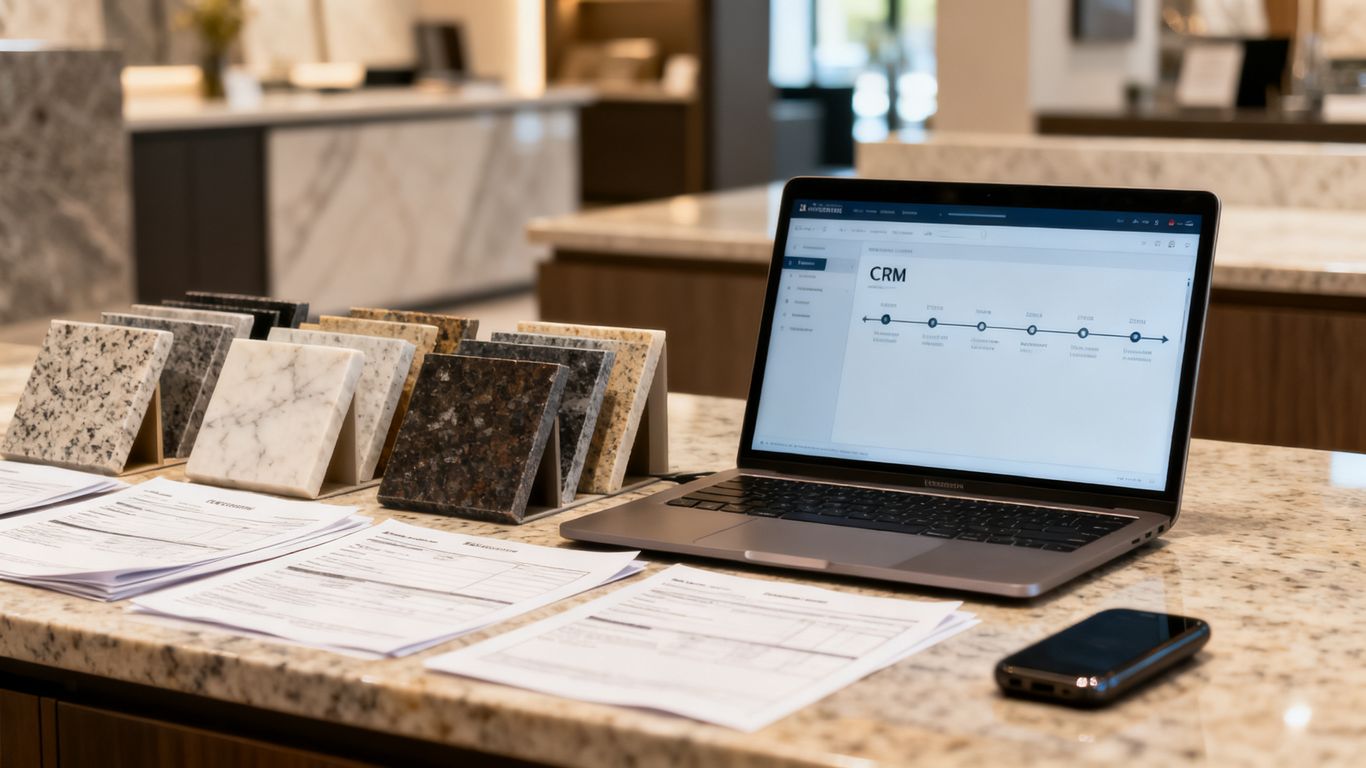
A practical sequence might begin with a helpful check-in, continue with a project-specific reminder, and finish with a low-pressure choice to update or close the estimate. The exact spacing should be adjusted using sales capacity, seasonality, and the age of the opportunity.
Set different follow-up windows for hot estimates and long-term remodel projects
For a quote tied to an imminent cabinet or installation milestone, the first follow-up may belong within a few days of the estimate going quiet. A long-term renovation deserves more space. Sending the same message at the same interval to both groups makes the hot lead feel neglected and the long-term lead feel chased.
Use project dates when they are known, such as cabinet delivery, expected demolition, or a requested installation month. When those dates are missing, use estimate age and the last contact date as reasonable fallback signals. The sales team should be able to pause or reschedule the sequence when a customer gives a clear timeline.
Build a three-email sequence instead of relying on one reminder
One reminder is easy to ignore, especially when the recipient is managing a renovation. Three emails allow the company to vary the usefulness of the conversation without repeating the same “just checking in” line. A simple structure can look like this:
- Email one confirms the earlier estimate and offers to answer a specific question.
- Email two addresses a likely project barrier, such as timing, material selection, or budget planning.
- Email three offers a clear choice to refresh the estimate, schedule a conversation, or close the loop.
Each email should have a distinct reason to exist. If the prospect does not engage after the final message, move the record to an appropriate nurture or suppression path instead of extending the same sequence indefinitely.
Use estimate status changes as automation triggers in the CRM
The campaign becomes more dependable when it starts from a status change rather than a spreadsheet export. A record moving from “estimate sent” to “no response” can begin a review period, while “follow-up requested” can trigger a task for a salesperson instead of an automated email. These triggers should use both status and elapsed time so a record does not enter the campaign prematurely.
Document the workflow in plain language. Everyone should know which field starts the sequence, which fields pause it, and where a human must take over. That clarity prevents duplicate emails when several team members update the same opportunity.
Stop sending when a prospect replies, books, or requests no further contact
Every message needs an exit condition. A reply should create a sales task or route to the assigned representative, while a booked consultation should remove the contact from the email sequence. An unsubscribe or direct request for no further contact must take priority over campaign goals.
Test these exits with real records before launch. It is better to find a broken suppression rule in a controlled test than after a prospect receives a reminder immediately following a phone conversation.
Match the message to the reason the estimate stalled
The strongest win-back messages do not pretend to know more than the sales record shows. They use the available context to make a relevant offer, then give the prospect an easy way to correct the assumption. A brief, respectful email can reopen a project without forcing the customer to repeat every detail they already shared.
The copy also needs to avoid making the company sound desperate. A stalled estimate is often a timing issue, not a judgment about the business. Treat the email as a helpful continuation of an earlier conversation.
Address price hesitation without training prospects to wait for discounts
If the notes show a price concern, acknowledge it directly without immediately cutting the price. Offer to review scope, material choices, edge details, or installation assumptions so the prospect can understand what shaped the estimate. A revised estimate should be based on a real project change, not an unexplained reduction designed to create artificial urgency.
This protects the value of the work and gives the salesperson a reason to re-engage. The message might ask whether the prospect wants to review options that better fit the current budget, rather than promising a sale price that may not preserve fabrication and installation margins.
Reopen projects delayed by installation timing, financing, or remodeling schedules
Timing objections call for flexibility. If the customer was waiting for cabinets, another contractor, financing, or a move, the email can ask whether the project window has changed. It can also offer to refresh the estimate around the new schedule instead of treating the old quote as final.
Avoid inventing availability or deadlines. If the company has not confirmed an installation slot, do not imply that one is being held. A straightforward question about the next milestone is often enough to restart the conversation.
Help shoppers who are comparing quartz, granite, porcelain, and other materials
Material comparison emails should make the decision easier, not bury the reader in technical detail. Refer to the material discussed in the estimate and offer a focused consultation about appearance, care, durability, slab selection, or project fit: provided the team can answer those questions accurately. A photo of a comparable completed project may also help someone picture the result.
The copy should avoid declaring one material universally superior. Prospects are choosing within a broader design and construction plan, so a useful email helps them clarify priorities and then connects them with someone who can discuss the available options.
Route unclear objections to a sales follow-up instead of guessing in the email
Sometimes the record only says “went cold.” That is not enough evidence to write a highly specific objection-based message. Use a neutral check-in that names the estimate and asks whether the project is still active, delayed, or no longer needed.
Give the prospect a simple reply path. A salesperson can learn more from a short response than from a clever paragraph built on an incorrect assumption. The campaign should create that opening rather than try to complete the entire sale in the inbox.
Create an offer that protects countertop margins
A win-back offer does not have to be a coupon. In many cases, the best offer is a useful next action that reduces uncertainty: reviewing the existing estimate, confirming measurements, discussing material choices, or planning around the remodel schedule. That approach gives the prospect a reason to respond while preserving the economics of the project.
Use the offer to remove friction, not to disguise a weak follow-up process. Before launch, confirm who will handle the response, how quickly they can respond, and what information the customer will receive next.
Choose between a design consultation, updated estimate, measurement visit, or incentive
Match the offer to the point where the project stopped. A material question may call for a design conversation, while a changed scope may justify an updated estimate. If measurements were never finalized, a measurement visit may be the logical next step. An incentive should be considered only when it has a clear business reason and does not undermine the value of the work.
Present one primary option in each email. Offering four unrelated choices can make the message feel like a menu and leave the prospect unsure what to do. The CTA should answer the practical question: what can the reader do right now?
Make time-sensitive promotions specific to inventory, fabrication, or installation capacity
Urgency is credible only when it comes from a real operating constraint. A promotion might relate to a confirmed material opportunity, a fabrication schedule, or installation capacity that the company genuinely needs to fill. The email should state the relevant date or condition clearly and avoid vague language about an offer ending soon.
This is also where the sales and operations teams need to agree. If inventory changes or installation capacity is already committed, the campaign should be updated or paused. A promise that cannot be honored costs more than the short-term response is worth.
Use financing and payment options to reduce upfront cost concerns
For prospects worried about the initial project cost, explain available payment options plainly and link to the relevant details when appropriate. Do not hide fees, eligibility requirements, or timing. The email can invite the prospect to discuss how the project might fit their budget without implying approval or guaranteed terms.
The sales team should receive the same information as the marketing team. A prospect who replies after seeing a financing message should not have to ask three people for the basic terms or discover that the offer applied only to a different project type.
Add proof through completed-project photos, reviews, warranties, and installation details
Proof works best when it answers a concern connected to the estimate. A completed-project photo can help with design confidence, while a review may address communication or installation quality. Warranty and process details can reduce perceived risk for someone who is unsure about moving forward.
Keep the proof specific and verifiable. Avoid anonymous claims or broad promises about every project. The email should make the company easier to trust without turning a short follow-up into a gallery or a wall of testimonials.
Write the win-back email around one clear next step
A good win-back email is short because the prospect already knows the basic context. The message should remind them what was discussed, explain why you are reaching out now, and present one easy action. One clear next step usually performs better operationally than several competing CTAs because the recipient and the sales team both understand what happens next.
Write for the customer who is scanning between jobsite visits, meetings, and family responsibilities. Keep the useful detail near the top, make the reply path obvious, and let the landing page or salesperson handle the deeper discussion.
Combine a specific subject line with a useful preheader
A subject line should identify the project or decision without sounding like a generic blast. “Still planning the Riverbend kitchen counters?” is more informative than “We miss you,” assuming the project name is accurate and appropriate to use. The preheader can add the reason for the message, such as offering to refresh the estimate around a new installation timeline.
Avoid false urgency and exaggerated claims. Specificity earns attention because it helps the reader recognize the earlier conversation, not because it pressures them into opening.
Personalize the email with the project details the prospect already shared
Use details that are both accurate and useful: the room, material under consideration, estimate date, requested installation period, or a question raised during the consultation. Do not insert every available field simply because the CRM has it. Too much personalization can feel intrusive, especially when a project has been dormant for months.
Have a fallback for missing data. A message that reads naturally without a project nickname is better than one with a broken merge field or an incorrect material reference. Preview the email against several real records before activating the sequence.
Reframe the original estimate as an easy starting point rather than a hard sell
The old estimate is a useful point of reference, but it may no longer reflect the customer’s scope, timing, or material choice. Say that the team can review or update it rather than presenting the document as a final decision waiting to be signed. This lowers the emotional cost of replying.
The tone should leave room for a changed plan. A prospect who is not ready today may still respond if the email does not imply that they have failed to act.
Use a direct CTA for replying, scheduling, or requesting a revised estimate
Choose the CTA based on the campaign segment. “Reply with your target installation month,” “Schedule a design conversation,” and “Request an updated estimate” each create a different workflow. The button or linked text should match what the team can actually deliver after the click.
Do not send every prospect to a generic homepage. A focused destination keeps the promise of the email intact and reduces the number of decisions required after the prospect re-engages.
Make the email readable and actionable on mobile devices
Use short paragraphs, a prominent CTA, and enough spacing around links and buttons. Put the project context and the next step before secondary proof or background information. The message should still make sense if the reader sees only the subject line, first sentence, and CTA while viewing it on a phone.
Test rendering across common email clients and check that the reply address, phone number, and booking link work. A polished layout cannot compensate for a broken action.
A short video about follow-up email strategy can support internal training, but it should not replace the actual campaign plan. Salespeople still need clear segments, exit rules, and response ownership behind the email.
Connect the campaign to the CRM, website, and paid media
A win-back email is only one part of the reactivation path. The CRM needs to preserve the estimate context, the website needs to make the promised action easy, and advertising audiences need to reflect the prospect’s new status. When these systems disagree, a person may reply to an email and continue seeing an irrelevant ad or receive a second sales message from another workflow.
The connection does not need to be elaborate at first. Accurate fields, consistent naming, and tested conversion events are more valuable than a complicated setup that the team cannot maintain.
Pass estimate value, material type, and sales outcome into the contact record
Store the information needed for segmentation and reporting in structured fields rather than leaving everything in free-form notes. Estimate value, material type, project stage, lead source, assigned representative, and sales outcome can then be used consistently across email, CRM views, and reporting.
Keep sensitive or speculative information out of fields that may be used automatically. A note saying “probably price objection” should not become a definitive customer attribute. Distinguish confirmed outcomes from sales hypotheses.
Track replies, booked consultations, revised estimates, and closed revenue
The campaign should record actions that move the opportunity forward. Opens and clicks can help diagnose delivery or content problems, but they are not revenue. Replies, booked consultations, revised estimates, and closed projects provide a more useful picture of whether the sequence is creating qualified conversations.
Name the events consistently across forms, booking tools, and CRM stages. A consultation booked from an email should remain attributable even if the person later calls the office or returns through a paid ad.
Send returning prospects to a relevant project or booking page
The destination should continue the email’s conversation. A material comparison message can point to a relevant project page, while a scheduling message should lead to a focused booking experience. The page should repeat the basic context, explain what happens next, and make contact options easy to find.
For broader planning, construction email marketing offers an additional perspective on using existing contacts and quote requests. Apply that general idea carefully to countertop estimates, where the next step often depends on scope, material, and installation timing.
Suppress win-back contacts from remarketing audiences after they re-engage
Once a prospect replies, books, or reopens an active sales conversation, remove them from the dormant-estimate audience. They may belong in a different audience or receive no advertising while the sales process is underway. Suppression protects relevance and prevents the company from paying to remind someone who has already taken action.
The same audience logic should account for closed projects, opt-outs, and disqualified leads. Review audience membership regularly because a one-time upload can quickly become outdated.
Coordinate Google Ads and Meta Ads follow-up without creating conflicting offers
Google Ads and Meta Ads can support the broader follow-up plan, but the messaging should not compete with the email. If the email offers an estimate review, an ad should not simultaneously promote an unrelated discount to the same person. Use agreed audience definitions, exclusion rules, and offer language across the team.
Keep email attribution separate from paid media attribution while still looking at the customer journey as a whole. A prospect may click an email, see a reminder ad, and then call. The reporting should recognize those interactions without claiming that one channel alone created the sale.
Measure revenue recovery and improve the campaign over time
The first campaign is a working model, not a permanent answer. Review results by audience and sales outcome so the team can tell whether the sequence is recovering real opportunities or simply generating low-value engagement. This is especially important for countertop businesses, where a small number of high-value projects can matter more than a large volume of clicks.
Set a reporting window that gives sales time to respond and projects time to close. Then compare performance with the cost of creative, software, staff time, and any incentive offered.
Distinguish opens and clicks from qualified reactivated opportunities
Open and click data can be useful directional signals, but privacy changes and accidental clicks make them imperfect measures of intent. Define a qualified reactivation as a meaningful reply, booked consultation, requested revision, or other agreed sales action. Define closed revenue separately.
This distinction keeps the campaign honest. A subject line test that improves opens but produces no sales conversations may be interesting, but it is not automatically a business win.
Compare recovered revenue by segment, lead source, material, and sales representative
Break results down far enough to reveal where the campaign is useful. Compare hot versus long-term projects, material categories, lead sources, estimate values, and assigned representatives. A segment with fewer responses may still produce the strongest margin or the most valuable closed projects.
Use a table like the following in the monthly review so the team examines both activity and outcome:
| Segment | Engagement signal | Qualified action | Closed revenue |
|---|---|---|---|
| Hot estimates | Opens and clicks | Replies or bookings | Revenue from closed projects |
| Long-term remodels | Return visits | Updated estimate requests | Revenue after project timing changes |
| Material comparison | Content clicks | Consultation requests | Revenue by selected material |
The table should be populated from consistent CRM events, not rough estimates from individual inboxes. It gives the sales and marketing teams a shared view of which audiences deserve more attention.
Test timing, subject lines, creative, offers, and calls to action one variable at a time
A clean test changes one meaningful element while keeping the audience and measurement window reasonably consistent. Start with timing or subject lines if the campaign has little engagement, then examine the offer or CTA once people are reaching the message. Do not change the entire sequence at once and then guess what caused the result.
Small audiences may not support formal statistical certainty, but disciplined comparisons are still better than memory. Record the hypothesis, audience, dates, and revenue outcome for each test.
Review lost-estimate reasons with the sales team each month
Marketing data cannot explain every stalled project. Hold a short monthly review with sales to compare automated labels against what representatives are hearing in conversations. Look for recurring patterns such as unclear estimates, slow response time, material uncertainty, scheduling gaps, or pricing misalignment.
Turn those findings into one or two campaign changes at a time. The review is also a chance to remove bad records, fix status definitions, and confirm that suppression rules match the way the team actually works.
Increase budget and outreach only after the campaign produces profitable closed projects
Scale cautiously. First confirm that reactivated opportunities are being handled promptly, tracked correctly, and closed at a profitable level. If the campaign creates more replies than the sales team can manage, increasing send volume may lower the quality of the experience.
Once the economics are clear, expand the best-performing segments and consider supporting them with paid media. Growth should follow evidence from closed projects, not excitement about a high click-through rate.
Make Scheduling Easier
If scheduling is the main point of friction, give prospects a simple path to choose a conversation time with Calendly. Add that action only where it matches the email’s promise, and make sure the team can follow up when a prospect selects a time.
Conclusion
A countertop estimate win-back campaign works best when it respects the original conversation. Segment the right records, match the message to the stalled reason, offer one useful next step, and judge the program by qualified opportunities and profitable revenue rather than surface-level engagement.
Frequently Asked Questions
How long should a countertop estimate win-back sequence be?
A three-email sequence is a practical starting point, with spacing based on project urgency and the prospect’s stated timeline. Stop the sequence when the person replies, books, updates the estimate, or asks not to be contacted.
Should every old countertop estimate receive a win-back email?
No. Exclude completed projects, disqualified opportunities, active conversations, unsubscribed contacts, bounced addresses, and anyone without appropriate email consent. Focus on prospects whose project still has a plausible path forward.
What should a countertop company offer in a win-back email?
A useful offer might be an updated estimate, design consultation, measurement visit, material discussion, or clearly defined incentive. The right choice depends on why the project stalled and should protect the company’s margins.
Should win-back emails always include a discount?
No. Discounts can train prospects to wait and may not address the real objection. A review of scope, timing, material choices, or payment options may be more useful and commercially sound.
What is the best subject line for a stalled estimate?
Use a specific, accurate reference to the project and a clear reason to reopen the conversation. Mentioning the room, material, or timing can help the recipient recognize the earlier estimate without relying on false urgency.
How should a business measure a win-back campaign?
Track meaningful replies, booked consultations, revised estimates, qualified reactivations, and closed revenue. Opens and clicks can help diagnose the email, but they should not be treated as the final business outcome.
When should a reactivated prospect leave the email sequence?
Remove the prospect as soon as they reply, book, request a revised estimate, enter an active sales process, or ask for no further contact. The CRM should make these exit rules automatic wherever possible.