
So, you've heard about virtual slab showrooms and how they can really boost sales, maybe even double them. It sounds pretty good, right? But how do you actually build one that works, and more importantly, gets people to actually buy? It's not just about putting some pictures online. We're talking about making a digital space that feels real, gets people excited about your countertops, and makes them want to take the next step. Let's break down how to make a countertop virtual showroom page CRO that actually converts.
Key Takeaways
- Make sure your virtual showroom shows people what they're looking for. Are they trying to see how a specific granite looks in a kitchen, or are they just browsing styles? Knowing this helps you set up the virtual space right.
- Your virtual showroom needs good pictures, 3D models, and easy ways to see different options. Think about how you can show off the details of each countertop.
- Getting people to your virtual showroom is key. Use ads on Google and Facebook, do some basic SEO so people find you when they search, and create content that homeowners will like.
- You need to know if your virtual showroom is actually working. Set up tracking to see when people take action, watch how they use the page, and test different things to make it better.
- Use the right software to make your virtual showroom look and feel good. Make sure it works on phones and loads fast. Adding things like AR can make it even more real for customers.
Designing Your Virtual Slab Showroom For Maximum Impact
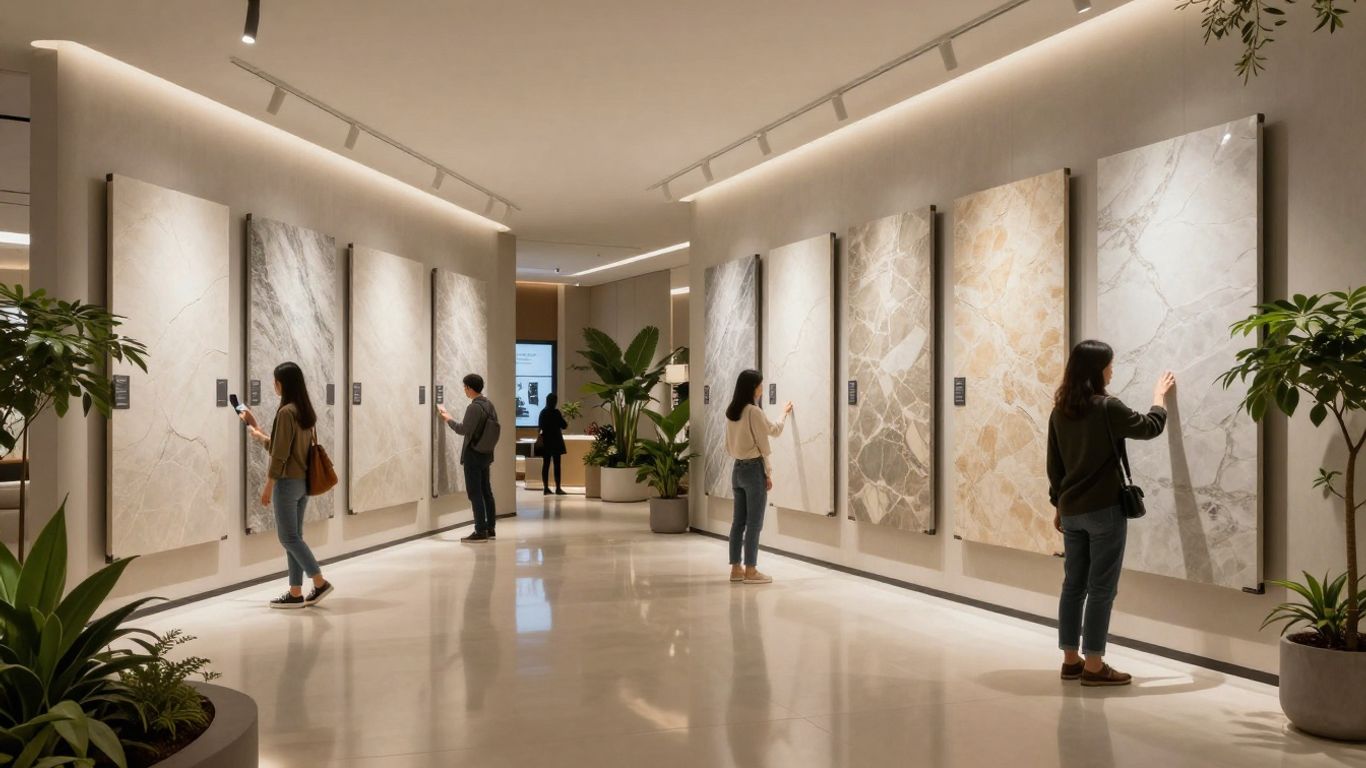
So, you're thinking about building a virtual slab showroom. That's smart. People are spending more time online looking for home improvement ideas, and a good virtual space can really grab their attention. But just throwing some pictures up isn't going to cut it. You need to think about how people will actually use it and what will make them want to take the next step.
Understanding User Intent For Virtual Showrooms
Why are people even clicking on your virtual showroom link? Mostly, they're in the research phase. They've got a project in mind, maybe a kitchen remodel or a new bathroom vanity, and they're trying to figure out what materials they like. They're not usually ready to buy right then and there. They want to see options, get ideas, and maybe narrow down their choices before they talk to a salesperson or visit a physical store. Think of your virtual showroom as the first date – you want to make a good impression and get them interested in a second date.
Key Elements of a High-Converting Virtual Showroom
What makes a virtual showroom actually work? It's a mix of things:
- Clear Product Presentation: Show the slabs clearly, from different angles, and in various lighting conditions. Don't hide any imperfections; be upfront.
- Contextualization: Show the slabs in real-world settings. A kitchen countertop, a bathroom vanity, a fireplace surround – this helps people visualize it in their own homes.
- Easy Comparison: Let users compare different slabs side-by-side. This is super helpful when they're trying to decide between a few favorites.
- Detailed Information: Include specs like dimensions, thickness, material type, and pricing (or a way to get a quote).
- Inspiration Gallery: Show examples of finished projects using your slabs. This can spark ideas they hadn't considered.
Integrating Visualizers With Product Catalogs
This is where the magic happens. Your virtual showroom needs to be connected to your actual product catalog. When someone clicks on a slab they like, they should be able to see all the details and maybe even use a visualizer tool. This tool lets them virtually place that slab in a sample kitchen or bathroom. It's not just about showing them the slab; it's about letting them see the slab in a context that matters to them. The better this integration is, the more likely they are to feel confident about their choice and move forward.
Building a virtual showroom isn't just about technology; it's about understanding the customer's journey. You're creating a digital space that mimics the helpfulness and inspiration of a physical showroom, but with the convenience of being accessible anytime, anywhere.
Optimizing The Virtual Showroom Page For Conversion Rate
So, you've got this cool virtual slab showroom set up. That's great! But just having it isn't enough. We need to make sure people actually use it and, you know, want to buy something. It’s all about making the experience smooth and, frankly, pretty easy for them.
Streamlining Navigation and User Flow
Think about how someone walks through a real store. They don't usually get lost, right? Your virtual space needs that same kind of logic. People should be able to find what they're looking for without scratching their heads.
- Keep the main categories obvious. Don't hide your different stone types or colors behind too many clicks.
- Use breadcrumbs. These are like little signposts showing people where they are and how they got there. It helps them backtrack if they need to.
- Make the search function work well. If someone knows they want a specific type of granite, they should be able to find it fast.
The easier it is for someone to find a product, the more likely they are to stick around and consider it. Clunky menus or confusing layouts are a quick way to lose a potential customer.
Leveraging High-Quality Imagery and 3D Models
This is where your virtual showroom really shines, or it should. Blurry pictures or models that look… well, fake, aren't going to cut it. People need to see the detail, the texture, the way light hits the surface. It’s like looking at a real slab, but better because they can do it from their couch.
- Zoom capabilities are a must. Let users get up close and personal with the veining and finish.
- Show different angles. A 3D model that spins around is way more helpful than a single photo.
- Consider lifestyle shots. Show the slab in a kitchen or bathroom setting. This helps people imagine it in their own home. You can find more tips on optimizing product pages that apply here too.
Implementing Clear Calls-to-Action
Okay, so someone's looking at a slab they love. What do you want them to do next? You need to tell them, clearly. Don't make them guess.
- "Request a Quote" button: This is usually a big one. Make it prominent.
- "Add to Favorites" or "Save for Later": People might not be ready to commit, but they want to keep track.
- "Find a Local Fabricator" or "Schedule a Consultation": Guide them to the next step in the buying process.
The goal is to guide the user smoothly from browsing to taking a concrete action. If they like a slab, the next logical step should be readily available. It's about removing friction at every turn.
Driving Qualified Traffic To Your Virtual Showroom
So, you've built this amazing virtual slab showroom. It looks great, it's easy to use, and it's ready to wow potential customers. But here's the thing: people need to actually find it. Building it is only half the battle. You need to get the right eyes on it, the folks who are actually in the market for countertops or flooring. Let's talk about how to make that happen.
Targeting Strategies for Paid Advertising Campaigns
Paid ads can be a super effective way to get people to your virtual space, but you've got to be smart about it. Throwing money at ads without a plan is just… well, throwing money away. Think about who you're trying to reach. Are they homeowners looking to renovate? Interior designers sourcing materials? Knowing this helps you pick the right platforms and keywords.
- Define your ideal customer: What are their demographics? What are their interests? What problems are they trying to solve?
- Choose your platforms wisely: Google Ads is great for people actively searching for terms like "quartz countertops showroom" or "virtual kitchen design." Social media platforms like Facebook and Instagram can work well for visual inspiration and reaching people based on their interests (e.g., home decor, renovation).
- Craft compelling ad copy: Your ad needs to grab attention and clearly state what you offer. Mentioning the virtual showroom directly is a good idea.
- Use precise targeting: On platforms like Facebook, you can target users by location, age, interests, and even life events like "recently moved" or "interested in home improvement."
The goal is to show your ad to people who are most likely to be interested in what you're selling, not just anyone.
SEO Best Practices for Virtual Showroom Pages
Search Engine Optimization, or SEO, is all about making sure your virtual showroom pops up when people search on Google or other search engines. It's a bit of a long game, but it brings in really motivated visitors.
- Keyword research: Figure out what terms people use when they're looking for slabs or showrooms online. Think about specific materials (granite, marble, quartz), applications (kitchen countertops, bathroom vanities), and the virtual aspect (virtual showroom, online design tool).
- On-page optimization: Use those keywords naturally in your page titles, headings, and descriptions. Make sure your page loads fast and is easy for search engines to read.
- Local SEO: If you serve a specific geographic area, make sure your Google Business Profile is up-to-date and optimized. Encourage reviews from happy customers.
- Content creation: Regularly add new content related to your products, design ideas, or the benefits of using a virtual showroom. This keeps your site fresh and gives search engines more reasons to rank you.
Content Marketing to Attract Homeowners
Content marketing is about creating useful, interesting stuff that draws people in. It's not just about selling; it's about helping and educating.
- Blog posts: Write articles about choosing the right countertop material, current design trends, or how to measure for a new kitchen island. Naturally, you can then link to your virtual showroom as a way to explore options.
- Inspiration galleries: Showcase beautiful projects that used your slabs. High-quality photos and descriptions can really capture attention.
- How-to guides: Create guides on topics like "How to Care for Your Quartz Countertops" or "The Pros and Cons of Different Natural Stones." This positions you as an authority.
- Videos: Short videos showing off different slab textures, explaining installation basics, or even a quick tour of the virtual showroom can be very engaging.
Think of content marketing as building a relationship with potential customers. You're providing value upfront, so when they're ready to buy, they think of you first. It's about being helpful and informative, not just pushy.
Getting people to your virtual showroom is an ongoing effort. By combining smart paid advertising, solid SEO, and helpful content, you can make sure the right audience finds their way to your digital doors.
Measuring and Improving Virtual Showroom Performance
So, you've built this cool virtual slab showroom. That's great! But how do you know if it's actually doing its job? You can't just set it and forget it. We need to look at the numbers and figure out what's working and what's not. Tracking your results is the only way to make it better.
Setting Up Conversion Tracking for Virtual Showrooms
First things first, you need to know what counts as a "conversion" for your showroom. Is it when someone requests a quote? Downloads a brochure? Or maybe when they click through to a specific product page? You've got to define this. Then, you'll use tools like Google Analytics to set up these goals. It's like putting a scoreboard up for your virtual space.
Here are some common conversion points:
- Requesting a sample
- Filling out a contact form
- Spending a certain amount of time in the showroom
- Clicking on a "buy now" or "get a quote" button
- Downloading product spec sheets
Analyzing User Behavior on the Virtual Showroom Page
Once tracking is in place, you can start watching how people actually use your showroom. Where do they go first? What slabs do they look at the most? Do they get stuck anywhere? Tools can show you heatmaps (where people click most) and session recordings (watching anonymized user journeys). This gives you a real peek into their experience.
For example, you might see that most people spend a lot of time looking at the "Calacatta Gold" section, but then they drop off when trying to find pricing. That's a clear signal something needs fixing there.
Understanding user paths helps you spot friction points. If visitors are leaving your virtual showroom before completing a desired action, it's a sign that the experience isn't as smooth as it could be. Identifying these drop-off points is the first step to improving engagement and conversion rates.
A/B Testing Elements for Continuous Optimization
This is where the real magic happens. You don't have to guess what might improve things. You can test different versions of your showroom to see which one performs better. This is called A/B testing.
Let's say you're not sure if a "Request Sample" button should be green or blue. You can set up a test where half your visitors see the green button (Version A) and the other half see the blue one (Version B). Then, you track which button leads to more sample requests. It’s a scientific way to make decisions.
Here are some things you can A/B test:
- Button colors and text
- Layout of product displays
- Placement of information (like dimensions or pricing)
- The order of steps in a configurator
- Different introductory text or videos
Leveraging Technology for an Immersive Virtual Experience
So, you've got the idea for a virtual slab showroom, which is great. But how do you actually make it feel real, like you're actually there picking out that perfect piece of granite? It all comes down to the tech you use. Picking the right tools is super important if you want people to stick around and actually consider buying.
Choosing the Right Virtual Showroom Software
This is where you start. There are a bunch of different software options out there, and they do different things. Some are pretty basic, just showing 3D models. Others are way more advanced, letting you change lighting or even see how a slab looks in a virtual kitchen.
- Basic 3D Viewers: Good for showing off the slab's texture and color. Easy to implement.
- Interactive Showrooms: Allows users to walk around, zoom in, and sometimes even place slabs in sample rooms.
- Full Customization Platforms: Lets users change countertop shapes, backsplashes, and see different edge profiles. These are more complex but offer a richer experience.
The software you pick will directly impact how realistic and engaging your showroom feels. Think about what your customers really need. Do they just want to see the slab, or do they want to design a whole kitchen around it?
Ensuring Mobile Responsiveness and Speed
Nobody wants to wait forever for a website to load, especially on their phone. If your virtual showroom is slow or doesn't work right on a mobile device, people will just leave. It’s that simple.
- Optimize 3D Models: Make sure the files aren't too big. Smaller files load faster.
- Test on Different Devices: Check how it looks and works on phones, tablets, and desktops.
- Use a Good Hosting Service: A fast server makes a big difference.
A clunky, slow experience on a phone is a surefire way to lose a potential customer before they even get a chance to appreciate your beautiful slabs. Make it easy for them, no matter how they're browsing.
Incorporating Augmented Reality Features
This is where things get really cool. Augmented Reality, or AR, lets people see how a slab would look in their own home using their phone or tablet. It’s like a virtual try-on for your countertops.
- Visualize in Their Space: Users can point their phone at their current kitchen counter and see how a new slab would fit.
- Scale and Fit: AR can help show the true size and how it would look in the actual room dimensions.
- Reduce Uncertainty: Seeing it in their own environment makes customers more confident in their choice.
AR can be a game-changer. It bridges the gap between the virtual showroom and the customer's reality, making the decision process much easier and more exciting. It’s not just about looking at a picture; it’s about seeing it in situ.
Want to make your virtual events feel super real? We've got the tech secrets to pull it off. Imagine your audience feeling like they're actually there! Ready to dive into the future of online gatherings? Visit our website to learn how we can help you create unforgettable virtual experiences.
So, What's the Takeaway?
Look, building a virtual slab showroom might sound like a lot, but the payoff is real. We've seen businesses using these digital spaces bring in twice as many customers compared to before. It's not just about showing off your products; it's about making it super easy for people to see what they're getting, right from their couch. If you're in the home services game and want to stand out, especially with things like countertops or custom builds, this is a smart move. Start small, figure out what works for your specific business, and watch those leads roll in. It’s a game-changer, plain and simple.
Frequently Asked Questions
What exactly is a virtual slab showroom?
Think of it like an online store, but instead of clothes, you're looking at things like countertops or tiles. It's a digital space where customers can see and explore different materials and designs from their own homes, without needing to visit a physical store.
Why are these virtual showrooms so effective?
They make it super easy for people to shop. Customers can browse anytime, anywhere, and get a really good look at the products. This convenience often leads to more sales compared to just having pictures on a website. It's like having a salesperson available 24/7!
What makes a virtual showroom 'high-converting'?
A good one has clear pictures and maybe even 3D views of the slabs. It's easy to navigate, so you can find what you're looking for quickly. Plus, there are clear buttons telling you what to do next, like 'Request a Quote' or 'See This In My Room'.
How do I get people to visit my virtual showroom?
You can use online ads, like those on Google or Facebook, to reach people who are already looking for what you offer. Making sure your website shows up when people search on Google (SEO) also helps a lot. Sharing cool content about your products can draw people in too.
How can I tell if my virtual showroom is working well?
You need to track how many people visit and how many end up taking action, like filling out a form or making a purchase. Looking at how people use the site – where they click, what they look at – helps you figure out what's working and what needs improvement.
Can I use my phone to explore a virtual showroom?
Absolutely! Most modern virtual showrooms are designed to work perfectly on phones and tablets. They load fast and look great on any screen size, so you can explore materials on the go.