What HVAC Companies Should Market in October (Hint: Not Emergency Repair)
Key Takeaways
October is the bridge between cooling-season demand and winter heating demand. The strongest HVAC marketing plans use that bridge to sell preparation, comfort, and higher-value services before a breakdown forces the decision.
- Lead with planned heating services instead of making emergency repair the central offer.
- Promote tune-ups, inspections, maintenance plans, and practical system-readiness packages.
- Segment campaigns by service line, system type, homeowner intent, and location.
- Send paid traffic to focused landing pages built for calls and appointment requests.
- Judge October performance by booked jobs, revenue, and November pipeline, not leads alone.
Reframe October around planned heating demand
October can feel quiet because the most obvious HVAC trigger, extreme weather, has not fully arrived. That does not mean homeowners have stopped thinking about their systems. It means the marketing message needs to meet them earlier, while they still have time to compare options and schedule work without pressure.
Why emergency repair is the wrong primary offer
Emergency repair is valuable, but it is a reactive service. Building an entire October campaign around it limits your audience to homeowners whose systems have already failed, while planned services can reach people who are noticing weak airflow, uneven rooms, rising bills, or an aging furnace. The broader opportunity is to make the next heating decision feel manageable before it becomes an urgent one.
A repair-focused ad also tends to create a narrow promise: call now because something is broken. An October offer can instead invite a homeowner to check the system, understand its condition, and decide what to do on their own timetable. That approach supports better scheduling and gives technicians more opportunities to identify legitimate follow-up work.
How weather and search behavior shift before winter
As mornings get colder, search behavior often moves gradually from cooling questions toward heating preparation. Homeowners may search for furnace tune-ups, heat pump service, heating inspections, replacement estimates, or ways to improve comfort before they ever search for emergency repair. Campaigns should reflect that progression rather than waiting for the first major cold snap.
Use October to build visibility for both immediate and research-stage intent. A seasonal HVAC marketing guide can help frame the shoulder season as a time to keep the schedule active, while your own campaigns should translate that idea into clear local offers and useful landing-page content.
Which homeowners are most likely to book early
The best early-booking audiences are not necessarily the people with the newest systems. They are often homeowners who have experienced recurring repairs, recently bought an older home, noticed inconsistent temperatures, or know that a system is approaching the end of its expected service life. Past customers with maintenance history are especially useful because the message can be tied to a real service timeline.
Build audiences and ad groups around those signals where the platform allows it, but keep the creative grounded in observable homeowner concerns. A homeowner does not need to be told that a replacement is inevitable. They need a simple next step that helps them understand whether maintenance, repair, or replacement makes the most sense.
How to position prevention, comfort, and convenience
Prevention works best when it is connected to an everyday benefit. “Avoid a breakdown” is familiar, but “start the season with even, reliable heat” gives the homeowner a more positive reason to act. Convenience matters too: flexible scheduling, a clear appointment window, and a straightforward explanation of what the visit includes can be stronger than a dramatic discount.
The central message should be that October is a comfortable time to make a heating decision. Planned service creates options: the homeowner can maintain the current system, address a smaller issue, or begin replacement research before winter demand compresses the schedule.
Build an October offer around heating system readiness
A good October offer has a defined scope, a clear audience, and a reason to book now that does not depend on panic. The offer should be easy to understand from an ad, easy to explain on the phone, and easy for a technician to deliver consistently. That alignment matters more than adding several unrelated discounts to one campaign.
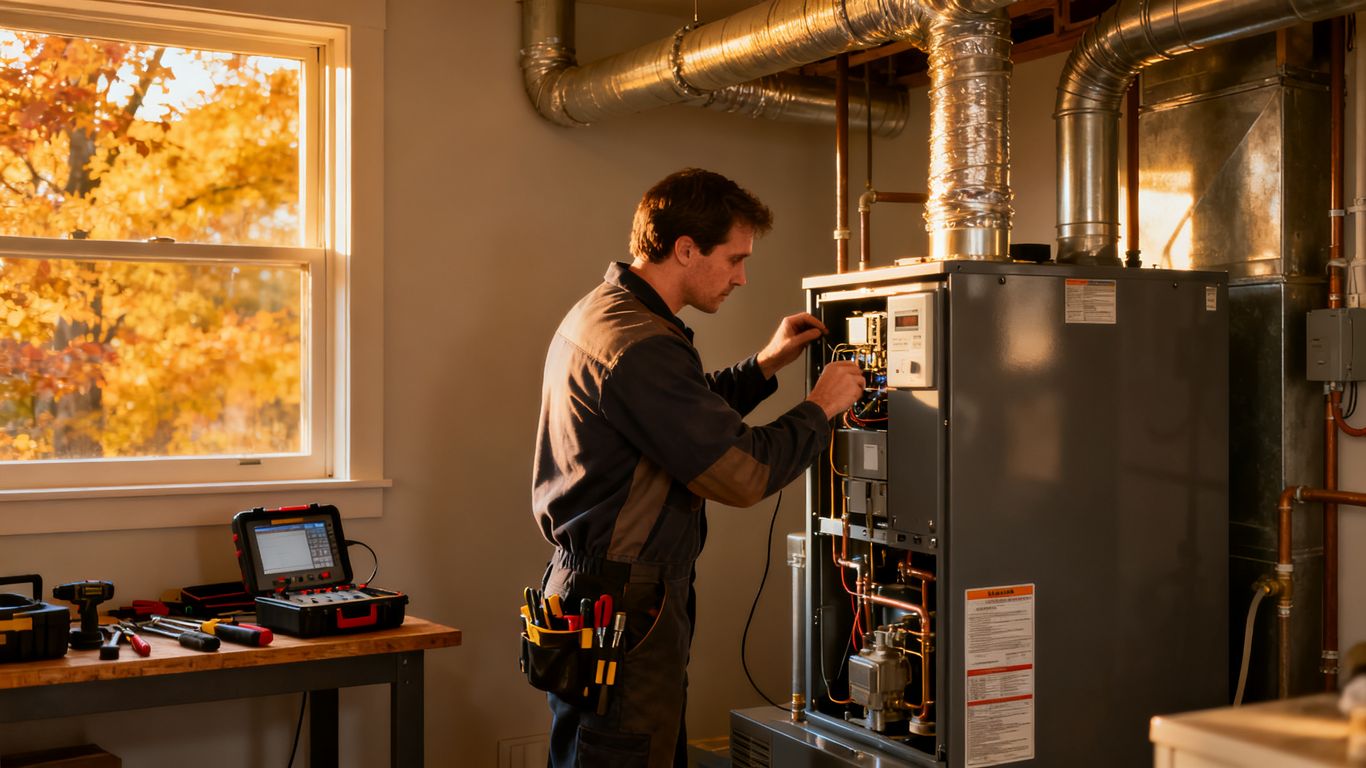
The most useful package is usually built around readiness: inspect the equipment, check its operation, identify concerns, and give the homeowner a practical recommendation. From there, the campaign can lead into maintenance, repair, replacement, or a longer-term service relationship.
Promote furnace and heat pump tune-ups
Tune-ups are a natural October offer because they fit the timing of the season. The ad should explain what the visit is intended to accomplish without promising a particular energy saving or outcome. Mention system preparation, operating checks, comfort concerns, and the value of addressing small issues while the home is not yet depending heavily on heat.
Keep the call to action specific. “Book your heating tune-up” is easier to act on than “learn more about HVAC services.” Separate furnace and heat pump messaging when the service process, homeowner concerns, or available technician expertise differs. That improves relevance and gives reporting a useful service-line structure.
Package inspections with safety and performance checks
A readiness package can make a basic tune-up feel more concrete by naming the categories covered during the visit. Depending on the company’s actual process, those categories might include equipment condition, operation, airflow, controls, and visible safety concerns. Avoid listing checks the team does not consistently perform; the offer must match the appointment experience.
Package language also helps the sales conversation. Instead of asking a homeowner to approve an unknown visit, the dispatcher can describe what the appointment is designed to assess and what kind of next-step recommendation may follow. Transparency creates confidence without turning the ad into a technical manual.
Use maintenance plans to create repeat revenue
Maintenance plans give October campaigns a longer horizon. They can turn a one-time tune-up into a relationship that supports future inspections, reminders, and service opportunities, provided the plan terms are clear and operationally realistic. Promote the practical benefits of staying on schedule rather than implying that membership prevents every possible failure.
Segment existing customers separately from new prospects. Existing customers may respond to a reminder tied to their last service, while new prospects need an explanation of what the plan includes and why recurring attention is useful. The two audiences should not share the same assumptions or landing-page copy.
Add urgency without relying on fear-based messaging
October urgency can come from timing, not threats. A limited number of pre-winter appointments, a seasonal scheduling deadline, or the benefit of getting an inspection completed before colder weather can all give the homeowner a reason to act. The claim must be true and easy for the office team to honor.
A useful October message usually combines three elements:
- A seasonal reason to schedule the visit now.
- A plain-language description of what the appointment covers.
- A low-friction next step, such as calling or choosing an appointment time.
After the list, make sure the landing page and call handlers use the same language. Consistency prevents a promising ad from turning into a confusing phone conversation.
Target the highest-value HVAC services
Tune-ups can fill schedule gaps, but they should not be the only service line in the October plan. The shoulder season is also a research period for homeowners considering replacement, indoor air quality work, or improvements to airflow and efficiency. These services need different messages, budgets, qualification questions, and follow-up sequences.
The goal is not to push every visitor toward the most expensive job. It is to identify the problem the homeowner is already trying to solve and present the appropriate next step. That makes the account easier to optimize and the customer experience more credible.
Identify replacement-ready homeowners before breakdowns happen
Replacement prospects often reveal themselves through context rather than one exact search term. They may have an older system, a history of repeated repairs, comfort problems that never fully resolve, or a strong interest in installation pricing. Ads can invite an evaluation or replacement consultation without declaring that every older system must be replaced.
Create a dedicated path for these prospects. The landing page should explain the consultation, outline what information helps prepare for it, and make room for questions about equipment, home comfort, and budget. A general emergency-repair page is rarely the right destination for someone still comparing options.
Market indoor air quality before homes are closed up
As homeowners spend more time indoors, indoor air quality becomes a timely topic. Educational ads can address dust, stale air, filtration questions, or comfort concerns, but the service description must stay within what the company actually provides. The strongest creative often starts with a recognizable household symptom and offers an assessment or conversation rather than an exaggerated health claim.
This is also a good place to use content in the decision path. A short video or article can answer a basic question, then invite the visitor to request an evaluation. The transition should be clear: education earns attention, while a specific service gives the visitor somewhere useful to go next.
Promote ductwork, insulation, and airflow improvements
Airflow problems are easy for homeowners to feel and difficult for them to diagnose. If the company provides ductwork, insulation, or related improvements, October is a sensible time to explain how those services may relate to uneven rooms, noisy operation, or comfort that varies across the home. Keep the claims practical and avoid promising a universal result.
Use separate creative for each type of improvement. Someone searching for an airflow assessment is not necessarily ready for an insulation project, and combining both in one ad makes it harder to understand what happens after the click. Clear service boundaries also improve lead quality.
Match offers to system type, home age, and service area
A campaign becomes more useful when its targeting reflects the local customer base. System type can shape the offer, home age can inform the message, and service area can determine whether the appointment is profitable. These details do not need to appear in every ad, but they should influence campaign structure and qualification.
| Audience signal | Useful October message | Best next step |
|---|---|---|
| Older furnace with repair history | Assess condition before winter demand rises | Replacement or repair consultation |
| Heat pump owner preparing for colder weather | Confirm heating operation and comfort | Heat pump tune-up |
| Home with uneven temperatures | Investigate airflow and room-to-room comfort | Diagnostic appointment |
| Existing maintenance customer | Schedule the seasonal visit on time | Maintenance-plan appointment |
The table is a starting framework, not a substitute for service-area economics or actual customer data. Review which audiences produce completed appointments and profitable jobs, then refine the offer rather than simply expanding reach.
Create a channel-specific heating company slow season marketing plan
Different channels play different roles in October. Search captures people already expressing intent, while social and audio can introduce a concern before the homeowner types a query. A practical HVAC marketing plan connects these roles to a shared offer, consistent tracking, and a follow-up process that does not lose prospects between channels.
Do not force every audience into the same creative. A searcher looking for a furnace tune-up needs immediate clarity; someone watching a short video may first need a simple explanation of why fall preparation matters. The campaign should earn the next action appropriate to that level of intent.
Capture high-intent demand with Google Search and LSAs
Google Search is useful for queries that name a service and location, such as heating tune-up, furnace inspection, or heat pump repair. Build tightly themed ad groups, use service-specific landing pages, and make call assets prominent during staffed hours. Local Services Ads can support local, call-oriented demand when the business is eligible and the profile information is accurate.
Do not measure these campaigns only by form fills. HVAC prospects frequently call, and a missed call can erase the value of a strong ad. Use the search terms, call quality, and booked-job data to decide which services deserve more budget.
Use Performance Max to reach homeowners researching upgrades
Performance Max can support broader reach for homeowners researching replacement or related upgrades, but it needs strong inputs. Give the campaign clear conversion actions, useful creative assets, and audience signals based on known service interests. Keep replacement research separate from low-cost tune-up goals when the economics and sales cycle differ.
The campaign should not become a catch-all for every HVAC service. If the account cannot distinguish a consultation request from a low-value information click, optimization will be guided by a muddled signal. Define what a valuable conversion means before increasing spend.
Retarget site visitors with Meta and short-form video
Retargeting is helpful for visitors who read about replacement, watched a service video, or reached a booking page without completing the next step. On Meta Ads, use a reminder that answers hesitation rather than repeating the original headline. A short clip can clarify what the appointment includes, what information the homeowner should have ready, or how scheduling works.
Exclude people who already booked when possible, and cap frequency so the reminder does not become irritating. Retargeting should feel like a helpful continuation of the research process, not pressure to buy a system immediately.
Test educational creative on Facebook, Instagram, TikTok, and Spotify
Educational creative gives October campaigns more room to work before a homeowner has urgent intent. On Meta Ads, test practical videos and carousels about preparation, comfort, and system age. TikTok can support simple vertical explanations, while Spotify Ads may fit short audio messages that reinforce seasonal readiness and direct listeners to a local service page.
Keep tests controlled. Change the opening idea, visual, or call to action one at a time when possible, and give the ad enough qualified traffic to reveal a pattern. Platform reach is not the same as appointment value, so connect creative reporting to downstream booking data.
A useful explainer can support this channel mix, especially when it answers a homeowner question without turning the video into a sales pitch. The final frame should still provide a clear route to a heating service or consultation.
Turn seasonal traffic into booked appointments
Generating attention is only half of the October problem. The visitor needs to understand the offer quickly, trust the company enough to contact it, and complete the action on a phone. Small conversion obstacles become expensive when paid traffic is spread across several services and platforms.
The booking path should mirror the campaign promise. If the ad promotes a heating tune-up, the page should not make the visitor search through air conditioning, plumbing, and general home-service options before finding the relevant form or phone number.
Send every ad to a focused heating landing page
A focused landing page should repeat the service, location, and reason to schedule in the first screen. It should explain what the appointment is for, show credible proof such as reviews or service details, and give the visitor a clear call or form option. Keep navigation limited if it distracts from the primary conversion.
Build separate pages for tune-ups, replacements, and air quality when the messages and qualification needs differ. This improves relevance and makes it easier to see which service line is actually producing booked work. A broader HVAC growth strategy can provide context, but the page itself should stay specific to the campaign.
Make calls and forms easy to complete on mobile
Many HVAC prospects will contact the company from a phone, often while moving between tasks. The phone number should be easy to find, tap-to-call should work, and forms should ask only for information the office truly needs to respond. A long form can reduce completion without necessarily improving lead quality.
Test the full path yourself on several devices. Check that the call routes correctly, the form confirmation appears, and the source is recorded. Then ask the office whether staff can answer and follow up during the hours the ads are running.
Use financing and transparent pricing to reduce hesitation
Heating work can involve a meaningful household expense, particularly when a repair becomes a replacement conversation. If financing is available, explain it accurately and avoid turning a starting price into a promise that applies to every home. Transparent service inclusions and a clear consultation process are often more persuasive than a vague “special offer.”
The ad, landing page, and phone script should use compatible language. If the page says one thing and the estimator explains another, the problem is not just conversion rate; it is trust. Make the next financial conversation straightforward and conditional on the actual home and system.
Track booked jobs instead of leads alone
A lead is an inquiry. A booked appointment is a scheduling outcome, and a completed job is closer to the revenue question the business actually cares about. Connect call tracking, form submissions, CRM stages, and revenue where possible so October decisions are based on what happened after the click.
At minimum, record source, service line, booking status, and job value. This is the difference between a campaign that appears busy and a campaign that contributes to a healthy schedule.
Optimize campaigns throughout October
October should be managed as a moving month, not a set-and-forget promotion. Temperatures change, search demand shifts, and the office learns which offers attract serious homeowners. A weekly review can catch problems early without creating constant, unhelpful changes to every campaign.
Start with clean naming, conversion definitions, and service-line separation. Then use actual call and CRM outcomes to decide where the next dollar should go. The account should become more informed as the month progresses.
Separate tune-up, replacement, repair, and air quality campaigns
Separate campaigns make it easier to control budgets and evaluate intent. Tune-up traffic may have a different cost and booking rate from replacement consultations, while air quality research may require more education before a contact. Distinct campaigns also let the landing page and follow-up match the homeowner’s question.
Keep emergency repair available, but do not let its urgency distort the performance view for planned services. Report each service line independently, then review the combined schedule and revenue picture.
Adjust budgets as temperatures and search volume change
Budget allocation should respond to demand and capacity. If a cold front increases heating searches but the team has limited appointment availability, spending more may create a poor customer experience. If the schedule has room and the offer is converting into profitable work, a controlled increase may be appropriate.
Use daily pacing checks and a more deliberate weekly review. Avoid making decisions from one unusually warm or cold day, especially in smaller service areas where volume can be uneven.
Use call recordings and CRM data to improve targeting
Call recordings can reveal whether ads are attracting the intended service need, whether callers understand the offer, and where the office conversation breaks down. CRM data adds the outcome: booked, canceled, completed, sold, or lost. Together, they show more than platform-reported conversions.
Remove recurring sources of poor fit from targeting and creative. If callers repeatedly ask for a service the campaign does not provide, revise the wording or add exclusions. If good prospects are failing to book, the issue may be availability, follow-up speed, or offer clarity rather than audience quality.
Measure cost per booked appointment and revenue by service line
Cost per lead is useful for diagnosing acquisition, but it does not tell the owner whether the schedule or revenue improved. Track cost per booked appointment, show rate, completed-job value, and revenue by service line. Compare those numbers with technician capacity and gross-margin realities before declaring a winner.
A campaign with fewer leads can be healthier if it creates more completed replacement consultations or profitable service calls. The right metric depends on the service, but the principle stays the same: optimize toward business outcomes, not the easiest event to count.
Plan November and winter follow-up campaigns from October results
October data should shape the next wave of campaigns. Identify which searches produced bookings, which videos assisted later conversions, which objections appeared on calls, and which service pages held attention. Then turn those findings into November reminders, winter readiness messages, and follow-up audiences.
Keep the useful learning even when a test ends. A paused ad can still teach you which homeowner concern deserves a clearer explanation, and a weak channel may simply need a better offer or measurement setup before receiving another budget increase.
Conclusion
The best October HVAC marketing does not wait for a furnace to fail. It gives homeowners a timely reason to prepare, creates clear paths for tune-ups and higher-value services, and measures whether attention becomes booked work. Build the heating company slow season marketing plan around real service capacity, specific audiences, and honest next steps; then use the month’s results to enter winter with a stronger pipeline. If you want help organizing the next conversation with a marketing team, you can schedule a conversation at a time that works for you.
Frequently Asked Questions
What should HVAC companies advertise in October?
HVAC companies should generally promote planned heating services such as tune-ups, inspections, maintenance plans, replacement consultations, and relevant comfort or air quality services. The right mix depends on the company’s capabilities, capacity, and local demand.
Why should emergency repair not be the main October offer?
Emergency repair reaches homeowners after a system has already failed. Planned heating offers reach a larger group of homeowners who are researching, preparing, or noticing early warning signs before winter demand becomes urgent.
When should an HVAC company start winter marketing?
Many companies should begin before the first major cold spell, using early fall to build awareness and capture homeowners who prefer to schedule in advance. Campaign timing should reflect local weather, historical search patterns, and appointment capacity.
How can HVAC companies market furnace tune-ups effectively?
Use a specific seasonal message, explain what the appointment covers, and send traffic to a focused page with a prominent call and simple booking form. The offer should be consistent across ads, landing pages, and phone scripts.
Should HVAC campaigns separate repairs and replacements?
Yes, separating them usually makes the message, budget, landing page, and follow-up more relevant. It also allows the business to compare performance by service line instead of blending very different customer intents together.
Which metrics matter most for October HVAC advertising?
Cost per booked appointment, show rate, completed jobs, revenue by service line, and return on advertising spend are more informative than lead volume alone. Call quality and CRM stages help explain why those numbers move.
How can an HVAC company improve leads from paid ads?
Start with accurate targeting, specific service pages, clear qualification language, reliable call and form tracking, and prompt follow-up. Review recordings and booked-job data regularly so the campaign improves based on actual customer outcomes.