Winter Facebook Ads for Furnace Replacement: The Fear-Free Campaign That Converts
Key Takeaways
A winter furnace campaign works best when it makes replacement feel clear, timely, and manageable rather than frightening. The strongest results usually come from matching the message, audience, landing page, and sales follow-up to the homeowner’s actual situation.
- Focus on comfort, certainty, and practical next steps instead of dramatic breakdown scenarios.
- Separate urgent replacement leads from homeowners researching a planned upgrade.
- Use local audiences, warm retargeting, and exclusions to protect budget quality.
- Make the creative and landing page explain what happens after someone responds.
- Optimize toward booked estimates and installed furnaces, not lead volume alone.
Position furnace replacement as comfort and certainty, not catastrophe
Winter gives furnace replacement a natural reason to enter the conversation, but fear is a poor foundation for a high-value decision. Homeowners may be worried about a cold house, an unreliable system, or an unexpected expense, yet they still need enough trust to invite a contractor into their home. A good campaign acknowledges the pressure without making the reader feel manipulated. The goal is to turn uncertainty into a simple next step.
Identify the winter moments that make homeowners take action
The strongest furnace replacement messages begin with recognizable moments. A system that struggles on the first truly cold night, a repair that keeps recurring, or rooms that never seem to warm up can all prompt a homeowner to reconsider an aging unit. Planned buyers may be thinking about reliability before the next cold snap rather than responding to a complete failure.
Those moments are more useful than vague claims about winter demand. Build ads around the experience the homeowner can identify: uneven comfort, repeated service visits, unusual noises, or concern about getting through another season. A message that feels observant is often more persuasive than one that simply shouts about an emergency.
Replace fear-based messaging with practical urgency
Fear-based copy tends to promise disaster, pressure the reader, or imply that every delay will become expensive. Practical urgency is different. It tells the homeowner why acting now may make scheduling easier, assessment more convenient, or the available options clearer, without pretending to know the condition of a system that has not been inspected.
Use language such as “plan before the next cold stretch” or “understand your replacement options” when the audience is not in an emergency. That tone can still move people to act, while preserving credibility. Clear next steps matter more than exaggerated warnings when the purchase requires consideration.
Segment emergency replacements from planned upgrades
A homeowner whose furnace has stopped working needs a different path from someone comparing replacement options for an older system. Put those audiences into separate campaigns or ad sets when volume allows. The emergency path should make calling and rapid contact easy; the planned path can spend more time on assessment, equipment choices, financing terms, and installation timing.
The distinction also improves sales operations. An urgent lead should not receive a slow, generic nurture sequence, while a planned buyer may appreciate an informative follow-up rather than repeated emergency language. Make the handoff visible in the CRM so the team knows what promise the ad made.
Match the message to homeowners’ readiness to buy
Readiness is not always obvious from demographics. Someone watching a furnace replacement video may be gathering information, while a repeat visitor to an installation page may be close to requesting an estimate. Give each group a different invitation: education for early research, an assessment for active consideration, and a direct call option for urgent needs.
This is also where channel roles matter. Facebook Ads can create demand before a homeowner searches, while Google Search Ads are better suited to people already looking for a furnace contractor. A useful platform choice guide can help clarify how those roles fit the sales cycle without forcing every prospect into the same campaign.
Build Facebook and Instagram audiences that fit a furnace campaign
Audience design should start with serviceability, not theoretical reach. A furnace replacement lead outside the installation area is not a useful lead, no matter how inexpensive it looks in the platform report. Define the practical territory first, then decide how much targeting complexity the account can support. For many local HVAC companies, a smaller audience with dependable follow-up beats a broad audience that overwhelms the office.
Use local geographic targeting around serviceable areas
Build the geography around the places technicians can actually serve and install within the promised timeframe. Use towns, ZIP codes, or radius targeting as appropriate, then check the map against dispatch realities, travel charges, and any areas the business does not cover. Avoid assuming that a neat radius automatically reflects the real service area.
Review lead addresses regularly after launch. If a meaningful share of submissions comes from outside the territory, tighten the geography or make the service area more prominent in the ad and form. Local relevance is not just a targeting setting; it is also a qualification message.
Layer homeowner, home age, and seasonal interest signals carefully
Broad targeting can work when the creative is specific and the geography is tight, but additional signals may help during testing. Homeownership and likely home age can be useful starting points, while seasonal heating interests may provide another angle. Treat these as hypotheses, not proof that a person needs a replacement.
Avoid stacking so many filters that delivery becomes thin or unstable. Test a reasonably broad local audience against a more layered version, keeping the creative and offer comparable. That gives you a clearer read on whether the audience or the message is doing the work.
Retarget video viewers, website visitors, and lead-form openers
Warm audiences deserve their own message because they have already shown some interest. A video viewer may need a concise explanation of the replacement process, while a landing-page visitor may respond better to availability, reviews, or a straightforward assessment. Someone who opened a lead form but did not submit may need reassurance about what information is requested.
Meta Ads can be used to run campaigns across Facebook and Instagram, so organize these audiences around the actions people took rather than treating every platform visitor as identical. Keep the windows practical for the buying cycle, and refresh exclusions as leads move through the sales process.
Exclude existing customers and recently converted leads
Exclusions protect both budget and customer experience. Remove recent leads, booked estimates, and completed replacements from prospecting where the data is reliable. Existing customers may belong in a separate maintenance or service communication strategy, but they should not accidentally receive a cold replacement ad that ignores their relationship with the company.
Check the timing of each exclusion. A person who requested information yesterday may still need a sales follow-up, while someone who completed a replacement last week should not continue seeing the same acquisition creative. Clean audience rules support cleaner reporting too.
Create ad creative that makes replacement feel manageable
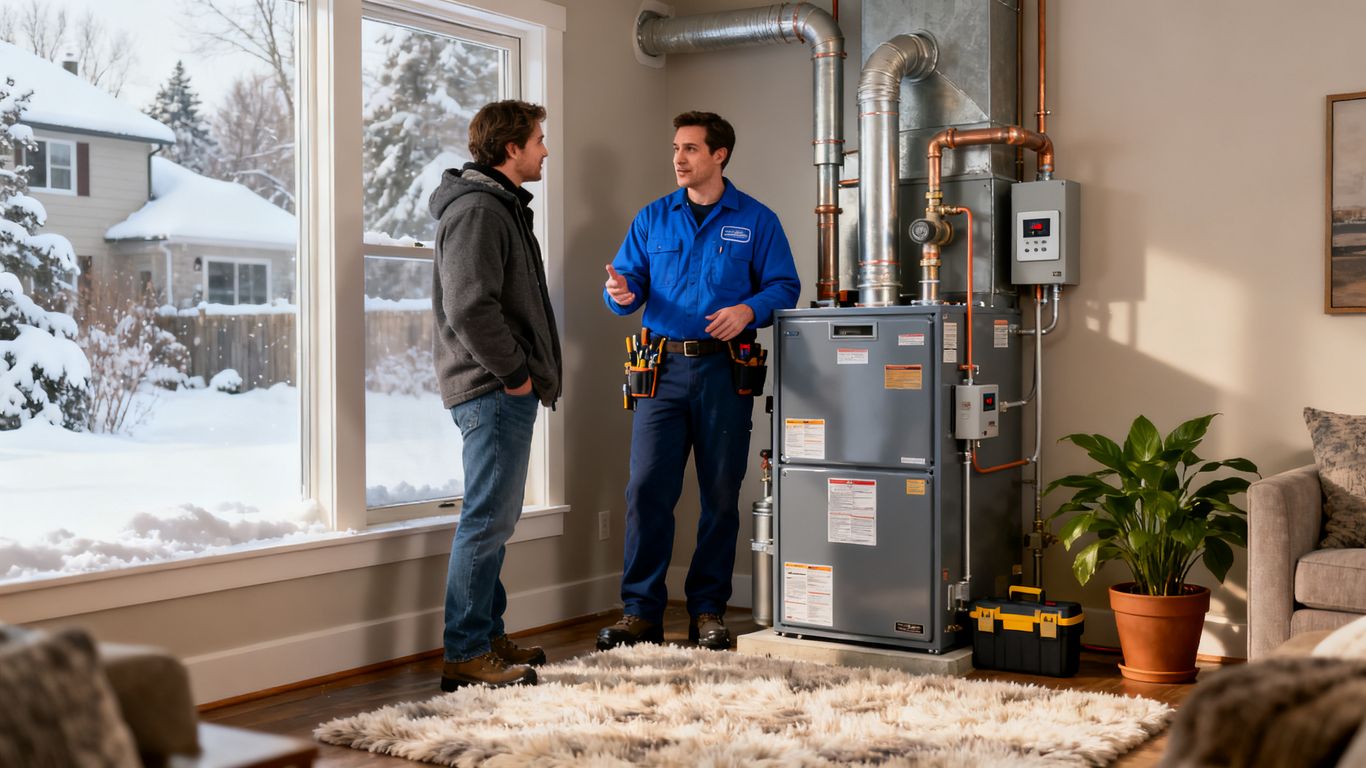
A furnace replacement is a large home decision, so the creative should reduce mystery. Show the home, the people doing the work, and the finished result in a way that feels familiar rather than staged. The ad does not need to look expensive; it needs to answer the quiet questions that make someone hesitate: Who will come? What happens next? How long might this take?
Show warm homes, professional technicians, and finished installations
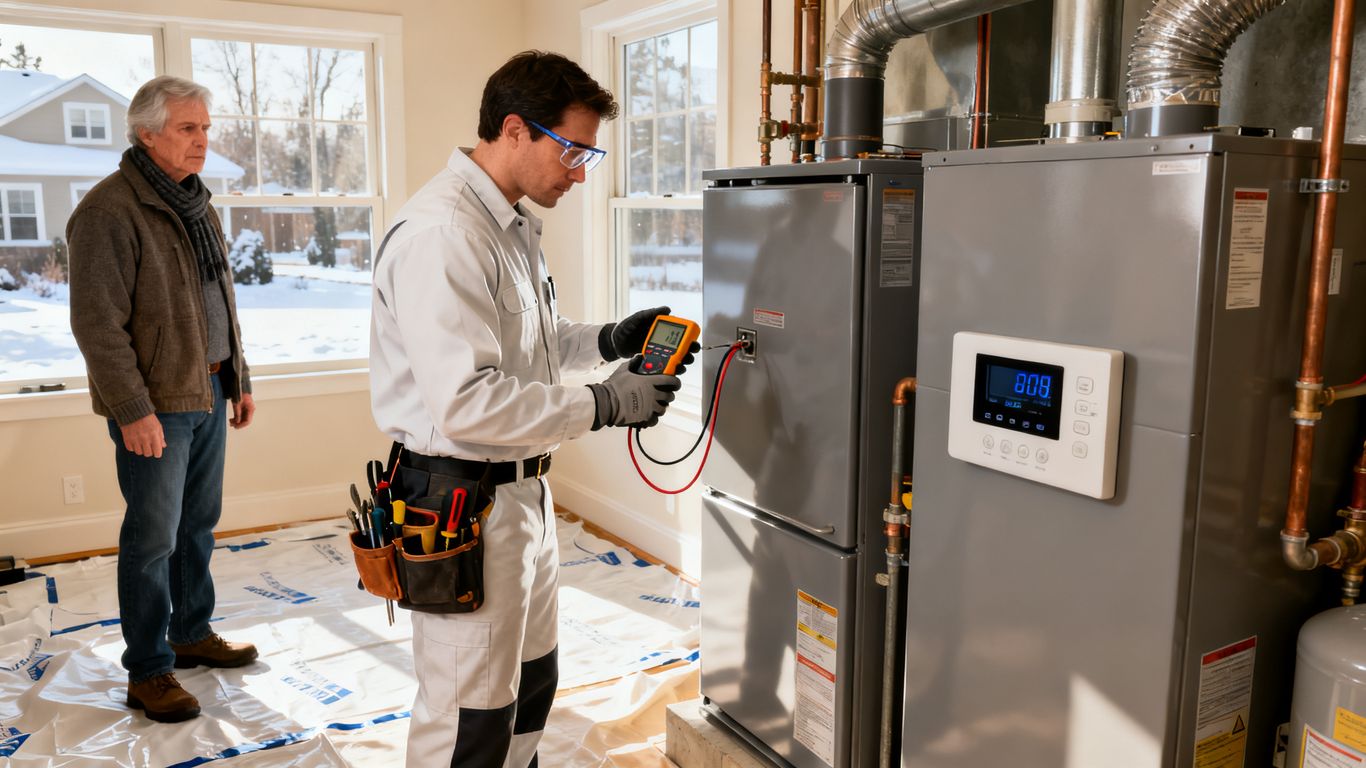
Use real technicians and real installation environments whenever possible. A clean mechanical room, careful protection of flooring, and a finished furnace can communicate professionalism more effectively than a generic family gathered around a thermostat. Keep the visuals locally believable and avoid imagery that implies a specific result the contractor cannot guarantee.
Pair the image with one clear promise, such as help comparing replacement options or a convenient way to request an assessment. The visual should support the message, not compete with several unrelated claims.
Use short videos to explain the replacement process
Short video is useful when it explains rather than performs urgency. A technician can walk through an inspection, show how options are discussed, or explain what homeowners should expect during scheduling. Keep the opening seconds focused on the homeowner’s question, since many viewers will decide quickly whether the video applies to them.
A simple sequence works well: identify the problem, explain the assessment, show the installation context, and close with one next step. Add captions for viewers who watch without sound, and make sure the same offer appears on the landing page.
A related winter HVAC advertising guide can provide additional ideas for seasonal framing, but the final video should still sound like the local contractor. Authenticity is more valuable than copying a formula from another market.
Write primary text around comfort, cost clarity, and scheduling
The primary text should acknowledge the homeowner’s concern and then make the response feel low-friction. Explain whether the first step is an assessment, estimate, or call, and avoid burying the service area at the bottom. If financing is available, describe it only with terms the business can substantiate.
A useful structure is a homeowner observation, a practical solution, and a clear action. “Rooms staying cold?” is more grounded than “Don’t let your family freeze.” The first invites recognition; the second creates drama without helping the reader decide.
Test before-and-after visuals without implying guaranteed savings
Before-and-after images can make the work easier to picture, especially when they show a dated installation becoming cleaner and more organized. They should not suggest that every homeowner will receive the same equipment, appearance, comfort improvement, or utility result. Label the context in the copy if the image comes from a particular job.
Test the visual against technician-led footage and a simple equipment-detail image. Judge the variants by qualified inquiries and booked estimates, not by thumb-stop rate alone. A striking image that attracts curiosity without purchase intent can consume budget quickly.
Adapt creative for Facebook Feed, Stories, and Reels
Each placement needs a composition that survives its format. Feed creative can carry a little more context, while Stories and Reels need an immediate visual hook, readable captions, and a vertical frame. Keep the call to action visible without filling the screen with text.
Make a small set of deliberate adaptations instead of resizing one asset and calling the work finished. Check how the technician’s face, furnace, and captions crop on mobile. Then compare placement performance only after confirming that each placement received a properly designed version.
Design an offer that reduces hesitation without discounting blindly
The offer is not necessarily a coupon. For a high-consideration replacement, it can be a clear assessment, a second opinion, or a conversation about options. The useful question is whether the offer helps a qualified homeowner take the next step while giving the sales team enough context to respond well. A cheap lead is not a good result if the promise attracts people who were never eligible.
Use a replacement assessment or second-opinion offer
An assessment gives the homeowner a reason to respond without forcing a purchase in the ad. Explain what the visit or conversation includes, what it does not include, and whether the homeowner receives an estimate or a set of replacement options. A second-opinion angle can work when people are unsure whether repair or replacement makes more sense.
Keep the wording honest about diagnosis and recommendations. The ad should not claim that every system needs replacement. It should offer clarity to people who are already considering the decision.
Explain financing and payment options with transparent terms
Financing can reduce the size of the immediate decision, but vague monthly-payment language often creates distrust. State that approval, terms, down payment, and availability depend on the applicable provider and customer circumstances when that is true for the business. Do not turn a financing message into a promise of universal affordability.
The landing page and sales script should use the same wording. If the ad mentions payment options but the form page says nothing about them, the prospect may feel that the offer changed after the click.
Add seasonal incentives without training prospects to wait for discounts
A seasonal incentive can give the campaign a timely reason to run, but it should support the replacement decision rather than become the entire value proposition. Use a defined end date only when the business will honor it, and explain eligibility clearly. Avoid cycling through dramatic “last chance” claims that teach people to ignore the next one.
Consider adding value through scheduling priority, an assessment, or clearer equipment comparison instead of reducing price automatically. The right offer protects margin while making the next step easier to understand.
Set expectations for availability, installation timing, and equipment options
Winter capacity is part of the offer. If installation dates vary, say so. If equipment options depend on the home, inventory, or assessment, explain that before the form is submitted. Clear expectations may reduce raw lead volume, but they generally make the remaining conversations more useful.
The team should know exactly what happens after a form or call arrives. A campaign promising a quick response needs a process capable of delivering one, especially when a homeowner is uncomfortable at home.
Send clicks to a furnace replacement landing page that converts
A strong ad can still fail when the destination feels unrelated or difficult to use. The landing page should continue the same conversation, make qualification simple, and give the homeowner more confidence than the ad alone could provide. It does not need every detail about HVAC; it needs the right details in the right order.
Align the page headline with the Facebook ad promise
Repeat the central promise in plain language near the top of the page. If the ad offers a furnace replacement assessment, the headline should not switch to a general heating-services message. Consistency reassures visitors that they reached the right place and reduces the mental work required to decide what to do next.
Support the headline with a short explanation of who the service is for and what the first step looks like. Keep the main call to action visible without making the page feel like a pop-up trap.
Make the service area and qualification criteria obvious
State the locations served before the visitor reaches the form. Include practical qualification details such as replacement versus repair focus, property type if relevant, and any limits on service. This filters out some poor-fit inquiries before they reach the office.
The page can still be welcoming while being specific. A homeowner should quickly know whether the company works in their area and whether the request matches the kind of replacement conversation being advertised.
Use a short form that captures useful sales context
Ask only for information that changes the follow-up. Name, contact details, location, and a brief description of the heating concern may be enough to begin. A question about urgency or whether the homeowner is seeking repair, replacement, or a second opinion can help route the lead.
Long forms create friction, but extremely short forms leave the sales team guessing. Test one additional context question at a time and compare booked estimates, not just submission rate. The form should make the next conversation better.
Add proof through reviews, certifications, warranties, and local experience
Proof should be specific and verifiable. Use genuine reviews, current certifications, clearly described warranty information, and accurate statements about local experience. Place proof near the decision point, where it answers concerns about workmanship and accountability.
Avoid turning the page into a wall of badges. A few relevant details, supported by readable explanations, will usually carry more weight than a crowded strip of logos. Make sure every claim remains current.
Give mobile visitors a tap-to-call path for urgent needs
Someone with a failed furnace may not want to complete a form. Put a visible call option on mobile and make the destination a staffed number during the hours promised in the ad. The call path should be as clear as the form path, with a short reminder of what information the caller should have ready.
Track calls separately from forms so the campaign does not hide a valuable response type. If calls are not answered promptly, change the ad promise or route calls to someone who can respond.
Track the campaign from lead submission to booked replacement
Lead generation metrics are only the beginning of a furnace campaign. The business ultimately needs to know which inquiries become conversations, estimates, sales, and installed systems. Tracking that chain requires agreement between the ad account, website, phone process, and CRM. Without it, optimization tends to reward the easiest event to generate rather than the outcome that pays the bills.
Configure Meta Pixel and Conversions API events
Set up the Meta Pixel for the key website actions and use Conversions API where the implementation supports it. Define events around the actual funnel, such as a qualified form submission, call connection, or booked estimate, rather than firing every event as a generic page view. Confirm event quality in testing before allocating more budget.
Document the event names, triggers, and ownership. Small tracking inconsistencies can make two campaigns appear different when they are simply recording actions differently.
Connect calls, forms, and CRM outcomes to the ad account
Forms should pass into the CRM with source, campaign, ad, timestamp, and homeowner context intact. Call tracking should preserve the same source information where possible. Then the sales team needs a consistent status process so “new lead,” “qualified,” “estimate booked,” and “sold” mean the same thing to marketing and operations.
Meta Ads reporting becomes more useful when it can be compared with the CRM rather than treated as the final record. Reconcile the systems often enough to catch missing calls, duplicate submissions, and leads assigned to the wrong campaign.
Separate low-quality leads from qualified replacement opportunities
A lead is not automatically an opportunity. It may be outside the service area, seeking a repair, missing valid contact information, or simply asking a general question. Build clear qualification rules and record the reason when a lead is rejected.
That feedback should reach the campaign manager. If one ad produces many inquiries but few qualified opportunities, its apparent efficiency may be misleading. The account needs signals that reflect sales usefulness.
Measure booked estimates, close rate, and cost per installed furnace
Use a funnel view to connect spend with revenue-producing activity. A simple reporting structure can keep the team focused on the differences between surface-level response and actual replacement performance.
| Metric | What it answers | Useful interpretation |
|---|---|---|
| Lead-to-contact rate | Can the team reach new inquiries? | Low performance may point to speed, data, or intent problems. |
| Qualified lead rate | Do submissions fit the service? | Reveals targeting and offer quality. |
| Estimate booking rate | Are qualified homeowners taking the next step? | Helps assess sales handling and offer clarity. |
| Close rate | Are estimates becoming replacements? | Shows sales fit, pricing, and trust issues. |
| Cost per installed furnace | What did acquisition cost for the real outcome? | The clearest campaign-level efficiency measure. |
Read the rows together rather than celebrating one low cost-per-lead number. A higher lead cost can be acceptable when the resulting estimates close more often and produce a lower cost per installed furnace.
Use offline conversion data to improve Meta’s optimization
When booked estimates and completed replacements are recorded offline, send the appropriate outcomes back through the available measurement setup. The purpose is to help the system distinguish a useful replacement opportunity from a form fill that never becomes a conversation. Keep customer data handling compliant and make sure the event mapping is accurate.
Optimization should follow enough conversion volume to be meaningful. If installed replacements are too sparse as an initial event, work backward to a reliable qualified stage while continuing to report deeper outcomes for analysis.
Launch, optimize, and scale the campaign without wasting winter budget
Winter budget is tied to more than media spend. It is also tied to technician availability, response speed, inventory, and the company’s ability to complete the work it advertises. Launch with enough structure to learn, but not so many ad sets that every segment receives too little delivery. The operating plan should be part of the campaign plan.
Start with a controlled local testing structure
Begin with a small number of clear variables: one local prospecting audience, one warm retargeting audience when volume supports it, and several distinct creative angles. Keep the offer and qualification rules stable during the first read. This makes it easier to understand whether performance changed because of the audience, creative, or destination.
The testing structure should reflect the business’s actual capacity. A single-location contractor does not need a complicated national-style account architecture to learn which message brings qualified homeowners forward.
Compare creative angles, audiences, and lead destinations
Test the ideas that could reasonably change buying behavior: comfort and reliability, replacement planning, transparent options, or a technician explaining the process. Compare website forms with native lead forms only when the follow-up and qualification experience are ready for both. Review the quality of the resulting conversations before choosing a winner.
Use a Facebook Ads for HVAC guide as a source of additional angle ideas, then adapt those ideas to the local offer and sales process. Borrowing a topic is fine; copying a promise that the business cannot support is not.
Set budgets around response time and installation capacity
A campaign should not generate more demand than the office can contact or the field team can serve. Set a budget that fits staffing, call coverage, estimate availability, and realistic installation capacity. If response times stretch, reduce spend or adjust the promise before lead quality deteriorates.
Budget increases should follow evidence from qualified opportunities and sales outcomes. A sudden increase during a cold snap may raise volume while also exposing weaknesses in call handling, scheduling, or inventory.
Review lead quality and placement performance every week
Weekly review is frequent enough to catch obvious waste without reacting to every daily fluctuation. Check geography, contactability, service type, creative, placement, form completion, and sales status. Look for patterns in the actual lead records, not only the platform dashboard.
A useful review produces a short list of actions: pause a poor-fit angle, revise a form question, improve a landing-page section, or coach the response team. Too many changes at once make the next review harder to interpret.
Scale winning ad sets without sacrificing follow-up speed
Scale in measured steps and watch the downstream funnel after each change. More impressions are not a victory if calls go unanswered or estimate appointments are pushed too far into the future. Keep the winning message intact while testing controlled variations around it.
The best winter campaign is coordinated with operations. When a qualified homeowner receives a fast, informed response and a clear path to an estimate, the ad has done its job without resorting to panic.
Book a strategy call
If your HVAC company needs help turning seasonal demand into a measurable paid campaign, book a strategy call to discuss the market, offer, tracking, and follow-up process.
Conclusion
Fear may win a click, but clarity is more likely to support a furnace replacement decision. Build the campaign around real winter moments, local serviceability, manageable creative, transparent offers, and measurement that reaches the installed job. When advertising and operations make the same promise, homeowners get a calmer buying experience and the business gets a better basis for growth.
Frequently Asked Questions
Are furnace replacement Facebook ads effective in winter?
They can be effective when the campaign reaches a serviceable audience with a clear offer and a credible reason to act. Performance depends on creative, local demand, follow-up speed, sales process, and installation capacity rather than seasonality alone.
Should a furnace campaign target emergencies or planned replacements?
Both can be valuable, but they should usually receive different messages and follow-up paths. Emergency prospects need an easy call option and rapid response, while planned buyers may need education, comparisons, and scheduling information.
What should a furnace replacement ad offer?
A replacement assessment, second opinion, estimate, or conversation about options can work well. The offer should explain what happens next and avoid promising a diagnosis, price, savings amount, or installation timeline that cannot be guaranteed.
How much text should a winter furnace ad include?
Use enough text to identify the homeowner’s problem, service area, practical benefit, and next step. Short, specific copy is generally easier to understand on mobile, but the best length depends on the creative format and audience awareness.
Should HVAC companies use lead forms or landing pages?
Both can work. Native forms reduce friction, while landing pages provide more space for qualification details, proof, financing explanations, and call options. Compare them using qualified opportunities and booked estimates, not submission volume alone.
How quickly should a furnace replacement lead receive a response?
As quickly as the business can respond reliably. Set a response expectation that matches staffing and call coverage, then monitor whether leads are contacted, reached, qualified, and scheduled within that window.
What is the most important furnace campaign metric?
Cost per installed furnace is the clearest bottom-line measure when enough data is available. Before that point, track lead quality, contact rate, booked estimates, close rate, and the reasons opportunities fail so optimization does not reward low-value inquiries.